Freedom251 › Crypto Accounting Software
Pacioli
What Pacioli is
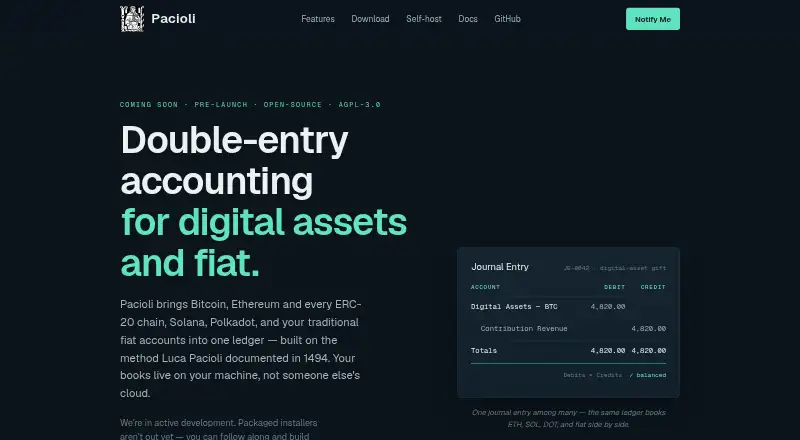
Pacioli is a double-entry accounting platform for digital assets and fiat accounts. It provides a chart of accounts, balanced debits and credits, and cost-basis methods including FIFO, LIFO, HIFO and specific-ID. Listed blockchain coverage includes Bitcoin, Ethereum and ERC-20 chains, Solana, XRP, Stellar, Polkadot and Cosmos, with read-only wallet connections. Users can also record bank transfers, invoices and cash alongside on-chain activity in any currency. Nonprofit accounting includes restricted and unrestricted net assets, fund tracking through release, and valuation of noncash digital-asset gifts. The desktop app stores data in an encrypted SQLite database on the user’s device; an account is not required, and cloud sync is optional. Pacioli is free and open source under the GNU Affero General Public License 3.0. It is pre-alpha, however, and has no published downloadable installer; builds exist only as an unpublished draft GitHub Release. Self-hosting is possible by building the React app as a static web bundle. Cloud service is marked coming soon, and reporting is planned.
Who it suits
Pacioli may suit people or nonprofits seeking double-entry accounting for digital assets alongside fiat activity. It is for users comfortable with a pre-alpha project and building the app themselves, since no downloadable installer is published.
What it does well
- Supports multiple cost-basis methods
- Records fiat and on-chain activity
- Includes nonprofit accounting features
- Stores desktop data in an encrypted local database
- Free and open source
What to know first
- Pre-alpha project
- No published downloadable installer
- Cloud service is marked coming soon
- Some networks require a paid Etherscan V2 tier
Limits
The free plan is labeled pre-launch and requires building from source; packaged installers are not yet available. The free Etherscan V2 tier does not serve Base, Optimism or BNB Smart Chain, which require a paid plan.
Plans
| Plan | Billed and limits | Price |
|---|---|---|
| Free and open-source | Windows, macOS and Linux · AGPL-3.0 | Free |
As pacioli.io lists them, read 15 Oct 2026. The maker's own page has the final word.
Getting started
- Open the Pacioli website.
- Choose the free plan at no cost.
- Build the React app from source, since no downloadable installer is published.
- Use the desktop app or build a static web bundle for self-hosting.
- Connect a supported wallet or enter fiat activity.
Pacioli is an open-source accounting project for people who need to reconcile digital assets with ordinary fiat activity. Its combination of local data storage and nonprofit accounting makes it an unusual fit for privacy-minded bookkeepers and organizations tracking donor-restricted funds. The central trade-off is readiness: it remains pre-alpha, with no published installer.
Overview
Pacioli is designed for double-entry bookkeeping rather than portfolio viewing alone. Its chart of accounts and balanced debits and credits bring on-chain activity, bank transfers, invoices and cash into a single accounting framework. That breadth could suit organizations with both crypto holdings and conventional finances, but pre-alpha status means it is not yet a dependable choice for production accounting.
The desktop app keeps records in an encrypted SQLite database on the user's device. No account is required, and cloud sync is optional, giving users control over where their accounting data resides. Pacioli is licensed under the GNU Affero General Public License 3.0.
Key features
Crypto and fiat bookkeeping
Pacioli supports wallet imports, tax-lot tracking and cost-basis methods including FIFO, LIFO, HIFO and specific-ID. Its stated blockchain coverage includes Bitcoin, Ethereum and ERC-20 chains, Solana, XRP, Stellar, Polkadot and Cosmos. Wallet connections are read-only, and the project lists integrations with MetaMask, Polkadot.js extension, Talisman and WalletConnect v2. That is a useful boundary for accounting access, though the free Etherscan V2 tier does not serve Base, Optimism or BNB Smart Chain; those networks require a paid plan.
Fiat transactions such as bank transfers, invoices and cash can be booked alongside on-chain activity in any currency. This makes Pacioli more relevant to full-ledger work than a tool focused only on tracking token balances.
Nonprofit accounting and reporting
Nonprofits can track net assets with and without donor restrictions, follow funds through release, and value noncash gifts of digital assets. These features address accounting needs that crypto trackers may not cover. Reporting for profit and loss, balance sheet and cash flow is planned, with US GAAP and IFRS presentation; organizations that need those reports now should not treat them as current capabilities.
Hosting and cloud plans
The same React app can be built as a static web bundle and hosted on Cloudflare Pages, Netlify, Vercel, Nginx, Caddy or Docker. That gives technically capable users a self-hosting route, but it does not remove the project's pre-alpha limitations. Pacioli Cloud is marked as coming soon, with end-to-end encrypted sync, zero-knowledge backups, version history and point-in-time restore described as planned service features.
Pricing
Free and open-source: free. The plan is pre-launch and requires building from source; packaged installers are not yet available. There is no stated seat or transaction cap, but the Etherscan V2 restriction means Base, Optimism and BNB Smart Chain require a paid plan. The free tier is best suited to developers and early adopters willing to compile the app, not readers looking for a ready-to-use accounting package.
Platforms
Pacioli targets Linux, macOS, Windows, web and self-hosted use. The platform range is broad, but the absence of a published installer is a practical obstacle for desktop users. Self-hosting is possible by building the web bundle and deploying it on a supported host.
Who it's for
Pacioli is most compelling for technically capable users, bookkeepers and nonprofits that want double-entry records spanning crypto and fiat, especially when local data control or donor-restricted fund tracking matters. It is a poor fit for organizations that need mature reporting today, a packaged desktop installation, or unrestricted access to the named Etherscan networks without paying for a higher API tier.
Pros and cons
- Pros: Combines crypto and fiat activity in a double-entry ledger, with multiple cost-basis methods for tax-lot work.
- Pros: Local encrypted storage and optional sync avoid requiring an account or default cloud storage.
- Pros: Donor restrictions, fund releases and noncash digital-asset gifts make it relevant to nonprofit accounting.
- Cons: Pre-alpha status and no downloadable installer make adoption difficult for users who need stable, convenient software.
- Cons: GAAP/IFRS financial reporting is planned, not a present reporting capability.
- Cons: Base, Optimism and BNB Smart Chain require a paid Etherscan tier.
Alternatives
Crypto Accounting Software is a useful starting point for comparing other crypto accounting options.
Choose Kryptos instead if mobile or API access matters, or if its free allowance of up to 100 transactions per tax year suits your needs. Its Pro Membership is $6.99 a month, with the first month billed at $3.
CoinTracking may be a better fit for readers who want Android, iOS or API access; its free plan is portfolio-view only, with a seven-day trial offering unlimited imports and no credit card required.
rotki is another desktop and self-hosted option for users who can work within the Free plan's 1,000 recent events and 10 user notes.
CryptaCount may suit web-based B2B use where a free allowance of one user, one workspace, one wallet, 1,000 transactions per month and one blockchain is sufficient.
HQ Wealth is worth considering for a web-based portfolio with a free plan limited to one portfolio, five on-chain scans per portfolio per month and a watermarked tax extract.
Tokenbooks offers a web and API option whose free plan covers one portfolio, five wallets and 1,000 total transactions.
Wag3s is a web-based alternative with a Starter plan free during Alpha, including wallet tracking, tax reports, AI categorization, multi-chain support and portfolio analytics.
Ledgible may be preferable to readers seeking a web-based tax or enterprise accounting product.
Verdict
Choose Pacioli if you need crypto and fiat double-entry bookkeeping, value local data control, or need nonprofit fund accounting—and can build from source while the project is pre-alpha. Its distinctive strength is bringing those accounting needs together under an open-source license. Look elsewhere if you need a packaged installer, production-ready reporting or a mature service today.
Verdict
Pacioli combines digital-asset and fiat bookkeeping with nonprofit accounting features, and is free and open source. Its pre-alpha status and lack of a published installer are important constraints for anyone considering it.
Questions
How much does Pacioli cost?
The Free and open-source plan is free.
Is Pacioli open source?
Yes. It is released under the GNU Affero General Public License 3.0.
Which platforms does Pacioli support?
The listed platforms are Linux, macOS, self-hosted, web and Windows.
Can I download a Pacioli installer?
There is no published downloadable installer. Builds exist only as an unpublished draft GitHub Release.
Does Pacioli require an account or cloud storage?
The desktop app does not require an account and stores data in an encrypted SQLite database on the user's device. Cloud sync is optional.
Which wallets does Pacioli integrate with?
The repository lists MetaMask, Polkadot.js extension, Talisman and WalletConnect v2.
Facts from Pacioli's own pages
- Accounting
- It provides a chart of accounts, balanced debits and credits, and cost-basis methods including FIFO, LIFO, HIFO and specific-ID. · pacioli.io, 1 Oct 2026
- Accounting engine status
- The repository says the engine includes exact arithmetic, period locks, append-only entries, approval provenance and FIFO lots. · github.com, 15 Oct 2026
- API and SDKs
- No public REST, GraphQL API or SDK is documented; the repository instead lists internal libraries such as Polkadot.js API, Ethers and web3 libraries. · github.com, 15 Oct 2026
- Blockchain coverage
- The site names Bitcoin, Ethereum and ERC-20 networks, Solana, XRP, Stellar, Polkadot and Cosmos. · pacioli.io, 15 Oct 2026
- Browser limitation
- The browser build is intended for lighter use because local SQLite and native dialogs depend on the desktop backend. · pacioli.io, 15 Oct 2026
- Cloud roadmap
- Pacioli Cloud is announced as coming soon with encrypted synchronization, zero-knowledge backups, version history and point-in-time restore. · pacioli.io, 15 Oct 2026
- Cloud service
- Pacioli Cloud is marked coming soon and is described as offering end-to-end encrypted sync, zero-knowledge backups, version history and point-in-time restore. · pacioli.io, 1 Oct 2026
- Desktop availability
- Packaged signed installers are not yet released; the project is described as version 0.1 and pre-launch. · pacioli.io, 15 Oct 2026
- Desktop technology
- The desktop application is built with Tauri and uses native wallet dialogs, local SQLite storage and offline-first operation. · pacioli.io, 15 Oct 2026
- Developer prerequisites
- The repository quick start requires Node.js 22 or newer, pnpm, current Rust and Git. · github.com, 15 Oct 2026
- Documentation status
- The repository says docs.pacioli.io is not live and that documentation currently exists only in the source repository. · github.com, 15 Oct 2026
- Double-entry and cost basis
- It provides a chart of accounts with FIFO, LIFO, HIFO and specific-ID cost-basis methods. · pacioli.io, 15 Oct 2026
- EVM integration
- EVM transaction and ERC-20 importing uses Etherscan V2, whose free tier excludes Base, Optimism and BNB Smart Chain. · github.com, 15 Oct 2026
- Fiat support
- Users can book bank transfers, invoices and cash alongside on-chain activity in any currency. · pacioli.io, 1 Oct 2026
- Fiat transactions
- Users can record bank transfers, invoices and cash alongside on-chain activity in any currency. · pacioli.io, 15 Oct 2026
- Financial reporting
- Planned reporting includes profit and loss, balance sheet and cash flow statements using US GAAP and IFRS presentation. · pacioli.io, 15 Oct 2026
- Import and export
- The repository lists round-trip CSV and JSON import/export for transactions and ledger data. · github.com, 15 Oct 2026
- Integrations
- The repository lists MetaMask, Polkadot.js extension, Talisman and WalletConnect v2 wallet integrations. · github.com, 1 Oct 2026
- Licence terms
- Pacioli uses AGPL-3.0; hosted modifications must publish source and derivative works must remain under AGPL-3.0. · github.com, 15 Oct 2026
- License
- Pacioli is released under the GNU Affero General Public License 3.0. · github.com, 1 Oct 2026
- Limit: retired network
- Moonriver is no longer supported after the Moonbeam sunset. · github.com, 15 Oct 2026
- Limit: Solana support
- The repository says a Solana service module exists but is not yet wired to the user interface. · github.com, 15 Oct 2026
- Local privacy
- Desktop data is kept in an encrypted SQLite database on the user's device, with optional cloud synchronization. · pacioli.io, 15 Oct 2026
- Multi-currency
- The repository describes configurable price sources and persisted API keys for fiat and crypto currencies. · github.com, 15 Oct 2026
Where Pacioli stands on Freedom251
- Crypto Accounting Software#1 of 25