Freedom251 › School Management Software

RosarioSIS
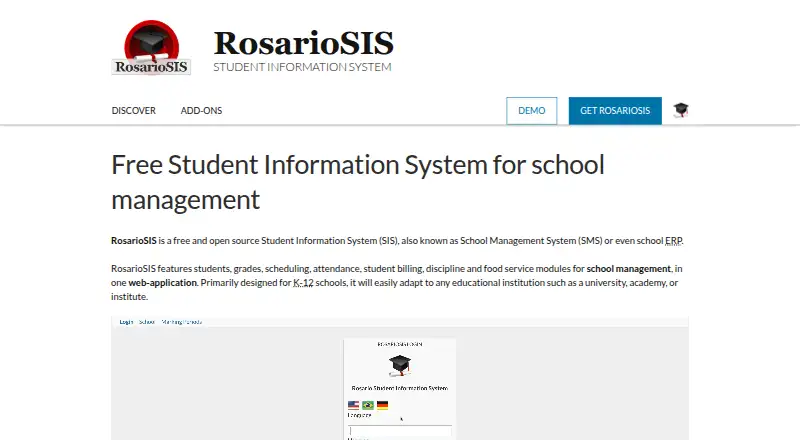
What RosarioSIS is
RosarioSIS is a free, open-source student information system for school administration, designed mainly for K–12 schools and adaptable to universities, academies and institutes. Its web application includes modules for student records, grades, scheduling, attendance, billing, discipline and food service. Schools can provide student and parent portals, accept online user and student registrations, and generate PDF documents. RosarioSIS runs on PHP with PostgreSQL or MySQL and can be accessed from an internet-connected computer. Its responsive design supports tablets and smartphones, and the project lists translations in French, Spanish, Brazilian Portuguese, Italian, Russian, Ukrainian, Czech, Greek, Turkish, German, Vietnamese and Bulgarian. An integration with Moodle can synchronize users, courses, schedules, events, assignments and portal notes. Schools can self-host the software or use hosted plans: PRIMARY costs €24 per month and PREMIUM costs €36 per month. Both list selectable student limits, while support and backup retention differ. Self-hosting requires PHP and a SQL database, and the school must install updates. Hosted service includes one-click installation and support, with a 30-day free trial advertised.
Who it suits
RosarioSIS suits schools seeking student, attendance, grade and administrative modules, especially K–12 schools. It can also be adapted for universities, academies and institutes.
What it does well
- Includes student, grade, attendance and billing modules.
- Student and parent portals are available.
- Moodle integration synchronizes courses and other records.
- Responsive design supports tablets and smartphones.
- Self-hosted software is free.
What to know first
- Self-hosting requires PHP and a SQL database.
- Self-hosted schools must manage updates.
- PRIMARY and PREMIUM cost €24 and €36 per month.
- Hosted backup retention is 7 days on PRIMARY.
Limits
The free self-hosted edition requires PHP and a SQL database, and the school must install updates. PRIMARY costs €24 per month and retains backups for 7 days; PREMIUM costs €36 per month and retains them for 30 days. Hosted student limits are selectable, and schools above 1,000 students should contact the provider for pricing.
Plans
| Plan | Billed and limits | Price |
|---|---|---|
| RosarioSIS self-hosted | Free software; requires PHP and a SQL database; school manages updates | Free |
| Self-hosted RosarioSIS | Requires PHP and SQL database · customer manages updates | Free |
| PRIMARY cloud | monthly · Unlimited staff and parents · unlimited schools · student allowance shown on signup | €24 a month |
| PRIMARY | €24 per month · Unlimited staff, parents and schools; student limit selectable; email support; 7-day backup retention | €24 a month |
| PREMIUM | €36 per month · Unlimited staff, parents and schools; student limit selectable; priority email support; 30-day backup retention | €36 a month |
| PREMIUM cloud | monthly · Unlimited staff and parents · unlimited schools · priority email · 30-day backup retention · premium modules | €36 a month |
| Basic | monthly · Cloud deployment · TrustRadius listing | $49 a month |
| Premium Bundle | one-time purchase · All listed premium modules and plugins · 30 days email support · updates for one year | €599, paid once |
The first 8 of 10 plans, as rosariosis.org lists them, read 7 Oct 2026. The maker's own page has the final word. Every plan
Getting started
- Visit https://www.rosariosis.org/ to choose self-hosting or RosarioSIS cloud hosting.
- For self-hosting, prepare PHP and a SQL database.
- Follow the installation guidance for GNU/Linux, Windows, Mac, cPanel, Softaculous or Docker.
- Choose cloud hosting for one-click installation and support, with a 30-day free trial.
- Select a hosted plan: PRIMARY is €24 per month or PREMIUM is €36 per month.
RosarioSIS is an open-source student information system built mainly for K–12 schools, with potential to serve universities, academies and institutes. It is best for schools that want a broad set of administrative modules and can either maintain their own installation or pay for hosting.
Overview
RosarioSIS brings student records, grades, scheduling, attendance, billing, discipline and food service into a web application. Student and parent portals, online registration and PDF document generation extend its reach to families and enrollment work. That breadth makes it a plausible central system for schools consolidating routine administration, though each school should weigh the work of self-hosting against the cost of a hosted plan.
The project began for a school in Colombia and was based on Centre/SIS before being released as free software. A public forum and invitations for community contributions, particularly translations and bug reports, give users a route to participate in the project.
Key features
Administration and family access
Attendance tracking, gradebook, fee management and admissions and enrollment cover important day-to-day school workflows. Portals provide student and parent access, while online registration can bring enrollment into the same application. Schools seeking one system across these tasks may value the scope, but the feature set alone does not establish how closely the workflows fit a particular institution.
Integrations and language support
Moodle integration synchronizes users, courses, schedules, events, assignments and portal notes, making RosarioSIS more useful for schools that already use Moodle. Hosted solutions also list Google and Microsoft single sign-on, PayPal and Stripe registration, Jitsi Meet, FET timetable imports and TTHotel smart-lock integration. The application supports translations in French, Spanish, Brazilian Portuguese, Italian, Russian, Ukrainian, Czech, Greek, Turkish, German, Vietnamese and Bulgarian, a practical advantage for multilingual communities.
Web access and deployment
RosarioSIS runs as a web application powered by PHP and PostgreSQL or MySQL, accessible from an internet-connected computer. Its responsive design supports tablets and smartphones. Documentation covers installation on GNU/Linux, Windows and Mac, as well as cPanel, Softaculous and Docker. Self-hosting avoids a recurring hosting plan, but requires a PHP environment, a SQL database and school-managed updates when new releases arrive. That maintenance obligation makes the free option less suitable for schools without technical capacity.
Pricing
The self-hosted software costs nothing. It removes licensing cost, but the school supplies the infrastructure and keeps the installation updated. The maker also offers installation for €60 and email support starting at €60 per month, covering use, configuration and consulting.
For hosted service, PRIMARY costs €24 a month, billed €24 per month. It includes unlimited staff, parents and schools, a selectable student limit, email support and seven-day backup retention. PREMIUM costs €36 a month, billed €36 per month, and adds priority email support and 30-day backup retention while retaining the same stated access and student-limit terms. Both hosted plans list HTTPS encryption; the hosted service also advertises daily backups. PRIMARY suits schools comfortable with shorter backup retention and standard email support, while PREMIUM is the clearer fit for those who value longer retention and faster support access. Schools with more than 1,000 students should contact the provider for custom pricing; student limits can otherwise be selected and plans automatically grow with the school.
The €599, paid once Premium Bundle is a separate purchase, billed €599. It includes premium add-ons, 30 days of email support and updates downloadable for one year. It may suit a school seeking those additions without choosing a monthly hosted plan, but it does not remove the stated self-hosting duties. A 30-day hosted trial gives schools a period to assess the service before committing.
Platforms
RosarioSIS is listed for Android, iOS, Linux, macOS, self-hosted deployment, web and Windows. Its web application and responsive design support access from computers, tablets and smartphones, while the documented installation options give technical teams several deployment routes.
Who it's for
RosarioSIS is a strong candidate for K–12 schools that need student, grade, attendance, scheduling, billing and discipline functions in one system, particularly those that value open-source software or Moodle synchronization. Universities, academies and institutes may also adapt it. Schools that cannot manage PHP and database maintenance should favor hosted service; those needing more than 1,000 student places should discuss custom pricing with the provider.
Pros and cons
Pros
- Broad school-management scope: student, grade, scheduling, attendance, billing, discipline and food service modules can consolidate several administrative needs.
- Free self-hosting option: the software has no licensing price, and documentation covers multiple operating systems and deployment routes.
- Choice of hosted support levels: PRIMARY and PREMIUM offer selectable student limits and unlimited staff, parents and schools, with different support priority and backup retention.
- Moodle synchronization: the integration covers courses and schedules as well as users, events, assignments and portal notes.
Cons
- Self-hosting requires ongoing technical work: schools need PHP and a SQL database, and must install releases to keep the system secure.
- Hosted fees recur monthly: schools opting out of maintenance responsibility pay €24 or €36 per month, with backup retention varying by plan.
- Large schools need a pricing conversation: more than 1,000 students requires contacting the provider for custom pricing.
Alternatives
Gibbon is another free, open-source school platform with self-managed hosting, worth considering if that model is preferred. openSIS offers a free, open-source downloadable edition for schools that want to install and manage it independently. OpenEMIS Admissions is a free, self-hosted web option with no licensing fees.
Gradelink is a paid alternative with Android, iOS, macOS, web and Windows support; its Gradelink Payments plan is priced at $0, with transaction fees potentially covered by the school or passed to families. Aeries SIS is a paid option for schools willing to contact sales for a district quote. Ed-admin uses annual agreements and school-specific pricing, with all 50 modules and four app portals included. Fedena has a free plan and trial, plus a Standard plan at $999 a year with 20 Core Modules, 17 Standard Modules, unlimited users and one-to-one online training. Infinite Campus is another paid option available on Android, iOS, web and API platforms.
Browse more options in Student Information Systems or School Management Software.
Verdict
RosarioSIS is best for schools seeking a broad, adaptable information system with the choice of free self-hosting or paid cloud service. Its strongest reason to choose it is the combination of core administration modules, family portals and Moodle synchronization; the main reason to look elsewhere is the need to avoid either self-managed updates or recurring hosted costs.
Verdict
RosarioSIS offers a broad set of school-management modules with both self-hosted and hosted options. Schools should account for update management when self-hosting, or compare hosted plan support and backup retention.
Questions
Is RosarioSIS free?
The self-hosted edition is free software. Cloud hosting has a 30-day free trial, and the PRIMARY plan costs €24 per month.
What does cloud hosting cost?
PRIMARY is €24 per month and PREMIUM is €36 per month. The Premium Bundle costs €599 once.
Which platforms does RosarioSIS support?
It is a web application accessible from an internet-connected computer, with a responsive design for tablets and smartphones. Listed platforms include Android, iOS, Linux, macOS, self-hosted, web and Windows.
Can RosarioSIS work with Moodle?
Yes. Its Moodle integration can synchronize users, courses, schedules, events, assignments and portal notes.
What does self-hosting require?
A PHP environment and a SQL database. The school is responsible for installing updates when new releases are available.
Who makes RosarioSIS?
The project began as a system for Nuestra Señora del Rosario school in Colombia and was based on Centre/SIS. It is publicly released as free software.
Facts from RosarioSIS's own pages
- Accounting and billing
- Accounting and Student Billing cover school income and expenses, staff payments, student fees, balances, statements, invoices and receipts. · rosariosis.com, 14 Oct 2026
- API
- A separate REST API plugin provides JWT authentication, an example client and read-only GET mode, with a 1,000-record page limit to reduce scraping. · gitlab.com, 14 Oct 2026
- Attendance
- Teachers can take attendance, record absences and comments, and consult attendance and completion reports. · rosariosis.com, 14 Oct 2026
- Communication
- Messaging, email and SMS add-ons support communication among administrators, teachers, parents and students, including attachments and notifications. · rosariosis.com, 14 Oct 2026
- Company location
- Goodfirms lists RosarioSIS headquarters as France. · goodfirms.co, 14 Oct 2026
- Company origin
- The project identifies its first release as July 2013 and its maintainer as François Jacquet in public GitLab repositories. · rosariosis.org, 14 Oct 2026
- Core modules
- The web application includes student, grade, scheduling, attendance, student billing, discipline and food service modules. · rosariosis.org, 7 Oct 2026
- Discipline
- The Discipline module records referrals, produces referral breakdowns and allows the discipline form to be configured. · rosariosis.com, 14 Oct 2026
- Documentation
- Documentation includes installation guides for Linux, Windows, Mac, cPanel, Softaculous and Docker, role-specific handbooks, sample reports, tips, a wiki and video tutorials. · rosariosis.org, 14 Oct 2026
- Documentation and installation
- The documentation lists installation guidance for GNU/Linux, Windows, Mac, cPanel, Softaculous and Docker. · rosariosis.org, 7 Oct 2026
- Extensibility
- The product supports additional modules, plugins, themes, translations through Poedit and Moodle integration setup. · rosariosis.org, 14 Oct 2026
- Food service
- Food Service supports menu design, meal tracking, student and staff accounts, transactions, statements and reports. · rosariosis.org, 14 Oct 2026
- Founded
- 2013 · rosariosis.org, 28 Sept 2026
- Grades and report cards
- The system configures grading scales, records grades and comments, calculates report-card results and flags anomalous grades. · rosariosis.com, 14 Oct 2026
- Hardware guidance
- The site lists minimum RAM of 1 GB for 250 students, 2 GB for 750 students and 3 GB for 1,000 or more students. · rosariosis.org, 14 Oct 2026
- Hosted plan limits
- The hosted page says schools with more than 1,000 students should contact the provider for pricing, while student limits can be selected and plans automatically grow with the school. · rosariosis.com, 7 Oct 2026
- Hosted service
- RosarioSIS cloud hosting includes one-click installation and support, and the maker advertises a 30-day free trial. · rosariosis.org, 7 Oct 2026
- Integrations
- Official and independent listings identify Moodle, PayPal, Stripe, Google login and Microsoft login integrations. · goodfirms.co, 14 Oct 2026
- Languages
- The official site lists French, Spanish, Brazilian Portuguese, Italian, Russian, Ukrainian, Czech, Greek, Turkish, German, Vietnamese and Bulgarian translations. · rosariosis.org, 14 Oct 2026
- Languages and devices
- The site says the responsive design supports tablets and smartphones and lists translations in French, Spanish, Brazilian Portuguese, Italian, Russian, Ukrainian, Czech, Greek, Turkish, German, Vietnamese and Bulgarian. · rosariosis.org, 7 Oct 2026
- Licence
- The core project is licensed under GNU GPL version 2 or later and may be used, modified and distributed freely. · rosariosis.org, 14 Oct 2026
- Limit: interface refinement
- A Goodfirms review calls for improvements in interface clarity, performance optimization and feature flexibility. · goodfirms.co, 14 Oct 2026
- Limit: OAuth
- A reviewer reports that RosarioSIS lacks a built-in OAuth 2.0 setup, although Google and Facebook login options are available. · goodfirms.co, 14 Oct 2026
- Limit: setup and learning curve
- Independent reviews describe installation and initial configuration as difficult or time-consuming for some organizations. · softwareadvice.com, 14 Oct 2026
Where RosarioSIS stands on Freedom251
- School Management Software#2 of 49
- Student Information Systems#3 of 32
- K-12 Student Information Software#3 of 22