Freedom251 › Marketing Performance Management Software
Robyn
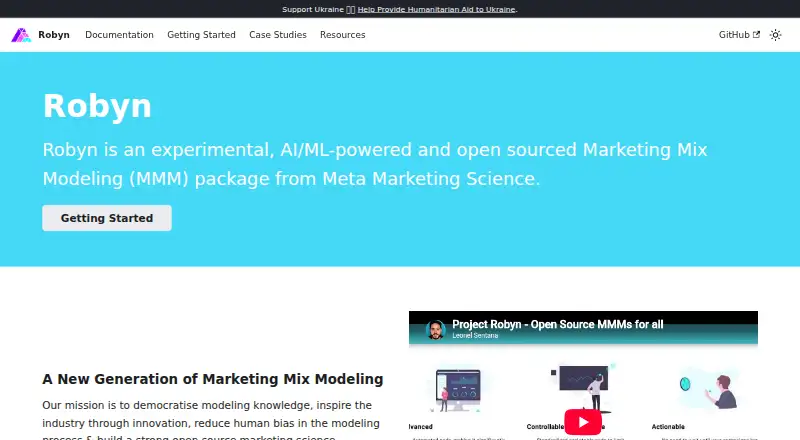
What Robyn is
Robyn is an open-source Marketing Mix Modeling package from Meta Marketing Science for estimating how media channels perform. It uses machine-learning techniques to model channel efficiency, effectiveness, adstock rates and saturation curves. Robyn automates hyperparameter optimization with evolutionary algorithms and uses ridge regression to address multicollinearity and reduce overfitting. Its time-series modeling uses Prophet to account for trend, seasonality and holidays. Models can be calibrated against methods including geo experiments, Facebook Lift and MTA. A budget allocator uses a constrained nonlinear solver to propose reallocations aimed at maximizing outcomes, and model one-pagers help compare outputs. Robyn is designed for granular datasets with many independent variables, especially those used by digital and direct-response advertisers with rich data. It does not require personally identifiable or individual-level data and does not depend on cookies or pixel data. A stable R version is available on CRAN, with a development version on GitHub. The Python version is a beta rewrite that may have translation issues; its API requires the Robyn R package to be installed first.
Who it suits
Robyn suits digital and direct-response advertisers working with granular datasets and many independent variables. It is intended for teams that can work with its R package or evaluate a beta Python version.
What it does well
- Estimates channel performance, adstock and saturation.
- Automates hyperparameter optimization with evolutionary algorithms.
- Can calibrate models against experiments and other methods.
- Budget allocation supports constrained reallocation scenarios.
- Does not require individual-level data, cookies or pixel data.
What to know first
- The Python version is beta and may have translation issues.
- The beta Python API requires the Robyn R package installed.
- Paid media variables and spend vectors must match in length and order.
Limits
Robyn is free and open source under the MIT license. The Python version is beta, may encounter translation issues, and requires the Robyn R package; paid media variables and spend vectors must have the same length and media order.
Getting started
- Choose the stable R version on CRAN or the development version on GitHub.
- Install the Robyn R package before using the beta Python API.
- Prepare granular marketing data with paid media variables and spend vectors in matching length and order.
- Use the package's modeling and calibration capabilities with your available data.
- Consult the public Robyn MMM Users Facebook Group or GitHub issues for support.
Robyn is a free, open-source marketing mix modeling package for analysts and advertisers who can work with detailed media data. It brings model estimation, calibration and budget planning into one technical workflow, rather than offering a turnkey measurement service.
Overview
Built by Meta Marketing Science, Robyn is aimed at granular datasets with many independent variables, particularly those from digital and direct-response advertising. That focus makes it a stronger fit for teams with rich media data than for advertisers with sparse inputs or little capacity to interpret models. Its privacy-conscious design avoids the need for personally identifiable information, individual-level log data, cookies or pixel data.
Robyn is free and MIT licensed. The stable R package on CRAN is the established option; a development version is on GitHub. The Python version is a beta translation that may have bugs, and its API requires the R package to be installed first. For most users, R is the more dependable starting point.
Key features
Robyn estimates channel efficiency and effectiveness, adstock rates and saturation curves. Its geometric, Weibull CDF and Weibull PDF adstock transformations give analysts different ways to model how advertising effects persist. Nevergrad evolutionary algorithms automate hyperparameter optimization, while ridge regression regularizes multicollinearity and helps prevent overfitting. These methods address common modeling challenges, but they do not eliminate the need for sound data and careful interpretation.
Prophet decomposes time-series trends, seasonality and holiday patterns. Robyn can calibrate models against ground-truth approaches including geo-based tests, Facebook Lift and MTA, as well as causal experiments such as randomized controlled trials and geo experiments. That calibration can help anchor model estimates to observed outcomes, provided teams have suitable experimental results to use.
For planning, a gradient-based constrained nonlinear solver reallocates budgets to maximize outcomes. Model one-pagers support comparisons among candidate models, and the package supports forecasting, scenario planning and ROI reporting. These capabilities make Robyn useful across analysis and planning, though the workflow remains a modeling package rather than a packaged, nontechnical reporting service.
Input discipline matters: paid media variables and paid media spend vectors must have the same length and media order. A mismatch can undermine the intended analysis, so teams need to prepare and align their data carefully.
Pricing
Robyn is free, with a free plan and no paid plan stated. That removes a software subscription cost, but users should still weigh the technical work involved in preparing data and running a modeling workflow. The free package is best for teams able to supply granular marketing data and manage the analysis themselves.
Platforms
Robyn is available for API use, Linux, macOS, Windows and self-hosting. The R version is stable on CRAN, while the Python version is beta and depends on the R package being installed first. Teams choosing Python should account for its beta status and potential translation bugs.
Who it's for
Robyn suits digital and direct-response advertisers with rich, granular media datasets, especially analysts who want to compare models, calibrate estimates against experiments and plan budget allocations. Its privacy-conscious input requirements are relevant to teams that do not want to rely on individual-level logs, cookies or pixel data.
It is a weaker fit for organizations seeking a low-effort, ready-made measurement product, or for teams without the data and technical capacity to maintain a modeling workflow. The beta Python version is also a poor choice for teams that require a mature Python-only API.
Pros and cons
- Pros: A free, MIT-licensed package combines media modeling, experiment-based calibration, model comparisons and budget allocation.
- Pros: It is designed for granular data and does not require PII, individual-level log data, cookies or pixel data.
- Cons: Paid media inputs and spend vectors must match in length and order, adding a precise data-preparation requirement.
- Cons: Python remains beta, may have bugs and requires the R package, limiting its appeal to Python-only teams.
- Cons: Its focus on rich, high-variable datasets makes it less suitable for advertisers with limited data or modeling capacity.
Alternatives
Marketing Performance Management Software is a broader category to explore when you want to compare tools beyond a marketing mix modeling package.
Google Meridian is another free, open-source option, with source code and methodology papers intended to support transparency and user auditability. Consider it if that emphasis is a priority.
Revup Marketing offers a free plan for one plan, one user and one team, with paid tiers for more plans, users and teams. It may suit a small team looking for a web-based freemium alternative.
Brandsystems is a paid web-based marketing resource management option with custom pricing; consider it if resource management is your priority.
Fintastic offers a paid, company-size-based subscription with unlimited users and data and support included. It may fit organizations seeking those enterprise subscription terms.
LiftLab is a paid enterprise marketing measurement platform with pricing and subscription terms set through an Order Form. Choose it if you want to discuss an enterprise platform through a demo and order process.
Measured is a paid platform positioned for enterprise brands, with a demo as the route to pricing. It may be a better match for an enterprise buyer seeking that positioning.
Planful has custom pricing based on company size, user count and selected modules. Consider it if those factors need to shape the subscription.
Revlo Marketing is another paid option.
Verdict
Choose Robyn if you have rich, granular marketing data and want a free, privacy-conscious toolkit for modeling, calibration and budget planning. Its breadth and open-source license are compelling for capable measurement teams; look elsewhere if you need a turnkey product, or a mature Python-first workflow.
Verdict
Robyn offers a modeling and budget-planning workflow for advertisers with detailed marketing data, alongside privacy-conscious input requirements. The stable R version is distinct from its beta Python option, which has stated limitations.
Questions
How much does Robyn cost?
Robyn has a free plan.
Is Robyn open source?
Yes. The repository states that Robyn is MIT licensed.
Which versions are available?
A stable R version is on CRAN, a development version is on GitHub, and a Python version is marked beta.
What does Robyn model?
It estimates media channel efficiency and effectiveness, adstock rates and saturation curves. It also models trend, seasonality and holiday patterns.
Does Robyn use personal-level data?
It does not require personally identifiable information or individual-level log data and does not depend on cookies or pixel data.
What are the Python version's limitations?
It is a beta translation of the R package and may encounter bugs or translation issues. The beta Python API requires the Robyn R package to be installed first.
Facts from Robyn's own pages
- Adstock options
- Robyn offers geometric, Weibull CDF, and Weibull PDF adstock transformations. · facebookexperimental.github.io, 30 Sept 2026
- Availability
- Robyn has a stable R version on CRAN and a development version on GitHub; the maker also documents a Python version marked beta. · facebookexperimental.github.io, 30 Sept 2026
- Budget allocation
- Its budget allocator uses a gradient-based constrained nonlinear solver to maximize outcomes by reallocating budgets. · facebookexperimental.github.io, 30 Sept 2026
- Calibration
- Robyn can calibrate models against ground-truth methodologies including geo-based tests, Facebook Lift, and MTA. · facebookexperimental.github.io, 30 Sept 2026
- Input requirement
- Paid media variables and paid media spend vectors must have the same length and media order. · facebookexperimental.github.io, 30 Sept 2026
- Integrations
- Robyn uses Nevergrad for optimization, Prophet for trend and seasonality decomposition, and glmnet for ridge regression fitting. · facebookexperimental.github.io, 30 Sept 2026
- Intended users
- The package is built for granular datasets with many independent variables and is described as especially suitable for digital and direct-response advertisers with rich data sources. · github.com, 30 Sept 2026
- License
- The repository states that Robyn is MIT licensed. · github.com, 30 Sept 2026
- Model calibration
- Robyn calibrates marketing mix models using causal experiments such as randomized controlled trials and geo experiments. · facebookexperimental.github.io, 30 Sept 2026
- Model comparisons
- Robyn generates model one-pagers to support intuitive model comparisons. · facebookexperimental.github.io, 30 Sept 2026
- Modeling
- Robyn uses machine-learning techniques to estimate media channel efficiency and effectiveness, adstock rates, and saturation curves. · github.com, 30 Sept 2026
- Optimization
- Robyn uses a multi-objective evolutionary algorithm for hyperparameter optimization. · facebookexperimental.github.io, 30 Sept 2026
- Privacy
- The maker describes Robyn as privacy friendly, requiring no PII or individual-level log data and not depending on cookies or pixel data. · facebookexperimental.github.io, 30 Sept 2026
- Privacy design
- Robyn does not require personally identifiable information or individual-level data and does not depend on cookies or pixel data. · facebookexperimental.github.io, 30 Sept 2026
- Product
- Robyn is an experimental, AI/ML-powered, open-source Marketing Mix Modeling package from Meta Marketing Science. · facebookexperimental.github.io, 30 Sept 2026
- Product type
- Robyn is an experimental, AI/ML-powered, open-source Marketing Mix Modeling package from Meta Marketing Science. · facebookexperimental.github.io, 30 Sept 2026
- Python API limitation
- The beta Python API requires the Robyn R package to be installed first. · facebookexperimental.github.io, 30 Sept 2026
- Python availability
- The Python version is a beta rewrite of Robyn's R package and may have translation issues. · facebookexperimental.github.io, 30 Sept 2026
- Python limitation
- The repository says the Python version is an LLM-translated beta and may encounter bugs. · github.com, 30 Sept 2026
- R availability
- Robyn has a stable version on CRAN and a development version on GitHub. · facebookexperimental.github.io, 30 Sept 2026
- Support
- Users can join the public Robyn MMM Users Facebook Group, raise GitHub issues, and take Meta's official Robyn blueprint course. · github.com, 30 Sept 2026
- Target users
- Robyn is built for granular datasets with many independent variables and is especially suitable for digital and direct-response advertisers with rich data sources. · facebookexperimental.github.io, 30 Sept 2026
- Time-series features
- Robyn uses Facebook Prophet to automatically decompose trend, seasonality, and holiday patterns. · facebookexperimental.github.io, 30 Sept 2026
- Time-series modeling
- Robyn uses time-series decomposition for trend and seasonality modeling. · facebookexperimental.github.io, 30 Sept 2026