Freedom251 › Duplicate File Finders
rmlint
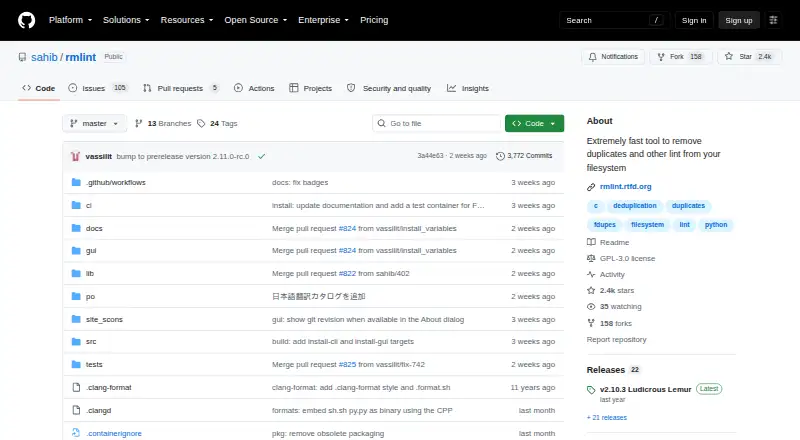
What rmlint is
rmlint is a free, GPLv3-licensed utility for finding duplicate files and other filesystem waste, then offering candidates for removal. It scans local filesystem paths, mounted volumes and file lists supplied through standard input. Beyond duplicate files and directories, it can identify nonstripped binaries, broken symbolic links, empty files and directories, and files with broken user or group IDs.
Duplicate detection can use several hashes or an exact byte-by-byte comparison. Optional basename or extension matching is also available. The documentation says rmlint can handle file sets containing millions of files. It provides multiple output options and can save a previous run so a later scan checks only new files. File previews and automatic selection are available, but there is no Recycle Bin or Trash feature. A Python graphical frontend, Shredder, ships alongside rmlint from version 2.4.0 onward. Shredder rechecks files before deletion; its documentation cautions that the interface remains in development and should be used at the user's risk. Linux is the main target, and the project says it runs and compiles under Linux, FreeBSD, Darwin and Solaris. Installation options are listed for Linux distributions and macOS. The project advises checking deletion candidates because duplicate-finding tools can produce false positives or have serious bugs.
Who it suits
rmlint suits Linux and macOS users who want to locate duplicate files and other forms of filesystem clutter for review. It can also fit users who prefer command-line workflows, multiple match methods or a graphical frontend, provided they check candidates before deletion.
What it does well
- Finds duplicates, broken links, empty items and other filesystem problems.
- Supports hash checks and exact byte-by-byte comparison.
- Offers optional matching by basename or extension.
- Can save a run so later scans check only new files.
- Provides previews and automatic selection.
What to know first
- There is no built-in Recycle Bin or Trash feature.
- Shredder's interface is still in development and carries a risk warning.
- The project cautions users to check deletion candidates.
Limits
The free plan is GPLv3-licensed software. There is no Recycle Bin or Trash feature; Shredder rechecks files before deletion, but its interface is still in development and should be used at the user's risk.
Plans
| Plan | Billed and limits | Price |
|---|---|---|
| rmlint | GPLv3-licensed software | Free |
As github.com lists them, read 8 Oct 2026. The maker's own page has the final word.
Getting started
- Visit the rmlint project on GitHub.
- Choose a listed installation option for Linux or macOS, or another supported system.
- Run a scan on local paths, mounted volumes or a file list supplied through standard input.
- Review previews and deletion candidates before removing files.
- Use Shredder if you want the bundled Python graphical frontend, keeping its development warning in mind.
Verdict
Pick rmlint if you need a free filesystem scanner with several ways to find duplicates and other unwanted items. Look elsewhere if a built-in Trash or Recycle Bin is essential; review removal candidates carefully, especially when using Shredder.
Questions
Is rmlint free?
Yes. The listed plan costs nothing, and the software is licensed under GPLv3.
Which systems does rmlint support?
The project names Linux as its main target and says it runs and compiles under Linux, FreeBSD, Darwin and Solaris. Installation options are listed for Linux distributions and macOS.
What can rmlint find?
It can find duplicate files and directories, nonstripped binaries, broken symbolic links, empty files and directories, and files with broken user or group IDs.
Does rmlint have a graphical interface?
A Python graphical frontend named Shredder ships alongside rmlint from version 2.4.0 onward. Its documentation says the interface is still in development and should be used at the user's risk.
Does rmlint include a Recycle Bin or Trash?
No. The listed feature coverage says it has no Recycle Bin or Trash.
How does rmlint compare files?
It supports several hash methods and exact byte-by-byte comparison, plus optional basename or extension matching.
Facts from rmlint's own pages
- Deletion safety
- Shredder rechecks each file before deletion, and its documentation warns that the interface is still in development and should be used at the user's risk. · rmlint.readthedocs.io, 8 Oct 2026
- Duplicate checks
- It supports several hashes for duplicate detection and an exact byte-by-byte comparison option. · rmlint.readthedocs.io, 8 Oct 2026
- Finds
- It can find duplicate files and directories, nonstripped binaries, broken symbolic links, empty files and directories, and files with broken user or group IDs. · rmlint.readthedocs.io, 8 Oct 2026
- GUI
- A Python graphical frontend named Shredder is shipped alongside rmlint from version 2.4.0 onward. · rmlint.readthedocs.io, 8 Oct 2026
- Installation
- The installation guide lists packages or installation options for Linux distributions and macOS, among other systems. · rmlint.readthedocs.io, 8 Oct 2026
- Large scans
- The documentation says rmlint can handle file sets containing millions of files. · rmlint.readthedocs.io, 8 Oct 2026
- License
- rmlint is licensed under GPLv3. · github.com, 8 Oct 2026
- Output and replay
- It offers numerous output options and can store the last run so a later scan only checks new files. · rmlint.readthedocs.io, 8 Oct 2026
- Purpose
- rmlint finds duplicate files and other space waste or broken items on a filesystem and offers to remove them. · github.com, 8 Oct 2026
- Support
- The project directs users who find bugs, have trouble running rmlint, or want to suggest features to its bug-reporting guidance. · github.com, 8 Oct 2026
- Supported systems
- The project says it runs and compiles under Linux, FreeBSD, Darwin, and Solaris, with Linux as its main target. · github.com, 8 Oct 2026
- Use caution
- The project cautions that duplicate finders, including rmlint, can identify false positives or have serious bugs, and recommends checking deletion candidates. · rmlint.readthedocs.io, 8 Oct 2026
Where rmlint stands on Freedom251
- Duplicate File Finders#18 of 38