Freedom251 › Open Source License Compliance Software
REUSE Tool
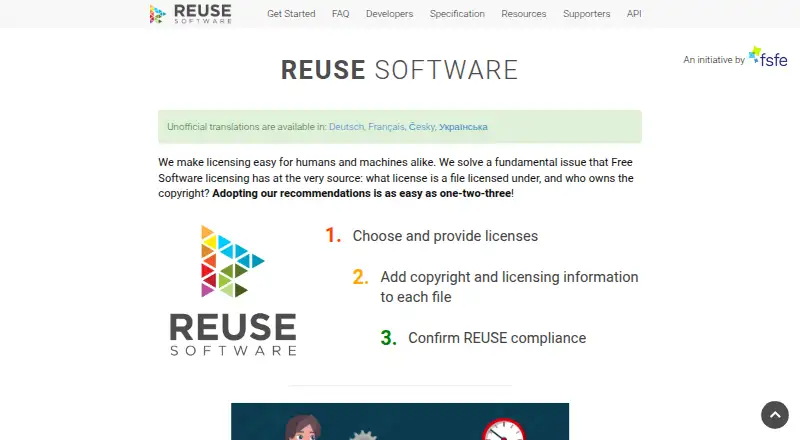
What REUSE Tool is
REUSE Tool helps software projects make Free Software licensing information clear, complete, and machine-readable. Its command-line tools download full license texts, add copyright and license details to file headers, and lint projects to find problems. A simple command can generate a software bill of materials. The REUSE API checks and displays compliance status, with a badge and generated JSON output available. Teams can include checks in CI/CD workflows such as Drone, Woodpecker CI, Forgejo Actions, GitHub Actions, and Docker-based processes. A pre-commit hook can run linting for each Git commit and prevent the commit when an error is found. Installation options include Debian and Fedora packages, pipx, pip, and source installation; Python 3.10 or newer is required. The free tool requires no registration and can be used offline. Its scope has a clear boundary: it does not determine whether a project follows the licenses of its dependencies. The tool's source code is licensed under GPL-3.0-or-later, its documentation under CC-BY-SA-4.0, and some configuration and data files under CC0-1.0.
Who it suits
REUSE Tool suits developers and teams who need to organize and check licensing information in their own software projects. It can also fit workflows that run checks in CI/CD or at commit time.
What it does well
- Downloads license texts and adds file-header information.
- Lints projects for licensing problems.
- Generates a software bill of materials.
- Integrates with several CI/CD workflows.
- Free, offline use requires no registration.
What to know first
- Does not check licenses of project dependencies.
- Requires Python 3.10 or newer.
Limits
The tool does not check whether a project respects the licenses of its dependencies. Python 3.10 or newer is required.
Plans
| Plan | Billed and limits | Price |
|---|---|---|
| REUSE Tool | no registration required · can be used offline | Free |
As reuse.software lists them, read 1 Oct 2026. The maker's own page has the final word.
Getting started
- Visit https://reuse.software/.
- Choose a listed installation route: Debian or Fedora package, pipx, pip, or source installation.
- Use Python 3.10 or newer.
- Run the command-line tools locally, or use the Docker image for CI/CD checks.
- Integrate the API, CI/CD checks, or pre-commit hook if they fit your workflow.
Verdict
REUSE Tool focuses on project licensing records, checks, and SBOM generation, with options for local use and automated workflows. Dependency-license compliance is outside its stated scope.
Questions
How much does REUSE Tool cost?
The REUSE Tool plan is free. It requires no registration and can be used offline.
What platforms are supported?
The listed platforms are API, Linux, self-hosted, and Windows.
Can it generate an SBOM?
Yes. It can generate a software bill of materials with a simple command.
Does it check dependency licenses?
No. It does not check whether a project respects the licenses of its dependencies.
What licenses cover REUSE Tool?
The original source code is GPL-3.0-or-later, documentation is CC-BY-SA-4.0, and some configuration and data files are CC0-1.0.
How can users get support?
Users can report issues and feature requests on GitHub. The [email protected] mailing list is available for discussion and support.
Facts from REUSE Tool's own pages
- API
- The REUSE API continuously checks and displays compliance status and can provide a badge and generated JSON output. · reuse.software, 1 Oct 2026
- CI/CD
- REUSE can be integrated into CI/CD processes, including Drone, Woodpecker CI, Forgejo Actions, GitHub Actions, and Docker-based workflows. · reuse.software, 1 Oct 2026
- Commands
- The CLI includes annotate, download, lint, lint-file, spdx, supported-licenses, and convert-dep5 commands. · reuse.readthedocs.io, 1 Oct 2026
- Compliance assistance
- The REUSE tool downloads full license texts, adds copyright and license information to file headers, and contains a linter to identify problems. · reuse.software, 1 Oct 2026
- Docker
- An fsfe/reuse Docker image is available for running compliance checks in CI/CD. · reuse.readthedocs.io, 1 Oct 2026
- Installation
- The documentation lists Debian and Fedora packages, pipx, pip, and source installation methods. · reuse.readthedocs.io, 1 Oct 2026
- Licensing
- The original source code of the tool is licensed under GPL-3.0-or-later, documentation under CC-BY-SA-4.0, and some configuration and data files under CC0-1.0. · reuse.readthedocs.io, 1 Oct 2026
- Pre-commit
- A pre-commit hook can run reuse lint on every Git commit and prevent the commit from proceeding when there is an error. · reuse.software, 1 Oct 2026
- Privacy
- FSFE says it strictly limits personal-data processing and will not sell user data to third parties. · fsfe.org, 1 Oct 2026
- Purpose
- REUSE provides recommendations and tools to make Free Software licensing easy, comprehensive, unambiguous, and machine-readable. · reuse.software, 1 Oct 2026
- Runtime requirement
- The tool requires Python 3.10 or newer; Git, Mercurial, Pijul, and Jujutsu are optional version-control dependencies. · reuse.readthedocs.io, 1 Oct 2026
- SBOM generation
- The tool can generate a software bill of materials with a simple command. · reuse.software, 1 Oct 2026
- Scope limit
- REUSE does not check whether a project respects the licenses of its dependencies; that requires different tools and processes. · reuse.software, 1 Oct 2026
- Support
- Users can report issues and feature requests on GitHub, and the [email protected] mailing list is available for discussion and support. · reuse.readthedocs.io, 1 Oct 2026