Freedom251 › Open Source License Compliance Software

licscan
What licscan is
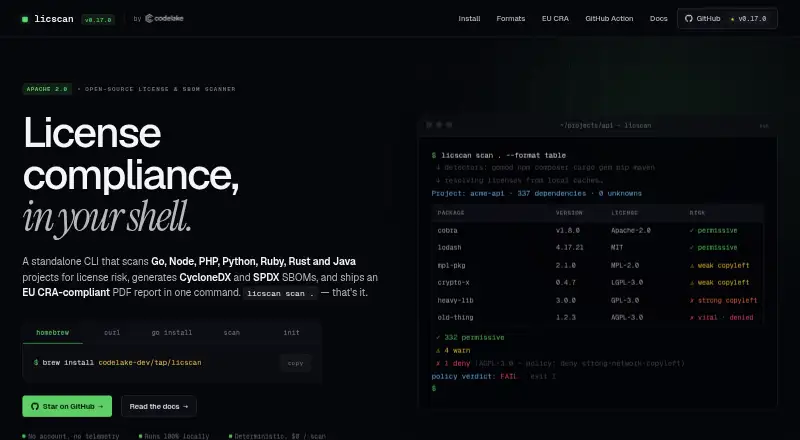
LicScan is a free command-line tool for checking project dependencies for license risk and generating software bills of materials (SBOMs) and EU CRA evidence. It supports Go, Node.js, PHP, Python, Ruby, Rust, and Java projects. Its configurable five-level policy model lets users deny, warn about, or allow licenses, with exceptions. Output options include table, JSON, HTML, Markdown, CycloneDX, SPDX, CRA PDF, SARIF, and JUnit. CRA mode creates a PDF and a CRA-extended CycloneDX JSON SBOM with manufacturer and product metadata. The maker says scans run locally without an account, telemetry, backend connection, or phone-home behavior, and that identical inputs produce identical outputs. Its official GitHub Action can comment verdicts on pull requests, fail builds for denied licenses, and upload SBOM artifacts. SARIF supports GitHub Code Scanning; JUnit XML is listed for Jenkins, GitLab CI, and Azure DevOps. LicScan runs on Linux, macOS, and Windows, with Homebrew, curl, and go install options. The free/open-source plan is $0 per scan under Apache 2.0.
Who it suits
LicScan suits developers and teams that need to check dependency licenses and generate SBOMs or EU CRA evidence in local or CI workflows. It supports seven project ecosystems and runs on Linux, macOS, and Windows.
What it does well
- Supports seven project ecosystems.
- Five-level policy model includes deny, warn, and allow rules.
- Offers outputs including CycloneDX, SPDX, CRA PDF, SARIF, and JUnit.
- Runs locally without an account or telemetry.
- Free at $0 per scan under Apache 2.0.
What to know first
- Roadmap support for CocoaPods and pub is not yet listed as available.
- The listed interface is a command-line tool.
- No free trial is offered.
Limits
The free plan is the standalone CLI, and project support covers Go, Node.js, PHP, Python, Ruby, Rust, and Java. CocoaPods and pub support are on the roadmap.
Plans
| Plan | Billed and limits | Price |
|---|---|---|
| Free / open source | $0 per scan · Apache 2.0 · standalone CLI | Free |
As licscan.dev lists them, read 3 Oct 2026. The maker's own page has the final word.
Getting started
- Visit https://licscan.dev/.
- Choose Homebrew, curl, or go install to install the CLI.
- Run it on a project in one of the supported ecosystems.
- Choose a license policy and report format for the scan.
- For CI, use the official GitHub Action or connect SARIF or JUnit output to a supported CI service.
LicScan is a command-line tool for checking dependency licenses and producing compliance artifacts. It is best suited to teams that want to make license decisions part of repository and CI workflows. Its case is strongest when local, repeatable scans and EU CRA evidence matter; it is a weaker fit for teams seeking a hosted review service.
Overview
LicScan scans repository dependencies in Go, Node.js, PHP, Python, Ruby, Rust, and Java projects. Its configurable five-level risk model supports deny, warn, and allow exceptions, turning license review into an enforceable policy rather than just an inventory. That flexibility is useful across different risk tolerances, though teams need to decide how their policy should treat each license.
The maker says scans run locally without an account, telemetry, backend connection, or phone-home behavior, and that identical inputs produce identical outputs. Those properties suit teams that want to keep scanning within their own environment and produce repeatable results. The repository-focused standalone CLI is less suited to organizations that need a hosted, centralized workflow. CocoaPods and pub are roadmap items, so projects using them do not have current ecosystem support.
Key features
LicScan can produce table, JSON, HTML, Markdown, CycloneDX, SPDX, CRA PDF, SARIF, and JUnit reports. The range serves both people reviewing results and CI systems consuming artifacts. CRA mode generates a PDF report and a CRA-extended CycloneDX JSON SBOM with manufacturer and product metadata, making the tool relevant to teams assembling that evidence rather than only tracking license risk.
The official GitHub Action can comment scan verdicts on pull requests, fail builds when licenses are denied, and upload SBOM artifacts. SARIF support also connects with GitHub Code Scanning, while JUnit XML is supported for Jenkins, GitLab CI, and Azure DevOps. These integrations make the CLI more practical in established pipelines, although the available workflow remains centered on repository scans.
Installation options include Homebrew, curl, and go install. The maker directs bug reports to GitHub issues and offers [email protected] for contact.
Pricing
The Free / open source plan costs nothing ($0 per scan · Apache 2.0 · standalone CLI). It includes a free plan with no per-scan charge, and the stated deployment option is on-premise. There is no free trial, but no trial is needed to access the free plan. This suits individuals and teams that can run a CLI in their own environment; the plan is not a hosted service with centralized review features.
Platforms
LicScan supports Linux, macOS, and Windows. Its listed installation methods include Homebrew, curl, and go install, giving developers several ways to add the CLI to their working environment.
Who it's for
LicScan is a strong fit for software teams that need license policy enforcement alongside SBOM or CRA evidence, especially when scans should remain local and feed into CI. It is less appropriate for projects built around CocoaPods or pub today, or for teams that want a hosted interface instead of a repository-scanning CLI.
Pros and cons
- Pros: A configurable five-level policy model can deny, warn on, or allow licenses, supporting decisions beyond a simple dependency list.
- Pros: CRA PDF and extended CycloneDX output add manufacturer and product metadata for teams preparing CRA evidence.
- Pros: Local operation without account, telemetry, or backend connection, plus deterministic outputs, suits privacy-sensitive and repeatable workflows.
- Cons: The standalone CLI and repository scan model do not provide a hosted, centralized review service.
- Cons: CocoaPods and pub are only roadmap items, leaving those package-manager users without current support.
Alternatives
Open Source License Compliance Software is a broader category to explore when comparing tools.
Choose FOSSology if you want an open-source license compliance toolkit and system, with API, web, and self-hosted platforms among its supported options. Apache Flink CDC is another free option for Linux, macOS, Windows, and self-hosted environments. DeepFilterNet is free and open source under MIT or Apache-2.0. OHRisk is a free open-source CLI under the MIT License. OSS Review Toolkit is a free open-source toolkit with no paid limits stated. OSSKB is a free API and web service, though it is best-effort and transaction frequency may be limited. REUSE Tool needs no registration and can be used offline. SBOM Workbench is a free download with a public GitHub repository.
Verdict
Choose LicScan if you need a free, local CLI that can enforce license policy and generate SBOM and CRA artifacts within repository or CI workflows. Its main advantage is combining those outputs with privacy-conscious, repeatable scanning. Look elsewhere if your project depends on CocoaPods or pub, or if a hosted, centralized service is essential.
Verdict
LicScan combines license policy checks with SBOM and CRA evidence generation, and its local operation avoids an account or backend connection. Its supported ecosystems are Go, Node.js, PHP, Python, Ruby, Rust, and Java; CocoaPods and pub are only on the roadmap.
Questions
How much does LicScan cost?
LicScan is free: the listed plan is free, with $0 per scan and an Apache 2.0 license.
Is there a free plan or trial?
Yes. LicScan has a free plan; there is no free trial.
Which operating systems does it support?
LicScan supports Linux, macOS, and Windows.
Which project ecosystems can it scan?
It supports Go, Node.js, PHP, Python, Ruby, Rust, and Java projects. CocoaPods and pub support are on the roadmap.
Does LicScan run locally?
Yes. It runs locally without an account, telemetry, a backend connection, or phone-home behavior.
Who makes LicScan?
The website identifies codelake Technologies LLC as the maker.
Facts from licscan's own pages
- CRA evidence
- CRA mode generates a PDF report and a CRA-extended CycloneDX JSON SBOM with manufacturer and product metadata. · licscan.dev, 3 Oct 2026
- GitHub Actions
- The official GitHub Action can comment scan verdicts on pull requests, fail builds on denied licenses, and upload SBOM artifacts. · licscan.dev, 3 Oct 2026
- Headquarters
- Wyoming, USA · licscan.dev, 28 Sept 2026
- Installation
- Install options shown include Homebrew, curl, and go install. · licscan.dev, 3 Oct 2026
- License policy
- A configurable five-level risk model supports deny, warn, and allow exceptions. · licscan.dev, 3 Oct 2026
- Maker
- The website identifies codelake Technologies LLC as the maker. · licscan.dev, 3 Oct 2026
- Other CI integrations
- The maker describes SARIF support for GitHub Code Scanning and JUnit XML support for Jenkins, GitLab CI, and Azure DevOps. · licscan.dev, 3 Oct 2026
- Purpose
- LicScan scans project dependencies for license risk and generates SBOMs and EU CRA evidence. · licscan.dev, 3 Oct 2026
- Reports
- Output formats include table, JSON, HTML, Markdown, CycloneDX, SPDX, CRA PDF, SARIF, and JUnit. · licscan.dev, 3 Oct 2026
- Reproducibility
- The maker describes scans as deterministic, with the same inputs producing the same outputs. · licscan.dev, 3 Oct 2026
- Security and privacy
- The site says LicScan runs locally without an account, telemetry, backend connection, or phone-home behavior. · licscan.dev, 3 Oct 2026
- Support
- The maker directs bug reports to GitHub issues and provides [email protected] for contact. · licscan.dev, 3 Oct 2026
- Supported ecosystems
- It supports Go, Node.js, PHP, Python, Ruby, Rust, and Java projects. · licscan.dev, 3 Oct 2026
- Supported package managers
- The homepage lists seven ecosystems, with roadmap support for CocoaPods and pub. · licscan.dev, 3 Oct 2026