Freedom251 › Open Source Package Health Tools
OHRisk
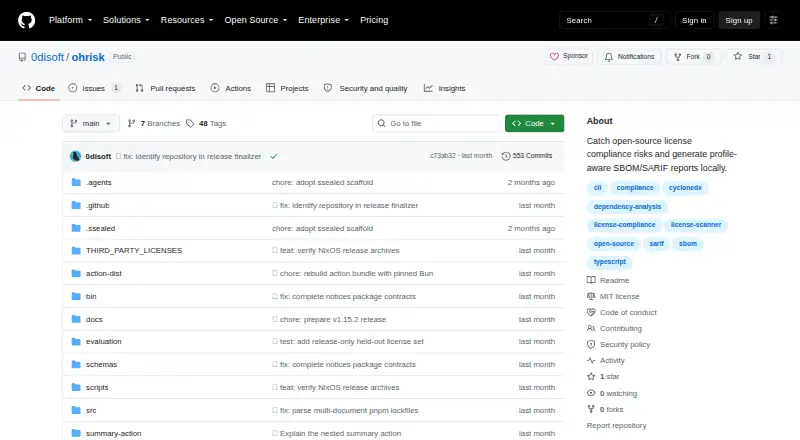
What OHRisk is
OHRisk is a local command-line tool for assessing open-source license risk in dependencies before a pull request ships. It evaluates dependencies under SaaS or distributed-app usage profiles and labels findings low, review, high, or unknown. Inputs include dependency information from ecosystems such as npm, Rust, Go, Python, Java, .NET, Ruby, and PHP, as well as CycloneDX and SPDX software bills of materials. It can use local package evidence and selected remote evidence sources, with checksum and identity validation described for supported ecosystems. Reports are available in terminal, JSON, HTML, Markdown, SARIF 2.1.0, and CycloneDX 1.5 JSON formats. A bundled GitHub Actions composite action supports scan, ci, and diff commands, with documented SARIF upload to GitHub code scanning. Local waiver files can keep waived findings visible while preventing them from triggering CI threshold failures. OHRisk is an MIT-licensed npm package, also runnable through pnpm, Yarn, or Bun commands; its packaged CLI requires Node.js 24.0.0 or later. It is a risk aid, not a substitute for legal review, and some dependency sources and graph types are not yet scanned. The free plan costs nothing.
Who it suits
OHRisk suits development teams assessing dependency-license risk in SaaS or distributed applications, especially teams using GitHub Actions. It can help organize review, but does not replace legal review.
What it does well
- Supports many dependency ecosystems and SBOM formats
- Generates SARIF and CycloneDX reports
- GitHub Actions support includes scan, ci, and diff
- Waived findings remain visible in reports
What to know first
- Requires Node.js 24.0.0 or later
- Some dependency sources and graph types are not scanned
- Does not replace legal review
Limits
The packaged CLI requires Node.js 24.0.0 or later. Some dependency sources and graph types are not scanned yet, including Gradle graph reconstruction and remote Terraform Registry metadata.
Plans
| Plan | Billed and limits | Price |
|---|---|---|
| Ohrisk | Open-source CLI · MIT License | Free |
As github.com lists them, read 29 Sept 2026. The maker's own page has the final word.
Getting started
- Open the OHRisk GitHub repository.
- Use npm to install or run the package, or use pnpm, Yarn, or Bun package-manager commands.
- Ensure Node.js version 24.0.0 or later is available for the packaged CLI.
- Use its scan, ci, or diff commands; GitHub Actions users can add the bundled composite action.
Overview
OHRisk is a local command-line utility for checking open-source license exposure in software dependencies before a pull request is merged. It is aimed at development and compliance teams that prefer on-premise analysis and CI enforcement over a hosted scanner. The bottom line is that it combines broad report and workflow support with meaningful, documented blind spots, so it works best as a repeatable decision aid rather than a complete legal or dependency inventory.
Key features
OHRisk evaluates dependencies under SaaS and distributed-application profiles, then labels results low, review, high, or unknown. Those categories help teams focus attention on obligations that deserve investigation instead of treating every package identically. The project explicitly positions the tool as risk decision support, not legal advice; high-impact releases and ambiguous findings still require legal review.
Input coverage spans npm, Rust, Go, Python, Java, .NET, Ruby, and PHP projects, plus CycloneDX and SPDX software bills of materials. SBOM imports include CycloneDX JSON and XML, SPDX JSON and RDF, and SPDX tag-value. OHRisk can draw on local package evidence and selected remote evidence sources, with checksum and identity validation described for supported ecosystems. That combination is useful when package metadata needs corroboration, although it does not make every ecosystem equally complete.
Output choices include terminal, JSON, HTML, Markdown, SARIF 2.1.0, and CycloneDX 1.5 JSON. Developers can read results directly, while security pipelines can consume machine-readable artifacts. The bundled GitHub Actions composite action provides scan, ci, and diff commands, and the workflow guide documents sending SARIF to GitHub code scanning. Local waiver files can keep an exception from failing a CI threshold while preserving the waived finding in reports, which supports auditability without blocking every accepted risk.
Policy enforcement is supported, along with obligation tracking and attribution reports. The tool is distributed under the MIT License and is available as an npm package, with install commands for npm, pnpm, Yarn, or Bun. Runtime use requires Node.js 24.0.0 or newer; Bun itself is not required.
Coverage has clear boundaries. The README says Gradle graph reconstruction and remote Terraform Registry metadata, among other dependency sources and graph types, are not scanned yet. Projects relying on those inputs should treat OHRisk results as partial until those dependencies are reviewed by another method.
Pricing
OHRisk is free: the Ohrisk plan costs nothing and provides the open-source CLI under the MIT License. There is no free trial because the product is already offered as a free plan. The published plan carries no seat, scan, or usage quota, making it suitable for teams that can operate their own command-line and CI infrastructure. Its trade-off is operational rather than monetary: deployment is on-premise, so users must provide the environment and account for the stated Node.js runtime.
Platforms
OHRisk runs on Linux, macOS, and Windows. Its package-manager distribution and local execution suit developer workstations, while the GitHub Actions integration targets repository CI. On-premise deployment is the fit for organizations that want scan artifacts and waiver handling inside their own workflow.
Who it's for
Choose OHRisk if your team needs license checks before pull requests, supports several language ecosystems, and wants policy thresholds, obligation tracking, attribution reports, or SBOM exchange without paying for a hosted service. It is particularly appropriate where local evidence, visible waivers, and SARIF-based GitHub workflows matter.
Look elsewhere, or pair it with another scanner, when Gradle dependency graphs, Terraform Registry metadata, or other unsupported sources are central to your inventory. It is also not the right standalone authority for legal conclusions.
Pros and cons
Pros
- Broad workflow output: terminal, document, SARIF, and CycloneDX reports cover both human review and automation.
- CI-ready controls: GitHub Actions commands, threshold enforcement, and documented SARIF upload support pull-request processes.
- Traceable exceptions: waivers can bypass a failure without hiding the underlying finding.
- Wide input model: major language ecosystems and CycloneDX or SPDX SBOMs are supported.
- No license fee: the MIT-licensed CLI is free to run on all supported desktop platforms.
Cons
- Incomplete graph coverage: Gradle reconstruction and remote Terraform Registry metadata are not scanned yet.
- Not legal advice: risk ratings guide review but cannot replace counsel for consequential licensing decisions.
- Runtime requirement: Node.js 24.0.0 or later may complicate use in older build environments.
- Self-managed operation: on-premise execution places setup and maintenance responsibility on the user.
Alternatives
Open Source License Compliance Software is a useful starting list if you want to compare a wider field.
FOSSology is another free, open-source compliance toolkit with API, web, self-hosted, and desktop platform options; choose it when a broader service-style deployment matters more than OHRisk's local CLI focus.
ScanCode.io is free Apache-2.0 software that runs in Docker or on a Linux server, making it preferable when containerized or server execution is the priority.
OSS Review Toolkit is a free open-source toolkit with no paid limits stated; consider it when you want an alternative toolkit approach across Linux, macOS, Windows, or self-hosted environments.
OSSKB is a free, best-effort service whose transaction frequency may be limited, so it fits occasional lookups rather than a fully local CI control.
REUSE Tool is free, offline-capable, and needs no registration; choose it for a simpler local compliance workflow. licscan is a free standalone CLI at $0 per scan. Apache Flink CDC and DeepFilterNet are free open-source projects, but their primary purposes are unrelated to license-risk review.
Verdict
OHRisk is a strong fit for teams that want a free, local license-risk gate with flexible reports, GitHub Actions integration, and visible waiver handling. Its main reason to choose it is the combination of policy-oriented findings and developer-friendly CI outputs. Its main reason to look elsewhere is incomplete dependency-source coverage, especially for Gradle and Terraform-related inventories, together with the need for separate legal judgment.
Verdict
OHRisk offers multiple report formats and CI workflows for license-risk review, including visible waivers. Its documented coverage gaps and legal-review caveat matter when interpreting its findings.
Questions
Does OHRisk have a free plan?
Yes. The Ohrisk plan is free, and the repository provides the CLI under the MIT License.
Which operating systems are listed?
OHRisk lists Linux, macOS, and Windows.
Which package managers can run it?
It is distributed as an npm package and can also be run using pnpm, Yarn, or Bun commands. The packaged CLI requires Node.js 24.0.0 or later, and Bun is not required.
Can OHRisk run in GitHub Actions?
Yes. A bundled composite action supports scan, ci, and diff commands. The guide documents uploading SARIF reports to GitHub code scanning.
Which SBOM formats can it import?
Listed formats are CycloneDX JSON and XML, SPDX JSON and RDF, and SPDX tag-value.
Is OHRisk legal advice?
No. OHRisk describes itself as a risk decision aid and says it does not replace legal review.
Facts from OHRisk's own pages
- CI integration
- A bundled GitHub Actions composite action supports scan, ci, and diff commands, and the guide documents SARIF upload to GitHub code scanning. · github.com, 29 Sept 2026
- Dependency coverage
- The README lists supported dependency inputs across ecosystems including npm, Rust, Go, Python, Java, .NET, Ruby, PHP, and CycloneDX or SPDX SBOMs. · github.com, 29 Sept 2026
- Install
- Ohrisk is distributed as an npm package and can also be run using pnpm, Yarn, or Bun package-manager commands. · github.com, 29 Sept 2026
- License
- The repository provides Ohrisk under the MIT License. · github.com, 29 Sept 2026
- License evidence
- Ohrisk can use local package evidence and selected remote evidence sources with checksum and identity validation described for supported ecosystems. · github.com, 29 Sept 2026
- Maker
- The GitHub maker profile is named 0disoft (ZeroDi) and lists Republic of Korea as its location. · github.com, 29 Sept 2026
- Not legal advice
- Ohrisk describes itself as a risk decision aid and says it does not replace legal review. · github.com, 29 Sept 2026
- Outputs
- It can generate terminal, JSON, HTML, Markdown, SARIF 2.1.0, and CycloneDX 1.5 JSON reports. · github.com, 29 Sept 2026
- Purpose
- Ohrisk is a local CLI that catches open-source license risk before a pull request ships. · github.com, 29 Sept 2026
- Risk profiles
- It evaluates dependencies under SaaS or distributed-app usage profiles and reports low, review, high, or unknown findings. · github.com, 29 Sept 2026
- Runtime
- The packaged CLI runs on Node.js version 24.0.0 or later, and users do not need Bun installed. · github.com, 29 Sept 2026
- Scope limitation
- The README states several dependency sources and graph types are not scanned yet, including Gradle graph reconstruction and remote Terraform Registry metadata. · github.com, 29 Sept 2026
- Waivers
- Local waiver files can suppress findings from CI threshold failures while keeping waived findings visible in reports. · github.com, 29 Sept 2026