Freedom251 › Open Source License Compliance Software
Licensable
What Licensable is
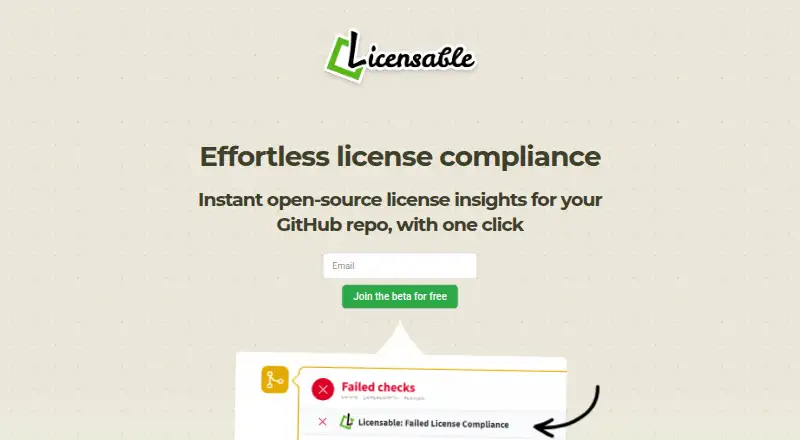
Licensable helps teams review open-source license obligations and compatibility in GitHub repositories. It examines manifest and metadata files to map a repository’s dependencies, then checks for potential obligations and whether dependency licenses fit the project’s license. If more than one license applies, it chooses the most permissive option. A check can report success, a neutral result if some dependency licenses may be unknown, or failure if a dependency license is incompatible with the repository license. Documented support covers Python, npm, Yarn, pnpm, Rust, Ruby, Go, CocoaPods, Gradle, Maven, and NuGet. License information is supplemented with sources including ClearlyDefined and curated datasets. Users connect it through GitHub, select organizations and repositories, and open a pull request to begin. Licensable is a cloud service for the web, with free plans for public repositories and private repositories during an open beta. Its privacy policy describes read-only OAuth scopes and HTTPS communications; source code is not persistently stored unless explicitly enabled. Repository metadata and analysis results are kept only as long as needed to provide the service or as required by law. Licensable describes results as best effort and not legal advice.
Who it suits
Licensable suits teams that maintain GitHub repositories and need to review dependency license obligations across supported ecosystems. It may also suit teams seeking repository checks in a pull request, provided they treat the results as best effort rather than legal advice.
What it does well
- Maps dependencies from manifests and metadata files.
- Checks potential license obligations and compatibility.
- Supports Python, JavaScript, Rust, Ruby, Go, and other ecosystems.
- Reports success, neutral, or failure check outcomes.
- Free plans cover public repositories and private repositories during open beta.
What to know first
- Results may be incomplete or incorrect.
- Analysis results are not legal advice.
- Private repository access is offered during an open beta.
Plans
| Plan | Billed and limits | Price |
|---|---|---|
| Private repositories (beta) | During the beta · Free for private repositories during open beta | Free |
| Public repositories | Free for public repositories | Free |
As licensable.io lists them, read 7 Oct 2026. The maker's own page has the final word.
Getting started
- Open https://licensable.io/.
- Install Licensable through GitHub.
- Select the organizations and repositories to grant access to.
- Open a pull request to start.
Verdict
Choose Licensable if you need cloud based license checks for GitHub repositories and your dependency files are among its supported ecosystems. Look elsewhere for a definitive legal assessment, since its results are best effort and not legal advice.
Questions
Is Licensable free?
Yes. Public repositories are listed as free. Private repositories are also listed as free during the open beta.
Which platforms does Licensable support?
The listed platform is web. It connects to GitHub repositories that the user grants access to.
Which dependency ecosystems are supported?
Documented manifest and lockfile support includes Python, npm, Yarn, pnpm, Rust, Ruby, Go, CocoaPods, Gradle, Maven, and NuGet.
How does Licensable report a check?
A check can succeed, return a neutral result when some dependency licenses may be unknown, or fail when a dependency license is incompatible with the repository license.
Is Licensable open source?
The listed facts do not identify Licensable itself as open source. Its purpose is to analyze open-source licenses in GitHub repositories.
How do I get started?
Install Licensable through GitHub, select organizations and repositories, and open a pull request.
Facts from Licensable's own pages
- Check results
- A check can report success, neutral when some dependency licenses may be unknown, or failure when a dependency license is incompatible with the repository license. · licensable.io, 7 Oct 2026
- Data retention
- The privacy policy says repository metadata and analysis results are retained only as long as needed to provide the service or as required by law. · licensable.io, 7 Oct 2026
- Data sources
- Licensable enriches license data with external sources such as ClearlyDefined and curated datasets. · licensable.io, 7 Oct 2026
- Dependency scanning
- It scans repositories for manifests or metadata files to capture the dependency tree. · licensable.io, 7 Oct 2026
- GitHub access
- It accesses GitHub repository metadata, dependency information, and source code for compliance analysis, with access limited to repositories the user grants. · licensable.io, 7 Oct 2026
- GitHub setup
- Users install Licensable through GitHub, select organizations and repositories, then open a pull request to start. · licensable.io, 7 Oct 2026
- License analysis
- It flags potential license obligations and checks compatibility with the project’s license. · licensable.io, 7 Oct 2026
- License selection
- When multiple licenses apply, it automatically selects the most permissive option. · licensable.io, 7 Oct 2026
- Limitations
- Licensable says its results are best effort, may not be fully correct or exhaustive, and are not legal advice. · licensable.io, 7 Oct 2026
- Purpose
- Licensable provides open-source license insights and compliance reporting for GitHub repositories. · licensable.io, 7 Oct 2026
- Security
- The privacy policy says OAuth scopes are read-only, communications use HTTPS, and source code is not persistently stored unless explicitly enabled. · licensable.io, 7 Oct 2026
- Support
- The terms list [email protected] for questions or feedback. · licensable.io, 7 Oct 2026
- Supported ecosystems
- Its documented lockfile and manifest support includes Python, npm, Yarn, pnpm, Rust, Ruby, Go, CocoaPods, Gradle, Maven, and NuGet. · licensable.io, 7 Oct 2026