Freedom251 › Project management tools
Redmine
What Redmine is
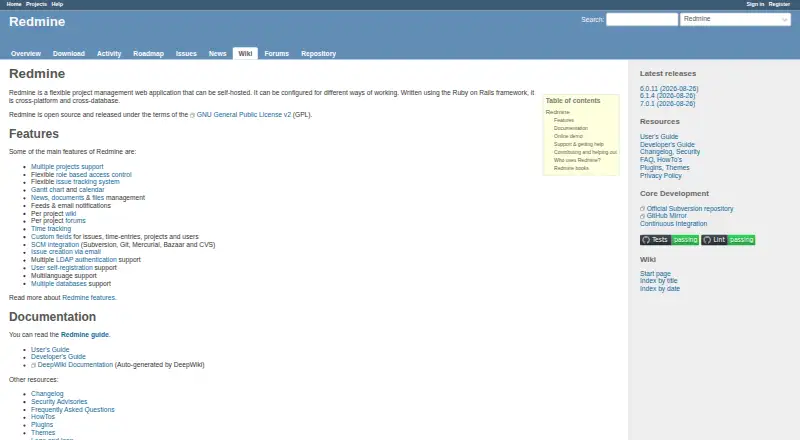
Redmine is a free, open-source web application for managing projects that can be self-hosted. A single instance can handle multiple projects, each with its own roles, visibility settings and enabled modules. Teams can define issue types and statuses and configure workflow transitions by issue type and role. Gantt charts and calendars use issue dates, while time entries can be reported by user, issue type, category or activity. Collaboration features include project wikis and forums, news, document and file management, feeds and email notifications. Its repository browser supports Subversion, CVS, Mercurial, Bazaar and Git. The REST API provides basic create, update and delete operations for documented resources in XML and JSON. Redmine is released under GNU GPL v2 and runs on many Unix, Linux, macOS and Windows systems where Ruby is available; it does not support JRuby. The project points users to forums and IRC for help. Its download page identifies the 7.0.x branch as the latest stable release, with newer features, fixes and security updates.
Who it suits
Redmine suits teams that want to manage multiple projects in a self-hosted application and configure issue workflows. It may also suit teams that need time reporting, repository browsing or a REST API.
What it does well
- One instance can manage multiple projects.
- Project roles and visibility can be set per project.
- Time entries can be reported in several ways.
- Repository browser supports five listed systems.
- Open source under GNU GPL v2.
What to know first
- Requires Ruby and does not support JRuby.
- Self-hosting requires users to run the application.
- Older branches have narrower support or are unsupported.
Plans
| Plan | Billed and limits | Price |
|---|---|---|
| Redmine (self-hosted) | Open source · GNU GPL v2 · Self-hosted | Free |
| Self-hosted Redmine | downloadable source · self-hosted installation | Free |
As redmine.org lists them, read 9 Oct 2026. The maker's own page has the final word.
Getting started
- Visit https://www.redmine.org/ and review the download page for the release branch.
- Choose a Unix, Linux, macOS, or Windows system where Ruby is available; do not use JRuby.
- Download and self-host Redmine under the GNU GPL v2 plan.
- Configure projects, project-specific roles, visibility, modules, issue types, statuses, and workflow transitions.
- Use the project forums or IRC chatroom for help and discussion.
Redmine is a free, open-source web application for managing projects, issues and development work on infrastructure you control. It is best for teams that need detailed, project-specific workflows and repository visibility, provided they can operate a Ruby-based installation. The trade-off is ownership of deployment, upgrades and support rather than a vendor-managed service.
Overview
A single Redmine instance can run multiple projects while giving each project its own roles, visibility rules and enabled modules. That shared-but-separate structure suits organisations with varied teams or clients that need different access policies without maintaining separate systems. Redmine is licensed under the GNU General Public License v2 and maintained by community volunteers; help is centered on forums and an IRC chatroom, so teams must be prepared to handle administration and troubleshooting themselves.
The application is cross-platform and cross-database, and is intended to run on most Unix, Linux, macOS and Windows systems where Ruby is available. JRuby is not supported. This gives administrators broad hosting choices, but the Ruby prerequisite remains a meaningful operational constraint.
Key features
Project and issue control
Administrators can define issue statuses and types, then restrict workflow transitions by issue type and role. In practice, that supports disciplined approval or triage processes and lets different projects follow different rules. The benefit depends on maintaining those configurations as processes change; Redmine gives control rather than a ready-made methodology.
Planning and time reporting
Gantt charts and calendars are generated from issue dates, giving teams schedule views connected to actual work items. Users can enter time and report it by user, issue type, category or activity. This is useful for capacity reviews, project accounting and retrospective analysis, although the value of the reports relies on consistent time entry.
Collaboration and records
Project wikis, forums, news, documents, files, feeds and email notifications keep discussion and reference material alongside project work. These modules make Redmine more than an issue register, particularly for teams that want project knowledge stored in the same system. Each project can enable only the modules it needs, limiting clutter for simpler engagements.
Repositories, identity and API
The repository browser covers Subversion, CVS, Mercurial, Bazaar and Git, making Redmine a practical hub for teams using different version-control systems. Authentication can connect to multiple LDAP directories, with optional online self-registration. A REST API supports documented resources and basic create, update and delete operations in XML and JSON, enabling integrations without replacing Redmine's core workflow.
Maintenance and security
Redmine publishes security advisories for vulnerabilities fixed in releases. The download page identifies the 7.0.x branch as the latest stable line, while older branches receive narrower support or are unsupported. Self-hosting therefore includes a real upgrade and security-maintenance obligation.
Pricing
| Plan | Price | What it means |
|---|---|---|
| Redmine (self-hosted) | free | Open source, GNU GPL v2, self-hosted |
There are no per-seat charges or hosted subscription terms in this plan. The economic advantage is strongest for organisations that already have the people and infrastructure to install, secure and update software. It is less suitable for teams that would need to buy external administration or want a guaranteed vendor-operated environment; those costs sit outside the licence.
Platforms
Redmine is available as a web application with support for Linux, macOS and Windows hosting where Ruby is available, plus API access and self-hosted deployment. It does not support JRuby. There are no native mobile platforms stated, so mobile use depends on access to the web application or an integration.
Who it's for
Redmine fits software and IT groups that need configurable issue workflows, Gantt and calendar planning, detailed time reports, project-level permissions and built-in browsing for Git or other repositories. It also suits organisations consolidating several projects on one controlled installation, especially where LDAP integration matters. Look elsewhere if you need a vendor to run the service, a mobile-first experience, or support beyond community forums and IRC.
Pros and cons
Pros
- Deep project-level control: roles, visibility and modules can differ by project within one instance.
- Configurable workflows: statuses, issue types and role-based transitions can reflect formal processes.
- Broad development coverage: repository browsing spans Git, Subversion, CVS, Mercurial and Bazaar.
- Strong reporting foundation: issue-linked schedules and multi-dimensional time reporting support planning and accountability.
- No licence fee: the GPLv2 self-hosted plan avoids per-user subscription costs.
Cons
- Operational responsibility: your team supplies the Ruby environment, deployment, upgrades and security maintenance.
- JRuby exclusion: environments standardized on JRuby cannot run Redmine.
- Community-led support: assistance is directed to forums and IRC rather than a stated vendor support service.
- Configuration overhead: flexible workflows and project modules require ongoing administration to stay useful.
Alternatives
Choose Asana instead if you want a freemium service with Android, iOS, macOS and Windows clients; its Personal plan is free forever for one or two people, with two users and a 100 MB maximum file size.
ClickUp is the better fit when a hosted freemium workspace and generous task access matter: its Free Forever plan includes unlimited tasks and members, 60 MB of storage and one form.
Pick Linear for a hosted, developer-oriented option with unlimited members, two teams and 250 issues on its free plan, plus API and desktop/web platforms.
Wrike suits teams wanting hosted work management with unlimited users, 2 GB of account storage and 200 active tasks on its free plan.
Consider YouTrack when a cloud service for up to 10 users and 30 GB of storage is preferable.
Azure Test Plans is an alternative for teams specifically seeking integrated test planning at $52 per user per month on its Basic + Test Plans plan.
Teamwork.com offers hosted project management with a free tier for five projects and five users.
monday.com is a hosted visual-workspace alternative with a free tier capped at two seats, three boards, three Docs, 200 items and 500 MB of storage.
For broader comparisons, browse IT Project Management Software, Game Bug Tracking Software, Game Project Management Software, Issue Tracking Software or Project Management Software.
Verdict
Redmine is a strong choice for technically capable organisations that want free, self-hosted control over multiple projects, issue workflows, time reporting and source repositories. Choose it for configurability and licence economics; look elsewhere when operating Ruby infrastructure, maintaining releases and relying on community support would outweigh the value of owning the system.
Verdict
Redmine offers configurable project and issue management alongside collaboration, time reporting and repository browsing. Its self-hosted model and Ruby requirement are important considerations for choosing it.
Questions
How much does Redmine cost?
The listed self-hosted plan is free. Redmine is open source under GNU GPL v2.
Can Redmine manage multiple projects?
Yes. One instance can manage multiple projects, each with project-specific roles, visibility settings, and enabled modules.
Which operating systems does Redmine support?
It should run on most Unix, Linux, macOS, and Windows systems where Ruby is available. JRuby is not supported.
Can Redmine track time?
Yes. Time entries can be reported by user, issue type, category, or activity.
Which source control systems does its repository browser support?
It supports Subversion, CVS, Mercurial, Bazaar, and Git.
Who maintains Redmine?
The site credits Jean-Philippe Lang and says Redmine is built and maintained by community volunteers.
Facts from Redmine's own pages
- Access control
- Administrators can define roles and permissions and assign different roles to users in each project. · redmine.org, 15 Oct 2026
- API
- The REST API provides access and basic create, update and delete operations for documented resources, in XML and JSON formats. · redmine.org, 9 Oct 2026
- API authentication
- REST access can use HTTP Basic authentication or an API key supplied as a parameter, credential, or X-Redmine-API-Key header. · redmine.org, 15 Oct 2026
- API coverage
- Issues, projects, users, time entries, and news are documented as stable API resources, while many other resources remain alpha or beta. · redmine.org, 15 Oct 2026
- Authentication
- Redmine supports authentication against multiple LDAP directories and optional online user self-registration. · redmine.org, 9 Oct 2026
- Collaboration
- Features include project wikis and forums, news, document and file management, feeds and email notifications. · redmine.org, 9 Oct 2026
- Content management
- Projects include news, documents, file sharing, per-project wikis, and forums. · redmine.org, 15 Oct 2026
- Custom fields
- Custom fields are available for issues, time entries, projects, and users, with filtering support. · redmine.org, 15 Oct 2026
- Databases
- The feature documentation lists MySQL, PostgreSQL, and SQLite support; installation documentation also covers Microsoft SQL Server. · redmine.org, 15 Oct 2026
- Documentation and support
- Official resources include user and developer guides, a changelog, FAQs, how-to articles, forums, IRC chat, and an unofficial Slack workspace. · redmine.org, 15 Oct 2026
- Extensibility
- The project site provides plugin and theme directories and identifies plugins as a way to extend Redmine. · redmine.org, 15 Oct 2026
- Gantt and calendar
- Gantt charts and calendars are generated from issue start and due dates. · redmine.org, 15 Oct 2026
- Installation limits
- JRuby is unsupported and SQLite is specifically not recommended for multi-user production use. · redmine.org, 15 Oct 2026
- Issue tracking
- Issue types, statuses, and workflow transitions can be customized by issue type and role. · redmine.org, 15 Oct 2026
- Languages
- The official feature page lists Redmine as available in 49 languages. · redmine.org, 15 Oct 2026
- Latest release
- The download page lists Redmine 7.0.2, 6.1.5, and 6.0.11 dated 2026-10-01, 2026-10-01, and 2026-08-26 respectively. · redmine.org, 15 Oct 2026
- LDAP
- Redmine supports authentication against multiple LDAP directories and optional automatic account creation. · redmine.org, 15 Oct 2026
- Licence
- Redmine is open source under the GNU General Public License version 2 or later. · redmine.org, 15 Oct 2026
- License
- Redmine is open source and released under the GNU General Public License v2. · redmine.org, 9 Oct 2026
- Limit: Capterra users
- Capterra reviewers report an outdated or unintuitive interface, difficult installation, maintenance work, and weaker Agile support than newer tools. · capterra.com, 15 Oct 2026
- Limit: G2 users
- Reviewers repeatedly criticize the dated interface, confusing Agile or sprint workflows, limited reporting, plugin compatibility problems, and missing advanced features. · g2.com, 15 Oct 2026
- Limit: GetApp users
- GetApp's synthesis says setup and maintenance require technical skills and that the interface is dated, complex, and less suitable for larger teams needing polished UX. · getapp.com, 15 Oct 2026
- Limit: Trustpilot complaint
- The sole Trustpilot reviewer complained about missing basic features, unresolved functionality issues, and project contributors closing tickets without fixing the underlying problems. · trustpilot.com, 15 Oct 2026
- Limit: TrustRadius users
- TrustRadius reviewers cite a learning curve, memory consumption, lagginess, complexity, and a lack of modern KPI dashboards. · trustradius.com, 15 Oct 2026
Where Redmine stands on Freedom251
- Project management tools#1 of 196
- Project Management Software#3 of 188
- Issue Tracking Software#1 of 40
- Game Project Management Software#1 of 32
- IT Project Management Software#1 of 28
- Bug Tracking Software#1 of 26
- Game Bug Tracking Software#1 of 26
- Project Planning Software#1 of 25