Freedom251 › AI Readability Checkers
Readability
What Readability is
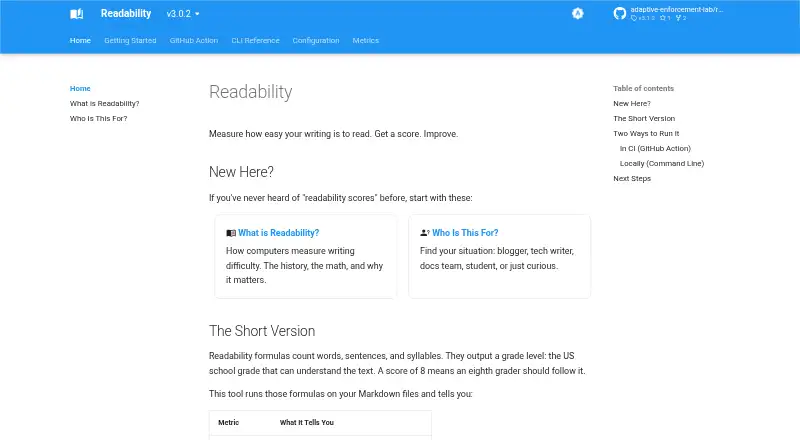
Readability analyzes Markdown files and reports measures of how complex their words and sentences may be. Its results include grade level, reading ease, and estimated reading time based on 200 words per minute. The listed grade-level formulas are Flesch-Kincaid, Gunning Fog, Coleman-Liau, SMOG, and ARI. It also reports word and sentence metrics and can detect or require MkDocs-style admonitions. Results can be produced as a table, Markdown, JSON, summary, or report.
The tool can run as a Go command-line program, in Docker, as a GitHub Action, or from source; pre-commit hooks are documented too. Configurable thresholds can make CI checks fail when documentation exceeds them. A .readability.yml file supports path-specific overrides, and a JSON Schema is available for editor validation and autocomplete. The GitHub Action can run checks in workflows and add a formatted report to the Actions job summary. Documented CI/CD examples cover GitLab CI, CircleCI, and Jenkins. The project is MIT licensed and provides pre-built binaries for Linux and macOS in amd64 and arm64, and for Windows in amd64. Its Docker guide describes Cosign image signatures, a signed SBOM, and a distroless base image that runs as a non-root user. Readability scores assess word and sentence complexity; they do not determine accuracy, completeness, context, or tone.
Who it suits
Readability suits bloggers, technical writers, documentation teams, and students who want to review how difficult Markdown content may be to read. Its threshold checks and workflow integrations also fit teams that want automated readability checks in CI.
What it does well
- Reports several grade-level scores, reading ease, and estimated reading time.
- Offers table, Markdown, JSON, summary, and report outputs.
- Thresholds can fail CI checks when documentation exceeds them.
- Runs as a CLI, Docker image, GitHub Action, or pre-commit hook.
- MIT licensed, with Linux, macOS, and Windows binaries.
What to know first
- Scores do not assess accuracy, completeness, context, or tone.
- The documented Windows binary is for amd64 only.
- Plain-language rewrites and accessibility guidance are not provided.
Limits
The project lists a free MIT-licensed plan with its GitHub Action, CLI, and Docker image; no paid plans are listed. Its scores cover word and sentence complexity, not accuracy, completeness, context, or tone.
Plans
| Plan | Billed and limits | Price |
|---|---|---|
| Readability | MIT-licensed GitHub Action, CLI, and Docker image; no paid plans listed | Free |
As readability.adaptive-enforcement-lab.com lists them, read 7 Oct 2026. The maker's own page has the final word.
Getting started
- Visit the Readability project website.
- Choose an installation route: Go command-line tool, Docker, GitHub Action, pre-commit hooks, or build from source.
- Download a pre-built binary for a listed operating system and architecture, if applicable.
- Set thresholds and path-specific overrides in .readability.yml.
- Run checks locally or in a CI workflow and choose an output format.
Readability is an open-source analyzer for Markdown, aimed at writers and teams who want to track text complexity in a repeatable way. Its strongest case is putting measurable checks into a documentation workflow; it is not a tool for rewriting prose or judging its substance.
Overview
Readability combines several grade-level scores with reading ease, estimated reading time, and word and sentence metrics. That breadth can help teams compare drafts and keep documentation within agreed limits. The scores measure complexity, however, not whether an explanation is accurate, complete, suited to its context, or appropriately toned.
Key features
Scoring and checks
Its grade-level formulas include Flesch-Kincaid, Gunning Fog, Coleman-Liau, SMOG, and ARI. It also estimates reading time at 200 words per minute and can measure word and sentence characteristics. MkDocs-style admonitions can be detected or required, a useful convention check for documentation teams that want more than a readability score. There are no plain-language rewrites or accessibility guidance, so editors must decide how to act on the results.
Thresholds and workflow
Configurable thresholds can fail a CI check when content exceeds a chosen limit, helping teams catch complexity regressions before merging changes. A .readability.yml file supports path-specific overrides, while a JSON Schema enables editor validation and autocomplete. The project documents a CLI, GitHub Action, Docker image, and pre-commit hooks, along with CI/CD examples for GitLab CI, CircleCI, and Jenkins. The GitHub Action can add a formatted report to an Actions job summary.
Outputs include table, Markdown, JSON, summary, and report formats, which gives teams options for both automated processing and human review. The Docker image is documented as Cosign-signed, with a signed SBOM and a distroless base that runs as a non-root user; the guide also explains how to verify its signature.
Pricing
Readability costs nothing. The MIT-licensed offering includes the GitHub Action, CLI, and Docker image, with no paid plans. It suits individuals and teams who need open-source complexity checks without a subscription. There are no paid tiers to trade up to for additional capabilities.
Platforms
Readability supports Linux, macOS, and Windows. Pre-built binaries cover amd64 and arm64 on Linux and macOS, but only amd64 on Windows. Users on Windows arm64 therefore cannot rely on a documented pre-built binary; the project also supports installation as a Go command-line tool, Docker, GitHub Action, or a build from source.
Who it's for
Bloggers, technical writers, documentation teams, students, and readers curious about readability can use it to assess Markdown text. Its most compelling fit is a documentation team that wants shared thresholds and checks in its development pipeline. Writers seeking feedback about accuracy, completeness, context, tone, accessibility, or specific rewrites should pair it with editorial judgment or choose a different kind of tool.
Pros and cons
- Pros: Multiple established grade-level formulas plus reading ease and time estimates offer more than a single score.
- Pros: Thresholds, path-specific configuration, and several workflow integrations make repeatable enforcement practical for documentation teams.
- Pros: The MIT license and free CLI, GitHub Action, and Docker image make it usable without a paid plan.
- Cons: Scores cannot determine accuracy, completeness, context, or tone, so they cannot replace editorial review.
- Cons: It offers neither plain-language rewriting nor accessibility guidance.
- Cons: The documented Windows binary is amd64 only, unlike the Linux and macOS binaries, which also support arm64.
Alternatives
For other free options, consider AI Readability Checkers as a category. ToolsVale Readability Checker is another free option with Android, iOS, Linux, macOS, web, and Windows support. Eclipse Readability Studio is also free and open source for Linux, macOS, and Windows. Choose Readability Formulas for free online readability calculators and its Readability Scoring System, or A2Z Tools Plain Language Analyzer for a free web-based analyzer that is limited to English.
APIVerve Website Readability API is worth considering when an API is the priority: its free plan includes 200 credits per month, a 5-request-per-minute limit, non-commercial use, required attribution, and community support. PageRefine is a free web tool with no signup. ProfText offers a free API and web plan with 5,000 characters per analysis, 30 clarity rules, AI-generated text detection, and unlimited analyses, but no citation verification or shareable report. For .docx support and German readability rules, choose the free, open-source Readability Analysis Tool (RAT), which runs on Linux and Windows.
Verdict
Choose Readability if you want a free, open-source way to measure text complexity and enforce thresholds in documentation workflows. Look elsewhere if you need automated plain-language rewrites, accessibility guidance, or an assessment of accuracy and tone.
Verdict
Choose Readability if you want a free, open-source way to measure text complexity and enforce thresholds in documentation workflows. Look elsewhere if you need automated plain-language rewrites, accessibility guidance, or an assessment of accuracy and tone.
Questions
Is Readability free and open source?
Yes. The listed Readability plan costs $0.00 per free, and the project identifies its license as MIT.
What does Readability analyze?
It analyzes Markdown files and reports grade level, reading ease, estimated reading time, and word and sentence metrics. It can also detect or require MkDocs-style admonitions.
How can I run it?
Documented options include a Go command-line tool, Docker, a GitHub Action, pre-commit hooks, and building from source.
Which operating systems have pre-built binaries?
Binaries are listed for Linux and macOS in amd64 and arm64, and Windows in amd64.
Can it check documentation in CI?
Yes. Configurable thresholds can fail CI checks, and a GitHub Action can add a formatted report to the Actions job summary.
Does it rewrite text or check accessibility?
Plain-language rewrites and accessibility guidance are listed as unavailable. The project says its scores assess word and sentence complexity, not accuracy, completeness, context, or tone.
Facts from Readability's own pages
- Additional checks
- It can measure word and sentence metrics and detect or require MkDocs-style admonitions. · github.com, 7 Oct 2026
- Configuration
- A .readability.yml file can set thresholds and path-specific overrides, and the project provides a JSON Schema for editor validation and autocomplete. · readability.adaptive-enforcement-lab, 7 Oct 2026
- Container verification
- The repository documents verifying the Docker image signature with cosign. · github.com, 7 Oct 2026
- Deployment
- It can be installed as a Go command-line tool, run through Docker, added as a GitHub Action, or built from source. · readability.adaptive-enforcement-lab, 7 Oct 2026
- Docker security
- The Docker guide says images are signed with Cosign, include a signed SBOM, and use a distroless base image that runs as a non-root user. · readability.adaptive-enforcement-lab, 7 Oct 2026
- GitHub integration
- The GitHub Action can run checks in workflows and add a formatted report to the Actions job summary. · github.com, 7 Oct 2026
- Headquarters
- Switzerland · readability.adaptive-enforcement-lab.com, 28 Sept 2026
- Integrations
- The project provides a GitHub Action and pre-commit hooks, and documents CI/CD examples for GitLab CI, CircleCI, and Jenkins. · readability.adaptive-enforcement-lab.com, 7 Oct 2026
- Intended users
- The product site names bloggers, technical writers, documentation teams, students, and curious readers as audiences for its introductory material. · readability.adaptive-enforcement-lab.com, 7 Oct 2026
- License
- The repository identifies its license as MIT. · github.com, 7 Oct 2026
- Limitations
- The maker says readability scores assess sentence and word complexity and cannot determine accuracy, completeness, context, or tone. · readability.adaptive-enforcement-lab, 7 Oct 2026
- Metrics
- It reports grade level, reading ease, reading time, and scores including Flesch-Kincaid, Gunning Fog, Coleman-Liau, SMOG, and ARI. · github.com, 7 Oct 2026
- Notable limit
- The documented pre-built Windows binary is for amd64; the page lists amd64 and arm64 for Linux and macOS. · readability.adaptive-enforcement-lab.com, 7 Oct 2026
- Output formats
- Listed output formats include table, Markdown, JSON, summary, and report. · github.com, 7 Oct 2026
- Platforms
- Pre-built binaries are listed for Linux amd64 and arm64, macOS amd64 and arm64, and Windows amd64. · readability.adaptive-enforcement-lab, 7 Oct 2026
- Purpose
- Readability analyzes Markdown files and reports readability scores. · readability.adaptive-enforcement-lab.com, 7 Oct 2026
- Reading formulas
- The project lists Flesch-Kincaid, Gunning Fog, Coleman-Liau, SMOG, and ARI grade-level scores. · github.com, 7 Oct 2026
- Supported binaries
- Pre-built binaries are listed for Linux (amd64, arm64), macOS (amd64, arm64), and Windows (amd64). · readability.adaptive-enforcement-lab.com, 7 Oct 2026
- Threshold checks
- Threshold enforcement can fail a CI check when content quality drops. · github.com, 7 Oct 2026
- Thresholds
- Users can configure thresholds and make CI checks fail when documentation exceeds them. · readability.adaptive-enforcement-lab.com, 7 Oct 2026
- Ways to run
- The project documents a command-line tool, a GitHub Action, a Docker image, and pre-commit hooks. · readability.adaptive-enforcement-lab.com, 7 Oct 2026
- Who it is for
- The documentation describes use cases for bloggers, technical documentation writers, documentation teams, students, and people curious about readability. · readability.adaptive-enforcement-lab, 7 Oct 2026
Where Readability stands on Freedom251
- AI Readability Checkers#11 of 26