Freedom251 › AI Readability Checkers

APIVerve Website Readability API
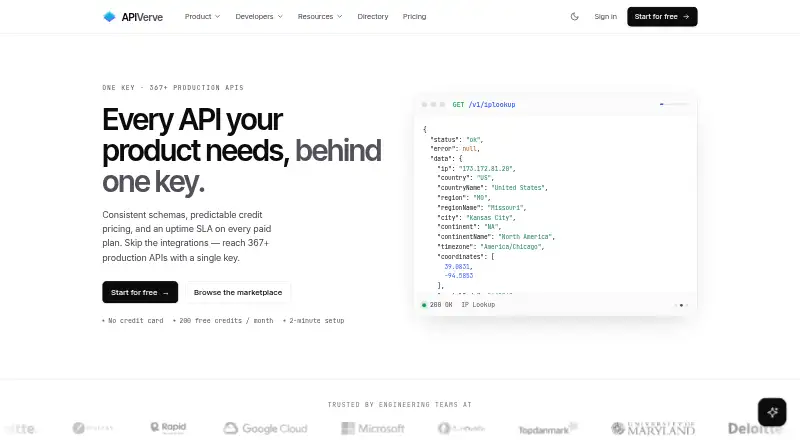
What APIVerve Website Readability API is
APIVerve Website Readability API analyzes a webpage and returns readability results, including eight scores and grade-level analysis. It accepts requests over HTTPS using POST at /v1/websitereadability. Calls use an API key in the x-api-key header; that key also works across APIVerve’s 300+ APIs. Results are available in JSON, XML, YAML, CSV, GraphQL, and MCP formats. The product page includes a live request tool that can be used without an API key, plus a snippet for embedding an interactive form without putting keys in the markup. VerveKit provides MCP agent access, while VerveSheets supports Google Sheets or Excel formulas. Listed developer and automation options include Zapier, Make, Power Automate, Pipedream, n8n, ViaSocket, Postman, and SDKs for Node.js, Python, and .NET. The service has a free plan and trial; paid plans start at $29.99 a month. Each API call uses 10 credits from the shared account pool.
Who it suits
It suits teams that need webpage readability scores in a website, spreadsheet, or automated workflow. The free plan is limited to 200 credits per month and non-commercial use.
What it does well
- Returns eight readability scores and grade-level analysis.
- Live request tool works without an API key.
- Supports six response formats, including JSON and CSV.
- Lists integrations, automation tools, and SDKs.
What to know first
- Each call costs 10 credits from the shared pool.
- Free plan allows 200 credits per month.
- Free plan is for non-commercial use and requires attribution.
Limits
The free plan includes 200 credits per month, allows 5 requests per minute, is for non-commercial use, and requires attribution. Each call consumes 10 credits from the shared account pool.
Plans
| Plan | Billed and limits | Price |
|---|---|---|
| Free | 200 credits / mo · 5 req/min · non-commercial use · attribution required · community support | Free |
| Starter | Billed monthly · 200,000 credits / mo · 60 req/min · commercial license · Zapier, Make & MCP access · email support | $29.99 a month |
| Mega | Billed monthly · 4,000,000 credits / mo · 10 team members · 25 scoped sub-keys · dedicated servers · 90-day audit history · priority support | $299.99 a month |
| Pro | Billed monthly · 1,000,000 credits / mo · 180 req/min · 3 team members · 5 scoped sub-keys · 10 embedded forms | $99.99 a month |
As apiverve.com lists them, read 7 Oct 2026. The maker's own page has the final word.
Getting started
- Visit the APIVerve Website Readability API page.
- Try a live request in the playground without an API key, or choose a plan.
- For API requests, send HTTPS POST to /v1/websitereadability with an API key in the x-api-key header.
- Use the returned results in a supported format or connect a listed integration or SDK.
APIVerve Website Readability API scores webpages and returns readability measures for use in software and automated workflows. It suits developers and teams that need repeatable checks rather than a standalone writing editor. Its multiple response formats and integrations are compelling, but 10-credit calls and the free plan’s non-commercial restriction matter when estimating cost and fit.
Overview
The service accepts webpage input through an HTTPS POST request to /v1/websitereadability. Requests use an API key in the x-api-key header, which also works across APIVerve’s 300+ APIs. Each call consumes 10 credits from a shared account pool, so other APIVerve usage can draw on the same allowance. That shared model is convenient for a broader API setup, but readability volume should be budgeted alongside other calls.
Responses support JSON, XML, YAML, CSV, GraphQL, and MCP access. A live request tool on the product page can be tried without an API key, and an embeddable interactive form can be added to a site without putting keys in the markup. These options make the service usable beyond a conventional API integration, while the supported input remains webpages.
Key features
The API returns eight readability scores and grade-level analysis. That gives teams several measures to work with in content checks, but it is not a general text-analysis endpoint: the input format is webpage. Bulk search has a limit of 200, and domain variations are not supported, which may constrain workflows built around alternate domain forms.
Integration coverage includes VerveKit for MCP agent access, VerveSheets formulas for Google Sheets or Excel, and automation through Zapier, Make, Power Automate, Pipedream, n8n, and ViaSocket. Postman and Node.js, Python, and .NET SDKs support developer workflows. The breadth is useful for teams with existing automation or spreadsheet processes; users who only need occasional manual scoring may not benefit from that flexibility.
APIVerve states a 99.9% uptime SLA and typical p50 latency of 1798 ms. It says traffic is protected with TLS 1.2+, stored data with AES-256, and API keys are hashed. Request and response content is processed in real time rather than retained, while usage logs are kept for 90 days.
Pricing
The Free plan costs free and includes 200 credits per month, 5 requests per minute, community support, and non-commercial use with attribution required. At 10 credits per call, the allowance supports up to 20 readability calls per month if all credits go to this API. It is suited to limited non-commercial evaluation, not a commercial deployment.
Starter costs $29.99 a month, billed monthly, and includes 200,000 credits per month, 60 requests per minute, a commercial license, Zapier, Make and MCP access, and email support. This is the entry paid tier for production use; compared with Free, it removes the non-commercial restriction and raises the call allowance substantially.
Pro costs $99.99 a month, billed monthly, for 1,000,000 credits per month and 180 requests per minute. It adds three team members, five scoped sub-keys, and 10 embedded forms, making it a better match for teams managing multiple integrations or forms. Mega costs $299.99 a month, billed monthly, and includes 4,000,000 credits per month, 10 team members, 25 scoped sub-keys, dedicated servers, 90-day audit history, and priority support. It is aimed at larger deployments needing higher allowances and team controls. All paid tiers bill monthly; the Free plan’s 200-credit cap is the sharpest practical constraint.
Platforms
The API is available on web and through API access. Its SDKs and integrations extend it into developer, spreadsheet, and automation workflows, but the service’s core analysis still takes a webpage as input.
Who it's for
This is a strong fit for developers, content teams, and businesses that need to score webpages repeatedly inside an application or automation. Starter is the sensible point of entry for commercial use; Pro or Mega make more sense when team membership, scoped keys, embedded forms, or larger monthly credit pools are important. It is a weaker fit for people seeking a standalone editor, arbitrary text analysis, or a free commercial service.
Pros and cons
- Pros: Six response options, grade-level analysis, and eight readability scores support varied programmatic workflows.
- Pros: A shared API key, no-key playground, and embeddable form lower friction for evaluation and deployment.
- Pros: Paid tiers provide a commercial license, with higher plans adding team controls, scoped keys, and dedicated servers.
- Cons: Each call costs 10 shared credits, so the free plan’s 200-credit monthly pool allows only 20 calls if used solely for readability.
- Cons: Free use is non-commercial and requires attribution, while the input is limited to webpages.
- Cons: Bulk search is capped at 200 and domain variations are unavailable.
Alternatives
For other options, see AI Readability Checkers.
- ToolsVale Readability Checker is a free alternative with broad desktop and mobile platform coverage; choose it when an API workflow is not the priority.
- Readability is a free MIT-licensed GitHub Action, CLI, and Docker image, better suited to teams that want an open-source tool in those formats.
- Eclipse Readability Studio is a free, open-source desktop option for Linux, macOS, or Windows.
- Readability Formulas offers free online readability tools and scoring, with extension and desktop platforms also listed.
- A2Z Tools Plain Language Analyzer is a free web tool for English-only analysis.
- PageRefine is a free web tool with no signup.
- ProfText offers a free API and web plan with 5,000 characters per analysis, 30 clarity rules, AI-generated text detection, and unlimited analyses; choose it when those text-focused checks suit the task better.
- Readability Analysis Tool (RAT) is a free GPLv3 open-source option for Linux and Windows that supports .docx and German readability rules.
Verdict
Choose APIVerve Website Readability API if your team needs webpage scoring inside software or automation and values multiple response formats and integrations. The commercial Starter plan makes the API usable beyond experimentation, but the 10-credit cost per call and shared pool are the key budget checks. Look elsewhere if you need arbitrary text input, free commercial use, or a standalone writing tool.
Verdict
The API combines webpage readability scoring with several response formats and workflow integrations. Check the credit allowance and plan terms against your expected volume and use.
Questions
Is there a free plan?
Yes. Free includes 200 credits per month, 5 requests per minute, non-commercial use, attribution, and community support.
What do paid plans cost?
Starter is $29.99 per month, Pro is $99.99 per month, and Mega is $299.99 per month.
How do API requests work?
Send an HTTPS POST request to /v1/websitereadability and provide an API key in the x-api-key header. Each request costs 10 credits from the shared pool.
Can I try it without an API key?
Yes. The product page offers a live request tool that can be tried without an API key.
What response formats are available?
The API supports JSON, XML, YAML, CSV, GraphQL, and MCP access.
What integrations and developer tools are listed?
The page names VerveKit, VerveSheets, Zapier, Make, Power Automate, Pipedream, n8n, ViaSocket, Postman, and SDKs for Node.js, Python, and .NET.
Facts from APIVerve Website Readability API's own pages
- Authentication
- Requests use an API key in the x-api-key header, and one key works across APIVerve’s 300+ APIs. · apiverve.com, 7 Oct 2026
- Automation and developer tools
- APIVerve lists Zapier, Make, Power Automate, Pipedream, n8n, ViaSocket, Postman, and SDKs for Node.js, Python, and .NET. · apiverve.com, 7 Oct 2026
- Availability
- The product page lists the API as online with a 99.9% uptime SLA and a typical p50 latency of 1798 ms. · apiverve.com, 7 Oct 2026
- Company
- EvlarSoft LLC identifies itself as the company behind APIVerve; its About page describes EvlarSoft as owner-operated but gives no founding year or headquarters. · evlarsoft.com, 7 Oct 2026
- Data handling
- APIVerve says it does not store API request or response content beyond real-time processing and keeps usage logs for 90 days. · apiverve.com, 7 Oct 2026
- Endpoint and method
- It uses POST at /v1/websitereadability over HTTPS. · apiverve.com, 7 Oct 2026
- Founded
- 2020 · apiverve.com, 28 Sept 2026
- Headquarters
- Lee's Summit, Missouri, United States · apiverve.com, 28 Sept 2026
- Integrations
- The product page names VerveKit for MCP agent access and VerveSheets for Google Sheets or Excel formulas. · apiverve.com, 7 Oct 2026
- Playground
- The product page offers a live request tool that can be tried without an API key. · apiverve.com, 7 Oct 2026
- Response formats
- The API supports JSON, XML, YAML, CSV, GraphQL, and MCP access. · apiverve.com, 7 Oct 2026
- Security
- APIVerve states that API traffic uses TLS 1.2+ and stored data uses AES-256, and that API keys are hashed rather than stored in plain text. · apiverve.com, 7 Oct 2026
- Support
- Support varies by plan: Free includes community support, Starter email support, and Mega priority support. · apiverve.com, 7 Oct 2026
- Usage limit
- Each call costs 10 credits from the account’s shared credit pool. · apiverve.com, 7 Oct 2026
- What it does
- The API analyzes a website and returns its readability score. · apiverve.com, 7 Oct 2026
- Zero-code embed
- APIVerve says users can embed an interactive form on a site with a snippet, without placing keys in the markup. · apiverve.com, 7 Oct 2026
Where APIVerve Website Readability API stands on Freedom251
- AI Readability Checkers#3 of 26