Freedom251 › Network Configuration Management Software
RANCID
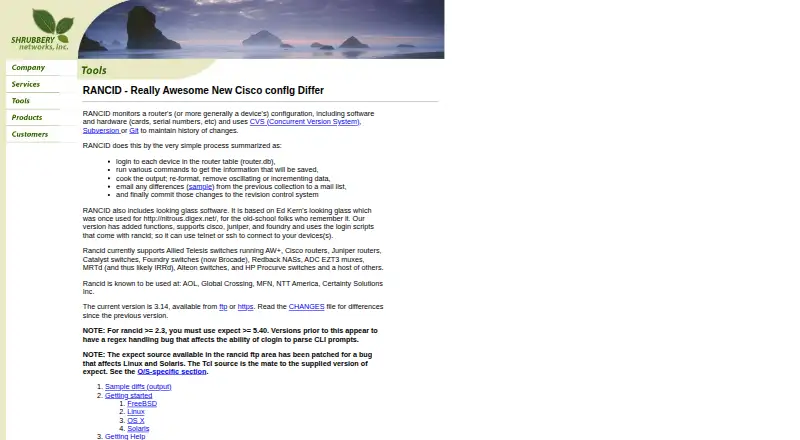
What RANCID is
RANCID monitors network-device configurations and keeps a version-controlled record of configuration and hardware or software history. It logs in to devices, runs commands, filters changing data that does not represent a meaningful configuration change, emails detected differences, and commits updates to a revision control system. The listed systems are CVS, Subversion, and Git. Login scripts can connect through Telnet or SSH, and the package includes looking-glass software for device access. The maker lists equipment support including Allied Telesis, Cisco, Juniper, Catalyst, Foundry/Brocade, Redback, ADC, Alteon, and HP Procurve, among others. RANCID is free and open source, with Linux, macOS, and self-hosted platforms listed. Its product page identifies version 3.14 as current. It has no GUI or web interface for configuration, though separate tools can display diffs and repositories. Setup instructions generally assume basic Unix and tool knowledge, and versions 2.3 and later require Expect 5.40 or later.
Who it suits
RANCID suits administrators who want configuration changes emailed and committed to version control for supported network devices. It is a better fit for people comfortable with Unix setup and device access permissions than those seeking a built-in configuration interface.
What it does well
- Emails detected configuration differences.
- Commits change history to CVS, Subversion, or Git.
- Connects to devices using Telnet or SSH.
- Lists support for a range of network-device makers.
What to know first
- No built-in GUI or web configuration interface.
- Setup instructions assume basic Unix and tool knowledge.
- Version 2.3 and later requires Expect 5.40 or later.
- Community device modules are not supported or tested by the maker.
Plans
| Plan | Billed and limits | Price |
|---|---|---|
| Free | No paid plans or usage limits stated | Free |
As shrubbery.net lists them, read 8 Oct 2026. The maker's own page has the final word.
Getting started
- Visit the RANCID product page and download the current release, version 3.14.
- Prepare an on-premises Linux or macOS environment.
- Install Expect version 5.40 or later for RANCID version 2.3 and later.
- Follow the distribution setup instructions, which assume basic Unix and tool knowledge.
- Provide permission to read device configurations and other data, then configure device login access and version control.
Overview
RANCID is an open-source tool for collecting network-device configurations and preserving their change history. It suits administrators who prefer Unix-based, command-oriented operations and want configuration changes recorded without a paid license.
Its strengths are a focused monitoring workflow and version-controlled history; the trade-off is that setup and day-to-day review lack a built-in configuration interface.
Key features
RANCID logs in to devices, runs commands, filters out values that change continuously or incrementally, emails detected differences, and commits updates to a revision-control system. CVS, Subversion, and Git are supported. This gives teams an audit trail and a way to compare configurations over time, though the workflow depends on email and repository tools rather than a product console.
It supports configuration backup, comparison, and scheduled backups, and runs on premises. Login scripts use Telnet or SSH; the included looking-glass software uses the same access methods. The maker identifies support for devices including Allied Telesis, Cisco, Juniper, Catalyst, Foundry/Brocade, Redback, ADC, Alteon, and HP Procurve, among others. Community modules may cover unsupported devices, but they are neither maintained nor tested by the maker.
RANCID has no GUI or web interface for configuration. Separate tools can display diffs and repositories, but teams must assemble that viewing workflow themselves. Device accounts need permission to read configurations and other data; TACACS+ can restrict the commands available to RANCID's user.
Pricing
Free: free. RANCID is open source, with no paid plans or usage limits stated. There is no free trial because the software is free. The license permits redistribution and use in source and binary forms subject to its conditions, and provides the software as is without express or implied warranties.
Platforms
RANCID is self-hosted and listed for Linux and macOS. The maker also provides getting-started links for FreeBSD and Solaris. Version 3.14 is identified as the current release. Version 2.3 and later requires Expect 5.40 or later, and the setup instructions generally assume basic Unix and tool knowledge.
Who it's for
RANCID is a good fit for network administrators who can manage Unix tools, device login permissions, and a version-control repository, and who mainly need reliable change capture and email alerts. It is a weaker fit for teams that want a built-in web console, vendor-supported extensions for every device, or a managed deployment.
Pros and cons
- Pros: Free, open-source software with no stated usage caps; preserves history in CVS, Subversion, or Git; emails configuration differences; supports backup, comparison, and scheduled backups.
- Cons: No configuration GUI or web interface; setup assumes Unix and tool knowledge; unsupported community modules lack maker support and testing; the software is provided without warranty.
Alternatives
ManageEngine Network Configuration Manager is worth considering for teams seeking broader platform availability, including web and mobile, or a free edition capped at two devices; it also offers a free trial.
Unimus suits smaller deployments that want a free allowance of 10 device licences and web access; its free plan excludes Compliance and SAML/OIDC.
Netpicker offers a free Foundation plan with unlimited devices for a single user, alongside Professional features for 10 devices.
Oxidized is another free, self-hosted option for Linux with API and web platforms.
rConfig may suit teams that want a no-device-limit, MIT-licensed Core edition, or a paid Starter plan with restore and deployment features for up to 300 devices.
Arista NG Firewall is a web-based freemium option focused on security and connectivity.
NetKeep is a free, self-hosted Linux server option for amd64 or arm64.
Gluware offers a renewable one-year Community Edition for up to 20 devices, with the application suite except Topology, plus community support and on-demand training.
Browse more options in Network Configuration Management Software.
Verdict
Choose RANCID if you need no-cost, on-premises configuration tracking and are comfortable with Unix administration, device command access, email alerts, and version control. Its focused history and change-notification workflow are compelling; look elsewhere if a built-in web interface or maker-supported coverage for additional device types is essential.
Verdict
RANCID provides a command-oriented workflow for tracking device configuration changes and retaining their history. Its lack of a built-in interface and Unix-oriented setup are important considerations.
Questions
How much does RANCID cost?
The Free plan is listed as free.
Is RANCID open source?
Yes. The maker lists it as open source, and its published license permits redistribution and use in source and binary forms subject to stated conditions.
Which platforms are listed?
The listed platforms include Linux, macOS and self-hosted. The site also provides getting-started links for FreeBSD and Solaris.
Does RANCID have a web interface?
No. The maker says it has no GUI or web interface for configuration. Separate tools can be used to view diffs and repositories.
Which version control systems does it support?
The product page lists CVS, Subversion and Git.
What does RANCID require to access devices?
It needs permission to read device configurations and other data. Its login scripts can connect using Telnet or SSH, and TACACS+ can restrict which commands its user may run.
Facts from RANCID's own pages
- Access permissions
- The FAQ says RANCID needs permission to read device configurations and other data, while TACACS+ can restrict which commands its user may run. · shrubbery.net, 8 Oct 2026
- Change alerts
- RANCID emails configuration differences to a mailing list and commits changes to a revision control system. · shrubbery.net, 8 Oct 2026
- Collection workflow
- It logs in to devices, runs commands, reformats output to remove oscillating or incrementing data, emails differences, and commits changes to version control. · shrubbery.net, 8 Oct 2026
- Company location
- Shrubbery Networks lists its address as 1111 NW 53rd Dr, Portland, Oregon 97210-1033, USA. · shrubbery.net, 8 Oct 2026
- Contributed modules
- Modules for unsupported devices in the contrib directory are not supported or tested by the maker. · shrubbery.net, 8 Oct 2026
- Current version
- The maker's page identifies version 3.14 as the current release. · shrubbery.net, 8 Oct 2026
- Device access
- RANCID's login scripts can connect to devices using telnet or SSH. · shrubbery.net, 8 Oct 2026
- Device support
- The maker lists support for devices including Allied Telesis, Cisco, Juniper, Catalyst, Foundry/Brocade, Redback, ADC, Alteon, and HP Procurve, plus others. · shrubbery.net, 8 Oct 2026
- Extra device modules
- Community modules for unsupported devices are available in the contrib directory, but the maker says it does not support or maintain them. · shrubbery.net, 8 Oct 2026
- Latest listed release
- The product page identifies version 3.14 as the current version and links to its download. · shrubbery.net, 8 Oct 2026
- License
- The published license permits redistribution and use in source and binary forms subject to its stated conditions. · shrubbery.net, 8 Oct 2026
- Looking glass
- RANCID includes looking-glass software that connects to devices using Telnet or SSH login scripts. · shrubbery.net, 8 Oct 2026
- Purpose
- RANCID monitors network-device configurations, records configuration and hardware/software history in a revision control system, and emails detected differences. · shrubbery.net, 8 Oct 2026
- Requirements
- The product page says RANCID version 2.3 and later requires Expect version 5.40 or later. · shrubbery.net, 8 Oct 2026
- Security and warranties
- The license provides the software 'as is' and disclaims express or implied warranties. · shrubbery.net, 8 Oct 2026
- Setup knowledge
- The maker says the distribution's setup instructions generally require or assume basic Unix and tool knowledge. · shrubbery.net, 8 Oct 2026
- Support
- The maker directs users to [email protected] and the rancid-announce and rancid-discuss mailing lists for problems, contributions, and suggestions. · shrubbery.net, 8 Oct 2026
- Supported operating systems
- The site provides getting-started links for FreeBSD, Linux, OS X, and Solaris. · shrubbery.net, 8 Oct 2026
- Version control
- The product page lists CVS, Subversion, and Git as supported systems for maintaining change history. · shrubbery.net, 8 Oct 2026
- Web interface
- The maker says RANCID has no GUI or web interface for configuration, though separate tools can be used to view diffs and repositories. · shrubbery.net, 8 Oct 2026
- Web interface limit
- The maker says RANCID has no GUI or web interface for configuration, though third-party tools can be used to view diffs and the repository. · shrubbery.net, 8 Oct 2026