Freedom251 › Identity Resolution Software
pyJedAI
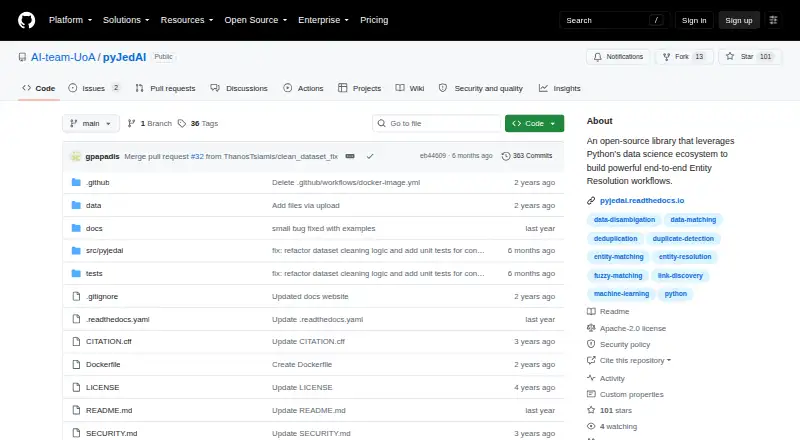
What pyJedAI is
pyJedAI is a free, open-source Python framework for creating end-to-end workflows that connect records and entities across data. It targets record linkage, entity resolution, and link discovery, and can process structured and semi-structured data. The framework includes multiple algorithms and supervised and unsupervised machine-learning techniques. Its blocking and matching methods can apply deep learning and NLP without requiring users to provide labeled instances. The project describes the framework as suitable for both expert and novice users; its package metadata also lists developers and science and research audiences. Installation options are pip, a Git checkout, or Docker. The README says it has been tested on Windows and Linux and requires Python 3.8 or later. On Windows, Microsoft Visual C++ 14.0 is also required. Integrations include NLTK, pandas, transformers, sentence-transformers, and FAISS CPU. pyJedAI uses the Apache-2.0 license and is listed as free, with no paid plans or usage limits stated.
Who it suits
It suits developers and researchers working on record linkage, entity resolution, or link discovery. The project identifies both expert and novice users as intended audiences.
What it does well
- Handles structured and semi-structured data.
- Includes supervised and unsupervised machine-learning techniques.
- Blocking and matching can use deep learning and NLP without supplied labels.
- Install through pip, Git checkout, or Docker.
- Free, with no paid plans or usage limits stated.
What to know first
- Requires Python 3.8 or later.
- Windows requires Microsoft Visual C++ 14.0.
- Security updates are listed for version 0.0.x.
Plans
| Plan | Billed and limits | Price |
|---|---|---|
| pyJedAI (open-source library) | No paid plans or usage limits stated | Free |
As github.com lists them, read 4 Oct 2026. The maker's own page has the final word.
Getting started
- Install through pip, a Git checkout, or Docker.
- Confirm that Python 3.8 or later is available.
- On Windows, provide Microsoft Visual C++ 14.0.
- Build a workflow for structured or semi-structured data using the framework's algorithms and methods.
pyJedAI is for people building record-linkage and entity-resolution workflows in Python. It is a strong fit for developers and research teams who want algorithmic flexibility without a software license fee, but not for readers looking for a ready-made interactive workflow builder.
Overview
The framework addresses record linkage, entity resolution, and link discovery across structured and semi-structured data. Its stated audience spans novice and expert users, though both need to work within a Python environment. That makes pyJedAI a practical choice for teams comfortable assembling technical workflows, rather than organizations seeking a turnkey application.
Key features
pyJedAI brings multiple algorithms together with supervised and unsupervised machine-learning methods. Its blocking and matching methods can use deep learning and natural language processing without user-provided labeled instances, a useful option when labeled examples are scarce. Supervised methods are also available, so teams with labeled data are not limited to that route.
It works with structured and semi-structured data and uses Python packages including NLTK, pandas, transformers, sentence-transformers, and FAISS CPU. Those integrations place it within a familiar data-science ecosystem, but also make it a better fit for technical users than anyone expecting a self-contained business application.
Installation is offered through pip, Git checkout, or Docker. The Apache-2.0 license makes the library free to use, and the project directs general questions to GitHub Discussions and bug reports to GitHub Issues. Its security policy supports version 0.0.x with security updates and asks users to report bugs through an issue.
Pricing
pyJedAI (open-source library): free. The open-source library has no paid plans or stated usage limits. This is a clear fit for individual developers, research groups, and teams that want to build their own resolution process without a software subscription. The trade-off is that the offering is a Python framework, not an interactive workflow service.
Platforms
pyJedAI is available for Linux and Windows, as well as self-hosted use. The project says it has been tested on Windows and Linux. It requires Python 3.8 or later; Windows users also need Microsoft Visual C++ 14.0. Check those prerequisites before choosing it, particularly if you are setting up a Windows environment.
Who it's for
Developers and science or research teams who want to build and adapt entity-resolution workflows in Python are the natural audience. Its supervised and unsupervised approaches, plus methods that do not require user-supplied labels, suit projects with different data-preparation constraints. Readers who want an interactive app rather than code should look elsewhere; the README points Java users to JedAI, which includes a web application for interactive workflow creation.
Pros and cons
- Pro: Multiple algorithms and supervised and unsupervised methods give technical teams options across record-linkage and entity-resolution tasks.
- Pro: Blocking and matching can use deep learning and NLP without requiring user-labeled instances, helping when labeled examples are unavailable.
- Pro: The Apache-2.0 library is free, with pip, Git checkout, and Docker installation paths.
- Con: A Python framework is not a turnkey interactive workflow builder, so teams wanting a graphical application will need another option.
- Con: Python 3.8 or later is required, and Windows adds a Microsoft Visual C++ 14.0 prerequisite.
Alternatives
Splink is another free, open-source Python package, with installation through pip or conda; consider it if that package and installation path better match your project.
InterSystems IRIS is a paid product with a free plan and free trial, and supports API, web, and self-hosted platforms; consider it if those platform options or its paid offering better suit your needs.
Hightouch offers a free plan with two active syncs per month, hourly syncs, and 100,000,000 operations per month; consider it if those sync allowances fit your use case.
Zingg offers an open-source Community plan for batch probabilistic matching across millions of records; consider it if those stated capabilities fit your workload.
AWS Entity Resolution is a paid service without a free plan; consider it if you specifically want a paid entity-resolution service.
Open Client Registry (OpenCR) is a free option with API, web, and self-hosted platforms; consider it if those platforms match your requirements.
Senzing Entity Resolution is a paid option with a free plan and trial; its listed 10M DSRs subscription is $58,560 a year. Consider it if that paid subscription is a better fit.
Treasure AI Composable CDP is a paid CDP with custom pricing and warehouse credits for query execution; consider it if you are looking for a composable CDP.
Browse more options in Identity Resolution Software.
Verdict
Choose pyJedAI if you want a free, open-source Python framework with a range of entity-resolution methods and the flexibility to build your own workflows. Look elsewhere if you need an interactive, ready-to-use application or cannot meet its Python and Windows prerequisites.
Verdict
pyJedAI brings entity-resolution workflows, algorithms, and machine-learning methods into a Python framework. Check its Python and Windows prerequisites, and note that the security policy lists version 0.0.x as supported for security updates.
Questions
Is pyJedAI free?
Yes. The listed open-source library plan is free, with no paid plans or usage limits stated.
What license does it use?
pyJedAI is released under the Apache-2.0 license.
Which operating systems are supported?
The README says it has been tested on Windows and Linux. The platform listing also includes self-hosted use.
What are the installation options?
The project provides installation through pip, a Git checkout, or Docker.
Which data-science integrations are included?
Listed packages include NLTK, pandas, transformers, sentence-transformers, and FAISS CPU.
Where can I ask questions or report a bug?
The project recommends GitHub Discussions for general questions and discussions, and GitHub Issues for bugs.
Facts from pyJedAI's own pages
- Algorithms
- It offers multiple algorithms and supervised and unsupervised machine learning techniques. · github.com, 4 Oct 2026
- Audience
- The project describes pyJedAI as intended for expert and novice users, and its package metadata lists developers and science/research audiences. · github.com, 4 Oct 2026
- Data types
- It can process structured and semi-structured data. · github.com, 4 Oct 2026
- Install
- The project provides installation through pip, Git checkout, or Docker. · github.com, 4 Oct 2026
- Integrations
- The project uses Python data-science and machine-learning packages, including NLTK, pandas, transformers, sentence-transformers, and FAISS CPU. · github.com, 4 Oct 2026
- Learning methods
- The project says its blocking and matching methods can use deep learning and NLP techniques without requiring labeled instances from the user. · github.com, 4 Oct 2026
- License
- pyJedAI is released under the Apache-2.0 license. · github.com, 4 Oct 2026
- Operating systems
- The README says pyJedAI has been tested on Windows and Linux. · github.com, 4 Oct 2026
- Problem types
- The framework targets record linkage, entity resolution, and link discovery problems. · github.com, 4 Oct 2026
- Purpose
- pyJedAI is an open-source Python framework for building end-to-end entity resolution workflows. · github.com, 4 Oct 2026
- Related web app
- The README points Java users to JedAI, which includes a web application for interactive creation of entity-resolution workflows. · github.com, 4 Oct 2026
- Requirements
- The README lists Python 3.8 or later and says Windows requires Microsoft Visual C++ 14.0. · github.com, 4 Oct 2026
- Security policy
- The security policy lists version 0.0.x as supported with security updates and directs users to open an issue to report a bug. · github.com, 4 Oct 2026
- Support
- The project recommends GitHub Discussions for general questions and discussions and GitHub Issues for bugs. · github.com, 4 Oct 2026
Where pyJedAI stands on Freedom251
- Identity Resolution Software#5 of 25