Freedom251 › Enterprise Service Bus Software
InterSystems IRIS
What InterSystems IRIS is
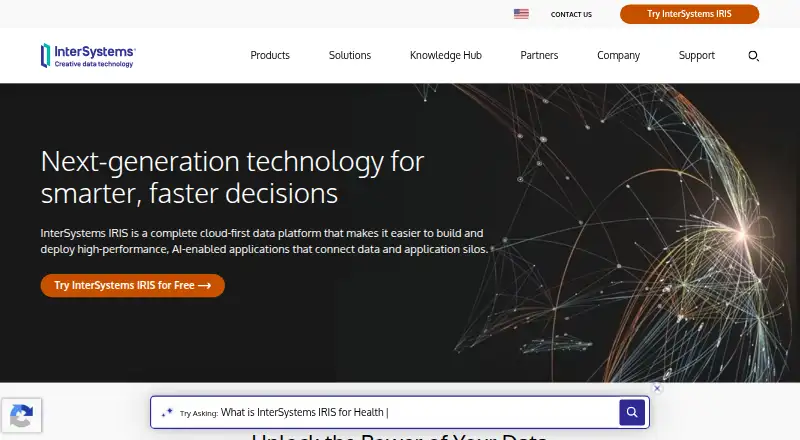
InterSystems IRIS is a cloud-first data platform for building and deploying applications that connect data and application silos. One DBMS engine combines SQL and NoSQL database management with transactions and concurrent analytics. Its capabilities include semantic search, retrieval-augmented generation, generative AI, machine learning, business rules, BI and NLP. For interoperability, it provides API management, low-code business-process orchestration, workflow and adapters for SQL, SOAP, REST, HTTP, FTP, SAP, TCP, LDAP and email. Built-in APIs support Java, .NET, JavaScript and Python, with JSON and XML among its data formats. Deployment options include public and private clouds, on-premises, hybrid, bare metal and virtual machines. Security features include authentication, role- and data-level authorization, encryption and tamper-proof auditing; availability and disaster-recovery options include clustering and database mirroring. Community Edition is free for evaluation and testing, but its built-in license expires one year after that product version's release. Paid pricing is available on request. InterSystems says its products receive multilingual, engineering-level 24/7 support.
Who it suits
InterSystems IRIS is positioned for data-intensive, mission-critical applications that need database, analytics and interoperability capabilities. It may suit organizations connecting data across cloud, on-premises or hybrid environments.
What it does well
- SQL and NoSQL, transactions and analytics share one engine.
- Supports semantic search, generative AI, ML, BI and NLP.
- Deployment options include public cloud and on-premises.
- Security includes encryption and row- or column-level authorization.
- Engineering-level multilingual support is available 24/7.
What to know first
- Paid pricing is available on request.
- Community Edition is intended for evaluation and testing.
- Community Edition license expires one year after its version's release.
- AWS infrastructure costs may apply to the free edition.
Limits
Community Edition is free for evaluation and testing, and its built-in license expires one year after that product version's release date. AWS infrastructure costs may apply.
Plans
| Plan | Billed and limits | Price |
|---|---|---|
| InterSystems IRIS Community Edition | $0.00; free of charge · AWS infrastructure costs may apply · no end date | Free |
| InterSystems IRIS | per-vCPU-hour; contact [email protected] · Pricing published through AWS and Azure marketplaces | On request |
As intersystems.com lists them, read 1 Oct 2026. The maker's own page has the final word.
Getting started
- Visit the InterSystems IRIS website.
- Choose Community Edition for free evaluation, or contact sales for paid pricing.
- Select a deployment option, such as AWS, Azure, another listed cloud, or an on-premises environment.
- Use the supported APIs and data formats to connect applications and data sources.
Overview
InterSystems IRIS is a broad data platform for organizations building applications that must connect databases, services and analytics. It suits teams with demanding, data-intensive workloads; its breadth is a strength, but buyers should expect to weigh a custom-priced platform against narrower tools.
InterSystems reports thousands of production implementations across more than 80 countries and positions IRIS for mission-critical applications. The privately held company was founded in 1978 and is headquartered in Boston.
Key features
Database, analytics and AI
IRIS combines SQL and NoSQL management, transaction processing and concurrent analytics in one database engine. Keeping those workloads together can suit applications that need both transactional data and analysis, while the range may be more than teams seeking only a straightforward relational database require. Semantic search, retrieval-augmented generation, generative AI, machine learning, business intelligence, natural-language processing and business rules extend the platform into application intelligence.
A data catalog, governance controls, hybrid matching, JSON support and API access add data-management breadth. Both batch and real-time delivery are supported, including batch file import and real-time APIs, giving teams options for different data flows.
Integration and connectivity
API management, low-code business-process orchestration, workflow and business rules are paired with adapters for SQL, SOAP, REST, HTTP, FTP, SAP, TCP, LDAP and email. That reach is useful when an application must coordinate with varied systems; organizations with a small, uniform stack may not need such extensive integration coverage. Built-in APIs for Java, .NET, JavaScript and Python, plus JSON and XML formats, support development across common application languages and data formats.
Deployment, security and resilience
Deployment spans AWS, Microsoft Azure, Google Cloud Platform, Tencent Cloud, private clouds, on-premises and hybrid environments, as well as bare metal and virtual machines. Managed cloud offerings include Cloud SQL and Cloud IntegratedML as cloud-native SaaS, with managed services also running in AWS and Azure. This range favors organizations that need deployment flexibility, though choosing among those models adds decisions that a single-hosted service avoids.
Security options include LDAP, Kerberos, direct passwords, OpenAM, OpenID and two-factor authentication, alongside role-based and row- or column-level authorization, encryption at rest and in motion, and tamper-proof auditing. Clustering, virtualization high availability and database mirroring with near-real-time synchronization support continuity and recovery needs. InterSystems' Worldwide Response Center provides multilingual, engineering-level support around the clock for its products.
Pricing
InterSystems IRIS Community Edition: free. It is intended for evaluation and testing, not an unrestricted production substitute: its built-in license expires one year after that product version's release date. AWS infrastructure costs may apply, and the plan is described as having no end date, which does not remove the version-based license expiry.
InterSystems IRIS: custom pricing, billed per vCPU-hour. Buyers contact [email protected]; pricing is published through AWS and Azure marketplaces. This usage-based structure makes the production option relevant to teams ready to scope deployment and consumption with the vendor, rather than buyers looking for a simple fixed subscription. No seat or usage quota is stated.
Platforms
IRIS supports API, Linux, macOS, self-hosted, web and Windows environments. The current server release supports Windows, AIX, Oracle Linux, Red Hat Enterprise Linux, SUSE Linux and Ubuntu; macOS is supported for development. Its cloud, on-premises and hybrid deployment choices accommodate varied infrastructure strategies, but macOS should be understood as a development platform rather than a listed server target.
Who it's for
IRIS is best suited to organizations building data-intensive or mission-critical applications that need database management, integration, analytics and AI in a coordinated platform. Its workflow scope is end-to-end, and it supports data cataloging, governance, eligibility verification, payment posting, patient collections and revenue analytics. Those functions make it relevant to healthcare and revenue-cycle workloads as well as broader connected-data applications. Teams wanting only a focused database or a no-cost production platform should look elsewhere.
Pros and cons
- Broad workload coverage: SQL and NoSQL, transactions, analytics and AI share one platform, useful for applications spanning operational and analytical work.
- Wide integration reach: adapters, orchestration and language APIs can connect diverse systems, though that breadth may exceed simpler projects' needs.
- Flexible deployment and resilience: cloud, hybrid and on-premises options combine with clustering and mirroring for organizations with continuity requirements.
- Production cost is harder to compare: per-vCPU-hour custom pricing requires vendor contact, while Community Edition is time-limited by version and intended for evaluation.
- Platform distinctions matter: macOS is supported for development, while the current server release targets other operating systems.
Alternatives
For identity resolution specifically, Splink is a free, open-source Python package installable through pip or conda, with Linux, macOS, Windows and self-hosted support; choose it when that focused, free package fits better than a wider data platform. Hightouch offers a free tier with two active syncs per month, hourly syncs and 100,000,000 operations per month, which may suit teams seeking a defined free sync allowance rather than IRIS's broader platform.
Zingg Community is a free open-source batch option with probabilistic matching for millions of records; its Enterprise plan adds batch and real-time capabilities at custom pricing. It is a more focused choice for matching workloads. Treasure AI Composable CDP is a paid alternative with custom pricing and warehouse credits for query execution, appropriate when a composable CDP is the target.
Quantexa Entity Resolution, LiveRamp RampID, Open Client Registry (OpenCR) and Precisely Data Matching and Entity Resolution are also alternatives to consider.
For broader category browsing, see Identity Resolution Software, Healthcare Provider Directories, Revenue Cycle Management Software, Data Fabric Software, Relational Databases and Multimodel Databases.
Verdict
Choose InterSystems IRIS when your organization needs a single platform spanning connected data, application integration, analytics and mission-critical deployment options. Its strongest case is breadth paired with operational resilience; the main reason to look elsewhere is that custom per-vCPU-hour pricing and the platform's scope may be a poor fit for focused or budget-transparent projects.
Verdict
InterSystems IRIS combines database, analytics, integration and deployment capabilities for complex application environments. Community Edition is an evaluation option with a time-limited license; paid pricing requires a request.
Questions
What does InterSystems IRIS cost?
Community Edition is free of charge. Paid InterSystems IRIS pricing is available on request and is billed per vCPU-hour; pricing is published through AWS and Azure marketplaces.
Is there a free plan or trial?
Yes. Community Edition is free, and a free trial is listed. The Community Edition license expires one year after the product version's release date.
Where can InterSystems IRIS run?
Deployment options include AWS, Microsoft Azure, Google Cloud Platform, Tencent Cloud, private clouds, on-premises, hybrid, bare metal, and virtual machines. Current server platforms include Windows and several Linux distributions; macOS is supported for development.
Which programming languages and formats does it support?
Built-in APIs support Java, .NET, JavaScript, and Python. Standard data formats include JSON and XML.
Who makes InterSystems IRIS?
InterSystems IRIS is made by InterSystems, a privately held company headquartered in Boston, Massachusetts, USA, and founded in 1978.
What support is available?
InterSystems' Worldwide Response Center provides engineering-level, multilingual, 24/7 support for InterSystems products.
Facts from InterSystems IRIS's own pages
- AI and analytics
- InterSystems IRIS supports semantic search, retrieval-augmented generation, generative AI, machine learning, business rules, BI and NLP. · intersystems.com, 1 Oct 2026
- Audience
- InterSystems IRIS is used in thousands of production implementations across more than 80 countries and is positioned for data-intensive, mission-critical applications. · intersystems.com, 1 Oct 2026
- Cloud services
- InterSystems IRIS Cloud SQL and Cloud IntegratedML are fully managed cloud-native SaaS offerings, while managed services run in AWS and Azure. · intersystems.com, 1 Oct 2026
- Community limits
- Community Edition has a free built-in license that expires one year after the product version's release date and is intended for evaluation and testing. · irisdocs.intersystems.com, 1 Oct 2026
- Company ownership
- InterSystems has been privately held since its founding in 1978. · intersystems.com, 1 Oct 2026
- Connectivity
- Built-in APIs support Java, .NET, JavaScript and Python, and standard data formats include JSON and XML. · intersystems.com, 1 Oct 2026
- Database
- It combines SQL and NoSQL database management with transactions and concurrent analytics in a single DBMS engine. · intersystems.com, 1 Oct 2026
- Deployment
- Deployment options include AWS, Microsoft Azure, Google Cloud Platform, Tencent Cloud, private clouds, on premises, hybrid, bare metal and virtual machines. · intersystems.com, 1 Oct 2026
- Founded
- 1978 · intersystems.com, 28 Sept 2026
- Free plan
- No · intersystems.com, 22 Sept 2026
- Headquarters
- Boston, Massachusetts, USA · intersystems.com, 28 Sept 2026
- Interoperability
- It provides API management, low-code business-process orchestration, workflow, business rules and adapters for SQL, SOAP, REST, HTTP, FTP, SAP, TCP, LDAP and email. · intersystems.com, 1 Oct 2026
- Product type
- InterSystems IRIS is a complete cloud-first data platform for building and deploying high-performance, AI-enabled applications that connect data and application silos. · intersystems.com, 1 Oct 2026
- Reliability
- High-availability and disaster-recovery options include clustering, virtualization high availability and database mirroring with near-real-time synchronization. · intersystems.com, 1 Oct 2026
- Security
- Security features include LDAP, Kerberos, direct passwords, OpenAM, OpenID, two-factor authentication, role-based and row or column-level authorization, encryption at rest and in motion, and tamper-proof auditing. · intersystems.com, 1 Oct 2026
- Support
- InterSystems' Worldwide Response Center provides engineering-level, multilingual 24/7 support for all InterSystems products. · intersystems.com, 1 Oct 2026
- Supported platforms
- The current release supports server platforms including Windows, AIX, Oracle Linux, Red Hat Enterprise Linux, SUSE Linux and Ubuntu, with macOS supported for development. · docs.intersystems.com, 1 Oct 2026
Where InterSystems IRIS stands on Freedom251
- Enterprise Service Bus Software#3 of 13
- Relational Databases#11 of 38
- Multimodel Databases#10 of 26
- Database Software#32 of 74