Freedom251 › Identity Resolution Software
Senzing Entity Resolution
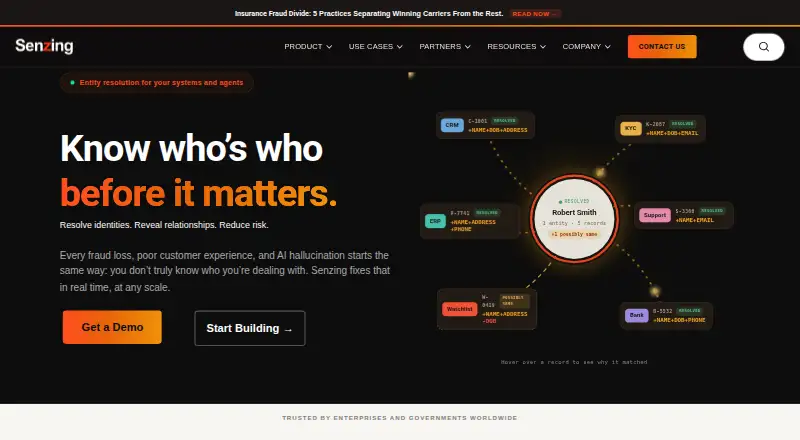
What Senzing Entity Resolution is
Senzing Entity Resolution turns fragmented records into entities and identifies relationships among them for fraud, compliance, and AI systems. The maker describes its engine as real-time, self-tuning, self-correcting, and relationship-aware, without custom training or tuning. It says the engine starts in under one second and scales from tens to billions of records within a customer's infrastructure.
Resolution decisions can include an audit trail explaining why records matched, which features were involved, and a confidence score. Senzing says the software runs within the customer's infrastructure and data does not flow to the company. Deployment options include bare metal, Docker, Kubernetes, private cloud, AWS, Azure, and air-gapped environments. Listed integrations include Python, Java, C#, Rust, Node.js, and an MCP server. The SDK download includes a free license for 500 source records; the AWS Marketplace free trial covers 250,000. Paid subscriptions include support. A listed plan costs $58,560 a year for 10M DSRs, based on upfront payment for the full term.
Who it suits
It suits organizations resolving records for fraud, compliance, or AI systems, including those in financial services, healthcare, public sector, insurance, and technology. It can be deployed within customer infrastructure, including air-gapped environments.
What it does well
- Audit trails include match explanations and confidence scores.
- Runs in customer infrastructure, with data not flowing to Senzing.
- Deployment options include air-gapped environments.
- SDK evaluation license covers 500 source records.
- AWS Marketplace free trial covers 250,000 source records.
What to know first
- SDK free license covers only 500 source records.
- Trying more than 500 SDK records requires an evaluation license.
- Listed 10M DSRs plan costs $58,560 a year.
Limits
The SDK download’s free license covers 500 source records; an evaluation license is needed to try more. The AWS Marketplace free trial covers 250,000 source records. The listed 10M DSR subscription costs $58,560 a year, billed annually with upfront payment for the full term.
Plans
| Plan | Billed and limits | Price |
|---|---|---|
| Senzing Subscription Pricing — 10M DSRs | $58,560 per year; prices are based on upfront payment for the full term. · 10M DSRs · support included at no additional charge | $58,560 a year |
As senzing.com lists them, read 4 Oct 2026. The maker's own page has the final word.
Getting started
- Visit the Senzing website
- Choose an available deployment route, such as Docker, Kubernetes, cloud or air-gapped deployment
- Download the SDK to use its free 500-source-record evaluation license
- Obtain an evaluation license to try more than 500 SDK records
- Consider the AWS Marketplace free trial for its 250,000-source-record license
- Connect applications using a listed language, the MCP server or marketplace access
Senzing Entity Resolution connects fragmented records into unified entities and maps relationships among them for fraud, compliance and AI workloads. It is best suited to organizations handling sensitive data that need explainable matching inside their own infrastructure. The main attraction is relationship-aware, real-time resolution without custom model training; the main reservation is the substantial annual subscription commitment.
Overview
Senzing is designed to determine when records refer to the same person, organization or other entity, then expose links between those entities. The engine is described as self-tuning and self-correcting, so teams do not have to create custom training or tuning routines before deploying it. That is a practical advantage for groups that want a working resolution layer without assembling a machine-learning project around it.
Results can include an audit trail explaining why records matched, which features contributed and the confidence score assigned. Those explanations make matches easier to review in compliance investigations and operational workflows than an unexplained yes-or-no output. Senzing also says processing remains in the customer’s infrastructure and data does not flow to Senzing, Inc., an important distinction for regulated or confidential datasets.
Key features
- Entity and relationship resolution: The engine resolves records into entities while revealing relationships between them. That combination is more useful for fraud and network analysis than deduplication alone. Fuzzy matching handles non-identical data, while duplicate prevention helps stop repeated records from entering downstream systems.
- Real-time operation: Senzing processes JSON requests and responses in real time and says the engine boots in under one second. This suits applications and AI agents that need decisions during a workflow rather than a later batch run.
- Broad scale: The maker says the engine scales from tens to billions of records within the customer’s infrastructure. That range gives small evaluations and very large deployments a common architecture, although the subscription tier supplied here is specifically sized at 10 million DSRs.
- Developer access: APIs and integrations for Python, Java, C#, Rust and Node.js, plus an MCP server, let teams connect the engine to software and AI agents in their existing stacks.
- Auditable decisions: Match reasoning, contributing features and confidence scores are available in the decision trail. This supports human review and evidence requirements instead of forcing users to trust an opaque result.
Pricing
The published subscription is $58,560 a year, billed $58,560 per year and paid upfront for the full term, for the 10M DSRs plan. Support is included at no additional charge. This is a fit for an organization with a substantial, defined record-resolution workload and budget for an annual commitment; it is harder to justify for a small team still validating its data or volume.
Senzing does provide ways to evaluate the engine before committing. The SDK download includes a free license for 500 source records, while trying more than 500 requires an evaluation license. The AWS Marketplace free trial raises that allowance to 250,000 source records. These caps are useful for a proof of concept, but they are not a continuing production free tier. The product is therefore best assessed against a representative sample before purchasing the paid term.
Platforms
Deployment can be on bare metal, Docker, Kubernetes, private cloud, AWS, Azure or an air-gapped environment. Senzing supports API, web, Linux, macOS, Windows and self-hosted use, giving infrastructure teams considerable control over where processing occurs. The v4 requirements name Amazon Linux, Debian, macOS on Apple Silicon, Red Hat, Ubuntu LTS and Windows x86-64. Supported databases include AWS Aurora PostgreSQL, AWS RDS for PostgreSQL, Azure SQL, Microsoft SQL Server, MySQL, Oracle, PostgreSQL and SQLite, with record-count notes applying to MySQL and SQLite.
Who it's for
The product targets financial services, healthcare, public sector, insurance, technology and agentic AI. It is a strong choice where privacy, explainability and relationship analysis matter together: for example, compliance teams tracing connected entities or fraud systems needing a real-time decision with defensible reasoning. Teams wanting only occasional file cleanup, a hosted email verifier or a low-cost open-source batch tool should look elsewhere.
Pros and cons
- Pros: Relationship mapping goes beyond simple deduplication; self-tuning and self-correcting behavior reduces the need to build matching models; audit trails and confidence scores support review; processing stays inside the customer’s infrastructure; deployment spans air-gapped systems, containers and major clouds; paid support is included.
- Cons: The stated subscription requires $58,560 upfront for a year; the supplied tier is capped at 10M DSRs; the SDK evaluation license covers only 500 source records unless an evaluation license is obtained; the AWS trial’s 250,000-record allowance is temporary rather than a permanent free plan.
Alternatives
For broader data-quality tooling and a free address-focused entry point, consider Melissa Data Quality, whose GAV Free plan costs nothing and allows 250 records per month. Paribus 365 is the better fit when a no-cost Windows or web search tool with unlimited users and up to 100K records is enough. Choose Yugandhar Open MDM Hub when a completely free Apache 2.0 MDM option matters more than Senzing’s commercial support model.
ZeroBounce is aimed at email verification, with 100 free monthly verifications and pay-as-you-go purchases, rather than entity resolution. OpenDQ offers a zero-license-cost data-quality platform, with external enrichment subscription-based. Pick Zingg for open-source probabilistic batch matching across millions of records, or its enterprise edition for batch and real-time use. Byteplant Data Validation suits one-time address-validation purchases whose credits do not expire. Workbooks is a CRM alternative with a 30-day trial and CRM subscriptions, not a dedicated entity-resolution engine.
For category browsing, see Customer Data Quality Software, Identity Resolution Software and Data Deduplication Software.
Verdict
Choose Senzing when your organization needs real-time, relationship-aware entity resolution with explainable decisions and strict control over where data runs. Look elsewhere if your requirement is a small-volume, low-cost cleanup tool or an open-source batch workflow; the annual upfront subscription is the decisive drawback.
Verdict
Senzing combines record resolution with relationship mapping and decision audit trails, with deployment options ranging from local infrastructure to major cloud environments. The listed 10M DSRs subscription costs $58,560 a year, paid upfront for the full term.
Questions
Does Senzing have a free plan or trial?
The SDK download includes a free license for 500 source records. The AWS Marketplace free trial includes a license for 250,000 source records.
What does the listed subscription cost?
The Senzing Subscription Pricing — 10M DSRs plan is $58,560 a year, with upfront payment for the full term.
Where does Senzing process customer data?
Senzing says its software runs in the customer’s infrastructure and data does not flow to Senzing, Inc.
Which platforms and operating systems are supported?
Listed platforms include API, Linux, macOS, self-hosted, web and Windows. The v4 operating system list includes Amazon Linux, Debian, macOS on Apple Silicon, Red Hat, Ubuntu LTS and Windows x86-64.
How can developers connect to Senzing?
Listed options include Python, Java, C#, Rust, Node.js and an MCP server. It is also available through AWS Marketplace and Microsoft Marketplace.
Is support included with paid subscriptions?
Yes. Senzing says support is included with paid subscriptions at no additional charge.
Facts from Senzing Entity Resolution's own pages
- AWS trial limit
- The AWS Marketplace free trial provides a free license for 250,000 source records. · senzing.com, 4 Oct 2026
- Cloud marketplaces
- Senzing is available through AWS Marketplace and Microsoft Marketplace and processes JSON requests and responses in real time. · senzing.com, 4 Oct 2026
- Data privacy
- Senzing says its software runs in the customer’s infrastructure and data does not flow to Senzing, Inc. · senzing.com, 4 Oct 2026
- Deployment
- The maker lists bare metal, Docker, Kubernetes, private cloud, AWS, Azure, and air-gapped deployment options. · senzing.com, 4 Oct 2026
- Evaluation license
- The SDK download includes a free license for 500 source records, and the maker says an evaluation license is needed to try more than 500 records. · senzing.com, 4 Oct 2026
- Explainability
- The homepage says resolution decisions include an audit trail showing why records matched, the features involved, and a confidence score. · senzing.com, 4 Oct 2026
- Founded
- 2017 · senzing.com, 28 Sept 2026
- Integrations
- Senzing lists Python, Java, C#, Rust, Node.js, and an MCP server for connecting the engine to applications and AI agents. · senzing.com, 4 Oct 2026
- Purpose
- Senzing resolves fragmented records into entities and reveals relationships between them for fraud, compliance, and AI systems. · senzing.com, 4 Oct 2026
- Resolution
- The engine is described as real-time, self-tuning, self-correcting, and relationship-aware, without requiring custom training or tuning. · senzing.com, 4 Oct 2026
- Scale and speed
- Senzing says the engine boots in under one second and scales from tens to billions of records inside the customer’s infrastructure. · senzing.com, 4 Oct 2026
- Support
- Senzing says support is included with paid subscriptions at no additional charge and is free. · senzing.com, 4 Oct 2026
- Supported databases
- The v4 requirements list AWS Aurora PostgreSQL, AWS RDS for PostgreSQL, Azure SQL, Microsoft SQL Server, MySQL, Oracle, PostgreSQL, and SQLite, with record-count notes for MySQL and SQLite. · senzing.com, 4 Oct 2026
- Supported operating systems
- The v4 requirements list Amazon Linux, Debian, macOS on Apple Silicon, Red Hat, Ubuntu LTS, and Windows x86-64. · senzing.com, 4 Oct 2026
- Who it serves
- The maker describes use across financial services, healthcare, public sector, insurance, technology, and agentic AI. · senzing.com, 4 Oct 2026
Where Senzing Entity Resolution stands on Freedom251
- Identity Resolution Software#6 of 25
- Customer Data Quality Software#7 of 27
- Data Deduplication Software#7 of 27