Freedom251 › Customer Data Quality Software
Yugandhar Open MDM Hub
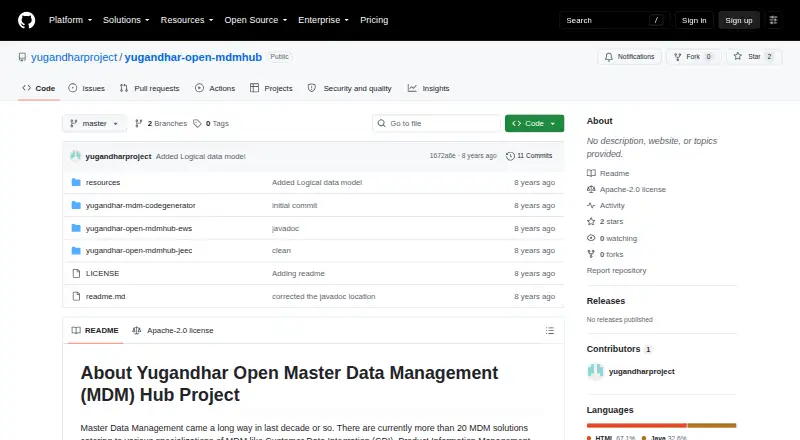
What Yugandhar Open MDM Hub is
Yugandhar Open MDM Hub is a free hub for integrating and harmonizing customer master data. Its extendable data model covers people, organizations, accounts, addresses, phone numbers, identifiers, relationships, vehicles, preferences, and properties. The project describes more than 450 prebuilt services, including 50+ composite services and 400 base table services. RESTful and message-queue interfaces connect the hub with other systems, while embedded validations, business rules, and match-and-merge support data quality and deduplication. MariaDB and Oracle are preconfigured; the project says it can be extended for MySQL, DB2, NoSQL, and PostgreSQL. Listed components include ActiveMQ, JTA, ORM, Spring Boot, Hibernate, JBoss, and Maven. User- and role-based authorization and row-level audit history support access control and transaction tracking. It also includes multilingual reference data, event management, pagination, and JSR 107-compliant Ehcache. It can run with an embedded Spring Boot web server or in a JEE container. Production hosting supports most Linux distributions; documented requirements include Java JDK 1.8 and a supported database.
Who it suits
It suits teams building customer master-data integration and harmonization workflows, particularly those using Linux and the listed Java and database options. It is free under the Apache 2.0 license.
What it does well
- Free under the Apache 2.0 license
- More than 450 prebuilt services
- Includes validation and match-and-merge capabilities
- Provides role-based authorization and row-level audit history
What to know first
- Production requirements include Java JDK 1.8
- GitHub releases page lists no published releases
- Production database options specify MariaDB or Oracle
Limits
Production requirements include Java JDK 1.8 and MariaDB 10.3 or later or Oracle. The JEE deployment option specifies JBoss EAP 7.1 or later.
Plans
| Plan | Billed and limits | Price |
|---|---|---|
| Free | completely free · Apache 2.0 license | Free |
As github.com lists them, read 14 Oct 2026. The maker's own page has the final word.
Getting started
- Open the project repository and review its linked project documentation.
- Choose an embedded Spring Boot web server such as Tomcat or a JEE container such as Red Hat JBoss.
- Prepare Java JDK 1.8 and MariaDB 10.3 or later, or Oracle.
- For the JEE option, use JBoss EAP 7.1 or later.
- Host on a Linux distribution; CentOS and Ubuntu are listed as tested.
Yugandhar Open MDM Hub is a free, self-hosted system for integrating and harmonizing customer master data. It is best suited to teams with Java and database skills that need a flexible customer record model. Its breadth and open-source license are strong draws; its production stack calls for careful planning.
Overview
This hub focuses on bringing customer records into a shared structure, rather than managing customer relationships as a general-purpose CRM. Its extendable model spans people, organizations, accounts, addresses, phone numbers, identifiers, relationships, vehicles, preferences, and properties. That range gives integration teams a substantial starting point, though they will need to adapt the model and run the service themselves.
REST and message-queue interfaces, embedded validation, business rules, deduplication, and match-and-merge address common integration and data-quality needs. More than 450 prebuilt services offer useful building blocks, including over 50 composite services and 400 base table services. The main tradeoff is deployment: production requirements include Java JDK 1.8 and MariaDB 10.3 or later or Oracle, and the project has no published GitHub releases.
Key features
- Extendable customer data model: It covers varied customer entities and their relationships, which can suit organizations consolidating records that do not fit a simple contact schema. Teams must still shape it around their own data.
- Service interfaces: REST and MQ access, plus the large set of prebuilt services, provide multiple ways to connect applications and build composite operations. This is most useful to teams comfortable working with APIs and the Java ecosystem.
- Data quality and audit: Validations, business rules, and match-and-merge support consistency and duplicate handling. Role-based authorization and row-level transaction history help control access and trace changes.
- Integration and operations: MariaDB and Oracle are preconfigured, with potential extensions for MySQL, DB2, NoSQL, and PostgreSQL. ActiveMQ, JTA, ORM, Spring Boot, Hibernate, JBoss, and Maven integrations fit established Java environments, but also make the technical profile specific.
- Additional capabilities: Multilingual reference data, event management, pagination, and JSR 107 compliant Ehcache caching round out the hub for retrieval and operational workflows.
Pricing
The Free plan costs nothing and is completely free under the Apache 2.0 license. That removes license fees for teams prepared to host and maintain the system. No paid plan is given; organizations needing a different commercial arrangement should expect custom pricing rather than a published tier.
The free offer is a better fit for technically capable teams that can provide their own Linux hosting and database operations than for buyers seeking a managed service. The project links documentation, Javadoc, and database docs and provides an email contact for questions and contributions.
Platforms
The hub supports API access, Linux, self-hosted deployment, and web use. It can run with an embedded Spring Boot web server such as Tomcat or in a JEE container such as Red Hat JBoss. Production hosting is described for most Linux distributions, with CentOS and Ubuntu tested. The documented production stack specifies Java JDK 1.8 and MariaDB 10.3 or later or Oracle; JEE deployments specify JBoss EAP 7.1 or later. Those requirements give infrastructure teams a concrete basis for planning, but they may constrain organizations standardizing on newer runtimes.
Who it's for
Yugandhar Open MDM Hub fits teams consolidating customer data across applications, especially when their records include more than people and contact details and they need deduplication, validation, or change history. Its Apache 2.0 license and broad Java integrations suit organizations with developers and operators able to own deployment and adaptation. Teams seeking a hosted product, a modernized runtime profile, or a release stream on GitHub should weigh those needs before adopting it.
Pros and cons
- Pros: A broad, extendable customer model can represent varied entities; more than 450 services and REST/MQ interfaces provide integration building blocks; validation, matching, and audit features address data quality and traceability; the Apache 2.0 plan has no license cost.
- Cons: Self-hosting places deployment and database operations on the buyer; Java JDK 1.8 is part of the documented production requirements; the GitHub releases page has no published releases, which leaves teams without that channel for assessing packaged release availability.
Alternatives
Consider Melissa Data Quality if you need address verification with a free tier that includes 250 records per month, plus a free trial. Paribus 365 is an option for teams that prioritize its free search-and-detect edition, which supports unlimited users and up to 100K records. Choose ZeroBounce for email verification, with 100 free monthly business-account verifications and a pay-as-you-go option starting at $39, paid once.
OpenDQ is another free data quality option, with external enrichment and enhancement offered by subscription. Zingg offers a free, self-hosted Linux community edition for batch probabilistic matching at scale. Senzing Entity Resolution is an alternative for entity resolution, with a paid annual plan and a free trial. Byteplant Data Validation is another option for API or web-based validation, with pay-as-you-go credits. For a broader CRM, Workbooks offers a 30-day free trial and paid CRM plan.
Browse the Customer Data Quality Software category to compare more tools.
Verdict
Choose Yugandhar Open MDM Hub if your team needs an adaptable customer master data foundation, values control over self-hosted deployment, and can support its Java and database stack. Its broad model, integration services, and free Apache 2.0 license make it compelling for capable engineering teams. Look elsewhere if you need managed hosting or prefer a project with published GitHub releases.
Verdict
Yugandhar Open MDM Hub combines a broad customer data model with service, validation, and audit capabilities. Review its documented runtime and database requirements before planning a deployment.
Questions
How much does Yugandhar Open MDM Hub cost?
The Free plan costs $0.00 per free. The project is licensed under Apache 2.0.
Which databases are preconfigured?
MariaDB and Oracle are preconfigured. The project says it can be extended for MySQL, DB2, NoSQL, and PostgreSQL.
What deployment options does it support?
It supports an embedded Spring Boot web server such as Tomcat or a JEE container such as Red Hat JBoss.
Which operating systems are supported?
Production hosting supports most Linux distributions. The project says it has been tested on CentOS and Ubuntu.
What are the production requirements?
The documented requirements include Java JDK 1.8 and MariaDB 10.3 or later or Oracle. The JEE option specifies JBoss EAP 7.1 or later.
Where can I find releases and support?
The GitHub releases page has no published releases. The repository links project documentation, Javadoc, and database documentation, and provides an email contact for questions and contributions.
Facts from Yugandhar Open MDM Hub's own pages
- Access and audit
- Capabilities include user- and role-based authorization and row-level transaction history through audit logs. · github.com, 7 Oct 2026
- Architecture
- The software uses Spring Boot, Hibernate and JBoss in a service-oriented architecture. · github.com, 14 Oct 2026
- Audit
- Row-level transaction history is maintained through audit logging. · github.com, 14 Oct 2026
- Authorization
- User- and role-based authorization is included. · github.com, 14 Oct 2026
- Caching
- The project lists a JSR107-compliant Ehcache caching framework. · github.com, 14 Oct 2026
- Code generation
- Rapid extension is supported through Hibernate reverse engineering and Freemarker code-generation templates. · github.com, 14 Oct 2026
- Customer data model
- Its extendable model covers people, organizations, accounts, addresses, phones, identifiers, groups, vehicles, preferences, properties and party relationships. · github.com, 14 Oct 2026
- Databases
- MariaDB and Oracle are preconfigured, and the project says it can be extended for MySQL, DB2, NoSQL, and PostgreSQL. · github.com, 7 Oct 2026
- Database support
- MariaDB and Oracle are preconfigured, with stated extensibility to MySQL, DB2, NoSQL and PostgreSQL. · github.com, 14 Oct 2026
- Data model
- Its extendable customer data model covers people, organizations, accounts, addresses, phone numbers, identifiers, relationships, vehicles, preferences, and properties. · github.com, 7 Oct 2026
- Data quality
- It includes embedded validations, business rules, and a match-and-merge framework. · github.com, 7 Oct 2026
- Deployment
- It can run with an embedded Spring Boot web server such as Tomcat or inside a Java EE container such as Red Hat JBoss. · github.com, 14 Oct 2026
- Development requirements
- The development setup lists Windows 7 SP1+, 8 GB RAM, 100 GB storage, Eclipse Java EE, Maven 3.5+, Spring Boot 2.0.2, Java 8 and database tooling. · github.com, 14 Oct 2026
- Documentation
- The repository links project guides, an API and transaction reference, data-model and customization guides, Javadoc and database documentation. · github.com, 14 Oct 2026
- Founded
- 2017 · github.com, 28 Sept 2026
- Independent catalog description
- A community-curated MDM list describes the hub as a Java Spring/Hibernate service-oriented CDI and MDM system with preconfigured enterprise-master-data microservices. · github.com, 14 Oct 2026
- Independent review evidence
- The opened independent category pages provide no verified Yugandhar user praise, complaints or review counts. · trustradius.com, 14 Oct 2026
- Interfaces
- The hub exposes RESTful and message-queue enabled integration patterns. · github.com, 14 Oct 2026
- JEE requirements
- The JEE deployment option requires Linux, Java 8, Oracle 11g Enterprise or later, JBoss EAP 7.1+ and Artemis or JBoss AMQ 7.0.2. · github.com, 14 Oct 2026
- Latest repository activity
- The latest listed commit is titled “Added Logical data model” and dated 27 July 2018. · github.com, 14 Oct 2026
- Licence
- The project is released under the Apache 2.0 license. · github.com, 14 Oct 2026
- License and security
- The project states it is licensed under Apache 2.0 and lists role-based authorization and audit logging; it does not state a security certification on the repository page. · github.com, 7 Oct 2026
- Limit: legacy stack
- The documented environment is tied to Java 8, Spring Boot 2.0.x and older Oracle, JBoss and Windows versions. · github.com, 14 Oct 2026
- Limit: operational burden
- Deployment is self-hosted and requires teams to provide Linux, Java, database, messaging and application-server infrastructure. · github.com, 14 Oct 2026
Where Yugandhar Open MDM Hub stands on Freedom251
- Customer Data Quality Software#1 of 27