Freedom251 › Predictive Analytics Software
Prophet
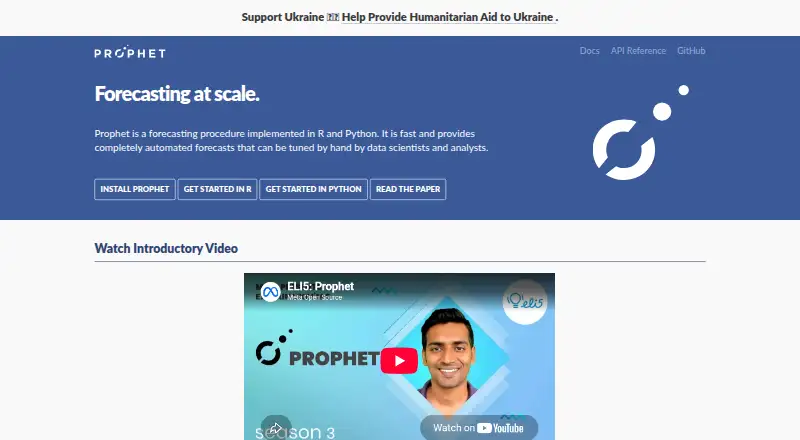
What Prophet is
Prophet is a forecasting procedure for time-series data that models non-linear trends, yearly, weekly, and daily seasonality, and holiday effects. The project says it is best suited to data with strong seasonal effects and several seasons of historical observations. It describes the procedure as robust to missing data and trend shifts, and typically able to handle outliers well. Users can adjust forecasts with human-interpretable parameters and add domain knowledge. Prophet provides R and Python implementations that share Stan code for fitting. Documentation covers country holidays, custom seasonalities, additional regressors, uncertainty intervals, and cross-validation. R installation is documented through CRAN; Python installation is through PyPI or conda-forge. The free software is under the MIT license, and the listed plan is free. Python requires version 3.7 or later; the guide specifies at least 4 GB of VM memory to install and 2 GB to use it. Windows setup has compiler requirements. As of v1.4.0, Prophet is in maintenance mode, taking bug fixes, dependency updates, and R parity changes, with no new features planned.
Who it suits
Prophet suits analysts or developers working with seasonal time series who want adjustable forecasts and can provide several seasons of historical data. It may fit users comfortable with R or Python and the relevant installation requirements.
What it does well
- Models multiple seasonal cycles and holiday effects.
- Adjustable parameters allow domain knowledge to be added.
- Documentation includes uncertainty intervals and cross-validation.
- Free, MIT-licensed R and Python implementations.
What to know first
- No new features are planned in maintenance mode.
- Python use requires version 3.7 or later.
- Windows setup requires a compiler.
Limits
Python use requires version 3.7 or later. The installation guide specifies at least 4 GB of VM memory to install Prophet and 2 GB to use it; Windows setup also has compiler requirements. The project is in maintenance mode as of v1.4.0, with no new features planned.
Plans
| Plan | Billed and limits | Price |
|---|---|---|
| Prophet | open-source forecasting software · R and Python implementations | Free |
As facebook.github.io lists them, read 9 Oct 2026. The maker's own page has the final word.
Getting started
- Choose the R or Python implementation.
- For R, install through CRAN; on Windows, provide a compiler and Rtools.
- For Python, install through PyPI or conda-forge and use Python 3.7 or later.
- For Windows Python installation with cmdstanpy, provide a Unix-compatible C compiler.
- Allow at least 4 GB of VM memory for installation and 2 GB for use.
- Consult the documentation or GitHub issue tracker for help.
Prophet is an open-source forecasting procedure for time-series data, available to R and Python users. It suits teams working with pronounced seasonal patterns and several seasons of history who want interpretable controls over a forecast. Its main appeal is a focused, free workflow for seasonal modeling; maintenance mode and platform-specific compiler requirements make adoption a more deliberate choice.
Overview
Prophet models non-linear trends alongside yearly, weekly, and daily seasonality and holiday effects. The project says it is most effective when seasonal effects are strong and the data contains several historical seasons, so it is a better fit for recurring demand, traffic, or operational cycles than for short or largely patternless series.
The procedure is designed to tolerate missing data, trend changes, and outliers. That robustness can reduce the amount of data preparation needed when a time series is imperfect, while human-interpretable parameters let practitioners incorporate domain knowledge instead of treating the model as an opaque black box. It is distributed under the MIT license and is free to use as open-source software.
Key features
- Seasonal and holiday modeling: Country holidays and custom seasonalities let a forecast reflect calendar-driven behavior beyond standard annual, weekly, and daily cycles.
- Additional regressors: External variables can be added when the target series depends on known drivers, making Prophet more useful than a calendar-only model for informed forecasting workflows.
- Uncertainty intervals: Forecasts can include interval estimates, giving decision-makers a view of expected range rather than a single point.
- Cross-validation: Built-in evaluation support helps measure forecast behavior over historical cutoffs instead of relying only on a fitted result.
- R and Python implementations: Both implementations share Stan code for fitting. R users can install through CRAN; Python users can use PyPI or conda-forge.
- Forecasting and evaluation workflow: The plan includes time-series modeling, forecasting workflows, model evaluation, and API access, covering the core lifecycle without a paid tier.
Help and contribution channels are the project documentation and GitHub issue tracker. That is suitable for a technical team comfortable with community-supported open-source software, but it is not a substitute for a commercial support contract.
Pricing
| Plan | Price | Includes |
|---|---|---|
| Prophet | free | Open-source forecasting software with R and Python implementations |
There is no paid upgrade, seat charge, usage quota, or trial period attached to this plan. The trade-off is operational: users take responsibility for installation, environment management, and support through documentation and GitHub.
Platforms
Prophet supports Linux, macOS, Windows, and self-hosted deployments. Python requires at least version 3.7. Installation needs a virtual machine with at least 4 GB of memory, while using Prophet requires at least 2 GB. Windows setup is the least frictionless path: R installation requires a compiler and Rtools, and Python installation with cmdstanpy requires a Unix-compatible C compiler.
Who it's for
Choose Prophet if you need a free, programmable forecasting component for seasonal time series and want explicit controls for holidays, custom seasonalities, regressors, and uncertainty. It is particularly suited to analysts and developers who can manage R or Python environments and validate forecasts with cross-validation.
Look elsewhere if you need a rapidly evolving feature set, turnkey hosted operation, or support that does not depend on project documentation and issue tracking. The repository places Prophet in maintenance mode from v1.4.0 onward: bug fixes, dependency updates, and R-parity changes are accepted, but no new features are planned.
Pros and cons
Pros
- Free MIT-licensed software: There is no purchase barrier for teams that can run and maintain it themselves.
- Strong seasonal toolkit: Holiday calendars, custom seasonalities, regressors, intervals, and cross-validation address common forecasting requirements in one procedure.
- Interpretable adjustment: Human-readable parameters and domain-knowledge inputs make it possible to explain and tune forecasts.
- Resilience to messy series: Missing data, trend shifts, and outliers are explicitly handled by the project’s design.
Cons
- Maintenance mode: No new features are planned, which limits its appeal for teams seeking an actively expanding forecasting platform.
- Windows build work: Compilers, Rtools, or a Unix-compatible C compiler can complicate installation on Windows.
- Resource and version prerequisites: Python 3.7 or newer and specified memory allocations may require environment changes before deployment.
- Community-led support: Assistance is routed through documentation and GitHub rather than a paid service desk.
Alternatives
For a broader directory of tools, see Predictive Analytics Software.
- MLJAR AutoML is a free, MIT-licensed open-source Python package and also offers web access, making it a better direction when automated machine-learning workflows matter more than Prophet’s seasonal procedure.
- ZebraDesigner is a paid label-design product with a free Essentials plan and trial; choose it for barcode label and tag creation rather than time-series forecasting.
- AutoGluon is a free Apache 2.0 open-source Python library for readers who want a broader automated machine-learning toolkit.
- KNIME Analytics Platform is a free, open-source desktop analytics platform for visual workflows instead of a focused forecasting procedure.
- Orange Data Mining is free software under GNU GPL 3.0 or later, with add-ons that may have additional licensing requirements.
- Weka is a free machine-learning suite with API support for users seeking a general data-mining environment.
- Aible offers hosted self-service plans, including a free Basic tier with 10 basic questions per month, for teams that prefer a web service to self-managed code.
- Amazon SageMaker Autopilot uses pay-as-you-go pricing for readers who want a managed cloud service rather than an open-source library.
Verdict
Prophet is a strong choice for technical users forecasting seasonal series with enough history to expose recurring patterns, especially when interpretable parameters, holiday effects, regressors, and built-in evaluation are priorities. Choose it for the zero-cost, R-and-Python workflow; look elsewhere if maintenance mode, Windows compiler setup, or community-only support conflicts with your operational needs.
Verdict
Prophet offers forecasting tools for seasonal time series, with options for regressors, holidays, and forecast evaluation. Its maintenance mode and Windows compiler requirements are important considerations before adopting it.
Questions
What does Prophet cost?
The listed Prophet plan is free. It is open-source software under the MIT License.
Which programming languages does it support?
Prophet has R and Python implementations that share Stan code for fitting.
How can I install it?
The project documents R installation through CRAN and Python installation through PyPI or conda-forge.
What are the Windows installation requirements?
Windows R installation requires a compiler and Rtools. Windows Python installation with cmdstanpy requires a Unix-compatible C compiler.
What data is Prophet best suited to?
The project says it works best with strong seasonal effects and several seasons of historical data. It models yearly, weekly, and daily seasonality, non-linear trends, and holiday effects.
Is Prophet still receiving new features?
As of v1.4.0, Prophet is in maintenance mode, accepting bug fixes, dependency updates, and R parity changes; no new features are planned.
Facts from Prophet's own pages
- Adjustability
- Users can tune forecasts with human-interpretable parameters and add domain knowledge. · facebook.github.io, 9 Oct 2026
- Best suited to
- The project says Prophet works best with time series that have strong seasonal effects and several seasons of historical data. · facebook.github.io, 9 Oct 2026
- Features
- The documentation covers country holidays, custom seasonalities, additional regressors, uncertainty intervals, and cross-validation. · facebook.github.io, 9 Oct 2026
- Implementations
- Prophet has R and Python implementations that share Stan code for fitting. · facebook.github.io, 9 Oct 2026
- Installation
- The project documents installation through CRAN for R and PyPI or conda-forge for Python. · facebook.github.io, 9 Oct 2026
- License
- The repository identifies the project license as MIT. · github.com, 9 Oct 2026
- Maintenance
- The repository says that as of v1.4.0 Prophet is in maintenance mode, accepting bug fixes, dependency updates, and R parity changes, with no new features planned. · github.com, 9 Oct 2026
- Platform setup
- The installation guide says Windows R installation requires a compiler and Rtools, and Windows Python installation with cmdstanpy requires a Unix-compatible C compiler. · github.com, 9 Oct 2026
- Purpose
- Prophet is a forecasting procedure for time series data with non-linear trends, yearly, weekly, and daily seasonality, and holiday effects. · facebook.github.io, 9 Oct 2026
- Robustness
- The project says Prophet is robust to missing data and trend shifts and typically handles outliers well. · facebook.github.io, 9 Oct 2026
- Runtime requirements
- The installation guide says Python use requires at least version 3.7 and a VM needs at least 4 GB memory to install and 2 GB to use Prophet. · github.com, 9 Oct 2026
- Support
- The project directs users to its documentation and GitHub issue tracker for help and contributions. · github.com, 9 Oct 2026
Where Prophet stands on Freedom251
- Predictive Analytics Software#11 of 37