Freedom251 › Augmented Analytics Software

Obviously AI
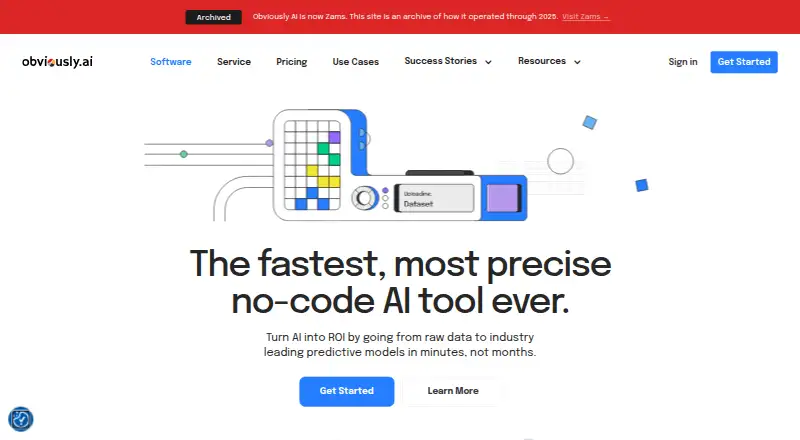
What Obviously AI is
Obviously AI is a web-based, no-code tool for building predictive models from structured data. Its listed use cases include classification, regression, and time series prediction. Users can share a model through an instant web app and dynamic link, or use real-time REST APIs to connect predictions to other apps and tools such as Power BI and Looker. The product also describes automatic model monitoring and Zapier automations. Listed integrations include Amazon Redshift, Google BigQuery, Google Drive, HubSpot, Shopify, Snowflake, Tableau, and Zapier. A structured dataset is required, and the product recommends at least 1,000 rows and 5 columns. CSV is the listed import format, with uploads limited to 10 MB. The Free plan costs nothing and includes 1,200 predictions, one user seat, unlimited models, CSV-only data, and up to 10,000 rows of data. Obviously AI is a B2B predictive analytics startup based in San Francisco. Its security details include SOC 2 Type II, GDPR data-retention compliance, HIPAA compliance, TLS encryption in transit, and AES-256 encryption for customer data at rest.
Who it suits
Obviously AI suits individuals, hobbyists, and non-profits seeking a no-code way to build predictive models from structured CSV data. It may also suit teams that want to connect predictions to listed business tools through APIs or integrations.
What it does well
- Lists classification, regression, and time series prediction
- Free plan includes unlimited models
- Shares models through dynamic-link web apps
- Lists integrations including BigQuery, Shopify, and Tableau
- States TLS and AES-256 encryption
What to know first
- Structured data is required
- CSV is the only listed import format
- Free plan has one user seat and 1,200 predictions
- Uploads are limited to 10 MB
Limits
The Free plan includes 1,200 predictions, one user seat, CSV-only data, files up to 10 MB, and up to 10,000 rows of data. It includes unlimited models.
Plans
| Plan | Billed and limits | Price |
|---|---|---|
| Free | 1,200 predictions · 1 user seat · unlimited models · 1M training rows · CSV only · classification, regression, time-series and clustering · AI agents · custom LLMs · REST APIs · 10 MB files · 10,000 rows · RPA automations · email support | Free |
| Startup Plan | No-code AI software · Agentic and predictive AI · AI agents · RPA automations · Recurring reports · Model dashboard · REST APIs · 1 use case · 100 MB files · 1 million rows · Dedicated AI strategist and data scientist | On request |
| SMB Plan | No-code AI software · Agentic and predictive AI · AI agents · RPA automations · Recurring reports · Model dashboard · REST APIs · 3 use cases · 1 GB files · 100 million rows · Dedicated AI strategist and data scientist | On request |
| Enterprise Plan | No-code AI software · Agentic and predictive AI · AI agents · RPA automations · Recurring reports · Model dashboard · REST APIs · 5 use cases · 10 GB files · 250 million rows · SAML/SSO · audit trails · data residency · private cloud setup | On request |
As obviously.ai lists them, read 15 Oct 2026. The maker's own page has the final word.
Getting started
- Visit the Obviously AI website.
- Prepare a structured dataset; at least 1,000 rows and 5 columns are recommended.
- Import data as a CSV file within the 10 MB upload limit.
- Use the Free plan, which includes one user seat and 1,200 predictions.
- Build a model and share it through a web app or connect it through a REST API.
Obviously AI is a no-code predictive analytics tool for people who want to build models from structured data without writing model code. It suits individuals exploring prediction and teams that need to share predictions or connect them to existing workflows, but CSV input and a tightly capped free tier limit its reach.
Overview
Classification, regression, and time-series prediction cover several common modeling needs. Models can be shared through instant web apps, connected to other applications through real-time REST APIs, or used in workflows that combine automatic monitoring with Zapier automations. That makes Obviously AI more than a modeling interface, though it still depends on having suitable structured data to start with.
Key features
Modeling and data
The product is built to turn raw data into predictive models without code. Its recommended starting point—at least 1,000 rows and five columns—sets a meaningful bar for small or sparse datasets. File imports are CSV, so organizations whose data is not readily available in that format will need another way to prepare it. The Free plan also caps uploads at 10 MB.
Sharing and integrations
Instant web apps provide a dynamic link for real-time model use, a practical option for sharing predictions without building a separate interface. REST APIs can integrate predictions into apps and send prediction data to tools such as Power BI and Looker. Listed integrations include Amazon Redshift, Google BigQuery, Google Drive, HubSpot, Shopify, Snowflake, Tableau, and Zapier. This breadth is useful for workflows spanning data storage, business tools, and automation; the value depends on whether the services a team uses are among those supported.
Security
Obviously AI states that it has a SOC 2 Type II report, complies with GDPR data-retention requirements, and is HIPAA compliant. It says data in transit uses TLS encryption and customer data at rest uses AES-256. These are relevant assurances for organizations handling sensitive information, alongside their own compliance and security requirements.
Pricing
The pricing model is freemium. The Free plan costs nothing and includes 1,200 predictions, one user seat, unlimited models, up to 1M rows of training data, CSV-only input, files up to 10 MB, and up to 10,000 rows of data. Email support is included. It is aimed at individuals, hobbyists, and non-profits; the single seat and prediction allowance make it better for individual evaluation than a shared or sustained production workflow.
The Enterprise Plan has custom pricing. It supports up to five use cases, files up to 10 GB, and up to 250 million rows of data. Paid plans include a dedicated AI strategist, dedicated data scientist, video call, and chat support. The larger file and data limits suit bigger deployments, but the plan's use-case cap and custom pricing are important considerations for teams comparing scale and cost.
Platforms
Obviously AI is available on the web. That keeps access browser-based; the listed platform coverage does not include desktop or mobile apps.
Who it's for
Obviously AI is a reasonable fit for individuals and small teams with structured, CSV-ready data who want to create common prediction models and share results by link or API. Larger organizations may value the Enterprise Plan's higher data and file limits, integrations, and dedicated support. It is a poor fit for projects built around unstructured data, non-CSV imports, or teams that need multiple seats on the free tier.
Pros and cons
- Pros: Classification, regression, and time-series use cases address several common predictive tasks without requiring model code.
- Pros: Web apps, REST APIs, and integrations offer distinct ways to distribute predictions and connect them to existing workflows.
- Pros: The Free plan includes unlimited models and up to 1M rows of training data, giving individuals room to explore within its other caps.
- Cons: Structured data is required, CSV is the stated import format, and the free upload limit is 10 MB.
- Cons: The Free plan allows one user and 1,200 predictions, restricting shared or ongoing use.
- Cons: Enterprise pricing is custom, so buyers cannot compare its cost from a fixed published rate.
Alternatives
For broader options, browse Predictive Analytics Software, AutoML Software, Augmented Analytics Software, or AI Data Analysis Tools.
- Julius AI is another freemium option, with Android, iOS, and web access and a free tier that includes daily credits and a Google Drive connector.
- Databricks Notebooks offers a free web edition with one serverless workspace and limited compute size and usage; consider it if that workspace-and-compute model better matches the project.
- Hex has a free Community plan with data-source connections, all cell types, small compute, and an agent trial, plus a paid Professional plan at $36 a month.
- Zoho Analytics has a free plan for two users, 10,000 rows, and five workspaces, which may suit a small analytics setup with those limits.
- Predict.ai offers a free plan with 500 credits per month, one workspace, one seat, one goal per workspace, one shared deployment, and 1 GB of monthly ingestion.
- Vizly has a free plan capped at zero messages per month and a Basic plan at $19.99 a month for up to 200 messages.
- disy Cadenza is a paid option with a free trial and pricing on request.
- Pyramid Analytics offers a free Community Edition for three users; its Standard Edition is for 30 users on a single server.
Verdict
Choose Obviously AI if you have structured, CSV-ready data and want to build and share classification, regression, or time-series predictions without writing model code. Its strongest case is the combination of web-app sharing, APIs, and integrations; look elsewhere if you need non-CSV imports, more than one free seat, or a known enterprise price before committing.
Verdict
Obviously AI offers several prediction use cases, model sharing, and integrations through a web interface. The Free plan is constrained to one seat, CSV input, and a 10 MB upload limit.
Questions
Is Obviously AI free?
Yes. The Free plan costs nothing and includes 1,200 predictions, one user seat, and unlimited models.
What does the Free plan limit?
It supports CSV-only data, files up to 10 MB, and up to 10,000 rows of data. It also includes one user seat and 1,200 predictions.
What data does Obviously AI require?
It requires a structured dataset and recommends at least 1,000 rows and 5 columns. CSV is the listed import format.
Which model types does it support?
Its listed use cases are classification, regression, and time series prediction.
Can a model connect to other tools?
Real-time REST APIs can send prediction data to tools such as Power BI and Looker. Listed integrations include Amazon Redshift, Google BigQuery, Google Drive, HubSpot, Shopify, Snowflake, Tableau, and Zapier.
What security provisions does Obviously AI list?
It states that it has a SOC 2 Type II report, complies with GDPR data-retention requirements, and is HIPAA compliant. Data in transit uses TLS encryption, and customer data at rest uses AES-256.
Facts from Obviously AI's own pages
- API authentication
- The 2020 API announcement says users generate an API key from the Obviously AI app settings page. · obviously.ai, 15 Oct 2026
- API capability
- The low-code API can return prediction reports and values, support live predictions in applications and feed prediction results into dashboards or workflows. · obviously.ai, 15 Oct 2026
- API documentation
- The site links a dedicated developers.obviously.ai API documentation portal, but the portal was not readable through the research browser. · obviously.ai, 15 Oct 2026
- APIs
- The homepage says real-time REST APIs can integrate AI into apps and send prediction data to tools such as Power BI and Looker. · obviously.ai, 7 Oct 2026
- Automation
- The homepage describes automatic model monitoring combined with if-this-then-that automations using Zapier. · obviously.ai, 7 Oct 2026
- Company and headquarters
- The About page identifies Obviously AI as a B2B predictive analytics startup based in San Francisco, California. · obviously.ai, 7 Oct 2026
- Compliance
- The company states that it supports GDPR requirements, HIPAA with a business-associate agreement, and CCPA controls. · obviously.ai, 15 Oct 2026
- Data requirements
- The data requisites page says a structured dataset is required and recommends at least 1,000 rows and 5 columns. · obviously.ai, 7 Oct 2026
- Data-science support
- Paid software-plus-scientist plans include a dedicated data scientist who can help with cleaning, merging and modeling data. · obviously.ai, 15 Oct 2026
- Deployment
- The product page says instant web apps let users share a dynamic link to use a model in real time. · obviously.ai, 7 Oct 2026
- Earlier origin
- Hampshire College reported that Dave and Debnath started Obviously AI in 2018. · hampshire.edu, 15 Oct 2026
- Encryption
- The security page says data in transit is encrypted using TLS and customer data at rest using AES-256. · obviously.ai, 7 Oct 2026
- Founded year
- A 2023 investment release says Obviously AI was founded in 2020 by Nirman Dave and Tapojit Debnath. · prnewswire.com, 15 Oct 2026
- Free plan audience
- The pricing page describes the Free plan as intended for individuals, hobbyists, and non-profits. · obviously.ai, 7 Oct 2026
- Free plan limits
- The Free plan lists 1,200 predictions, one user seat, unlimited models, and CSV-only data among its limits and features. · obviously.ai, 7 Oct 2026
- Funding news
- Hampshire College reported a $4.7 million seed round announced in August 2021. · hampshire.edu, 15 Oct 2026
- Headquarters
- Crunchbase places the company in San Francisco, California. · crunchbase.com, 15 Oct 2026
- Integrations
- The official integrations catalog lists Airtable, Amazon Redshift, Box, Chartio, CSV, Dropbox, Google Analytics, Google BigQuery, Google Drive, HubSpot, JSON, Kaggle, Mode, MongoDB, MySQL, PostgreSQL, Salesforce, Shopify, Snowflake, SQL Server, Tableau, Typeform and Zapier. · obviously.ai, 15 Oct 2026
- Legal name and founders
- Crunchbase lists the legal name as Obviously AI, Inc. and names Nirman Dave and Tapojit Debnath as founders. · crunchbase.com, 15 Oct 2026
- Limit: configurability and cost
- The Capterra reviewer found the product costly and said preset settings prevented the needed customization. · capterra.com, 15 Oct 2026
- Limit: customization
- A G2 reviewer said the automated product and pricing limited how much they could customize data handling. · g2.com, 15 Oct 2026
- Limit: onboarding clarity
- A G2 reviewer wanted more help understanding the interface at first use. · g2.com, 15 Oct 2026
- LinkedIn company size
- LinkedIn lists Obviously AI as a privately held software-development company with 2–10 employees. · linkedin.com, 15 Oct 2026
- Model deployment
- Users can publish models as instant web apps with shareable links for real-time predictions. · obviously.ai, 15 Oct 2026
Where Obviously AI stands on Freedom251
- Augmented Analytics Software#5 of 32
- Ai Analytics#5 of 23
- Low-Code Machine Learning Platforms Software#8 of 28
- Predictive Analytics Software#12 of 37
- AI Data Analysis Tools#14 of 27
- AutoML Software#16 of 30
- Data Science Analytics#18 of 30