Freedom251 › Data Mining And Extraction Software
Weka
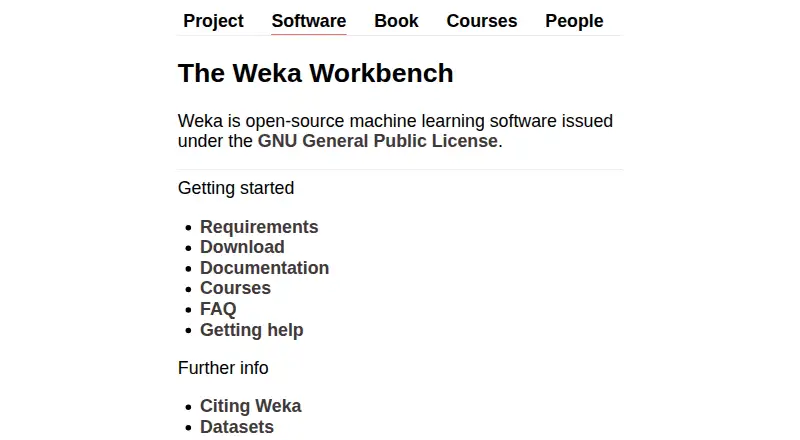
What Weka is
Weka is free, open-source machine learning software distributed under the GNU General Public License. Its stable release is version 3.8, while 3.9 is the development version and may include changes that break compatibility with earlier releases. The stable branch receives bug fixes and feature upgrades intended to preserve compatibility. Weka provides a Java API and can also be used through Jupyter notebooks; the latest official releases require Java 8 or later. Downloads are listed for Windows, Mac OS, and Linux, with Intel and ARM options for each. Versions 3.8 and 3.9 include a package manager for community-added functionality, though downloading and installing packages requires an internet connection. Built-in help and a comprehensive manual are included, and users can also turn to documentation, mailing list archives, forums, and a mailing list for help and bug reports. Distributed derivative works must use the GPL. Commercial projects that need Weka code in a non-GPL program may be able to obtain an appropriate license. Models serialized with version 3.7 are incompatible with 3.8, and the documented migrator has an exception for RandomForest.
Who it suits
Weka suits users working with machine learning who want a free desktop application or Java API, including notebook use. Developers distributing Weka code should consider the GPL requirements.
What it does well
- Free and open source under the GPL.
- Java API and Jupyter notebook use are supported.
- Downloads include Windows, Mac OS, and Linux.
- Package manager supports community-added functionality.
- Built-in help and a comprehensive manual are included.
What to know first
- Installing packages requires an internet connection.
- Official releases require Java 8 or later.
- Version 3.7 serialized models are incompatible with 3.8.
- Development version 3.9 may break compatibility.
Limits
Weka is free. The 3.9 Development version may include changes that break compatibility; 3.8 serialized models cannot load models created in 3.7, with a documented migrator exception for RandomForest.
Plans
| Plan | Billed and limits | Price |
|---|---|---|
| Weka 3.9 Development | Development version; may include features that break compatibility with earlier releases | Free |
| Weka 3.8 Stable | Open-source software under the GNU General Public License | Free |
| Weka open-source software | Desktop Java workbench · stable and development branches · package manager requires internet | Free |
As weka.waikato.ac.nz lists them, read 3 Oct 2026. The maker's own page has the final word.
Getting started
- Visit the Weka website.
- Choose Weka 3.8 Stable or Weka 3.9 Development.
- Download the build for Windows, Mac OS, or Linux and select Intel or ARM as applicable.
- Install Java 8 or later for the latest official releases.
- Use the built-in help or manual, or consult the API and command-line Javadoc.
Weka is open-source machine-learning software for people who want a free desktop toolkit, Java API, or notebook workflow. Its stable release is the safer fit for ongoing work; GPL obligations and an older model-format break deserve attention before adoption.
Overview
Weka offers a stable 3.8 release and a 3.9 development version. Stable updates preserve compatibility with earlier releases, making 3.8 the sensible default for established workflows. Version 3.9 may introduce breaking changes, so it suits users prepared to manage that risk in exchange for trying the development track.
The software supports forecasting, time-series modeling, model evaluation, and automated machine learning, with batch deployment. That range makes it useful across several modeling tasks, but batch is the stated deployment mode; users seeking a live-serving workflow should consider another tool.
Key features
Packages and programming
Weka 3.8 and 3.9 include a package manager for community-developed functionality. Installing packages requires an internet connection, a practical constraint for offline or restricted environments. The Java API, Javadoc for API and command-line parameters, and Jupyter notebook use give developers and notebook users alternatives to relying on the desktop interface alone.
The latest official releases require Java 8 or later. That prerequisite is manageable for Java-based teams, but it adds setup work for users who do not already maintain a Java environment.
Documentation and support
Built-in help and a comprehensive manual give users a starting point for learning the software. The project also points to mailing list archives, community forums, and a mailing list for questions and bug reports. This community-led support model offers several places to seek help, rather than a stated commercial support channel.
Pricing
Weka 3.8 Stable costs nothing and is open-source software under the GNU General Public License. Weka 3.9 Development also costs nothing, but its development status may bring features that break compatibility with earlier releases. For most users, the stable edition is the better starting point; the development edition is for those who accept greater change risk.
There is no free trial, because both listed editions are free. The key cost consideration is licensing: distributed derivative works must be licensed under the GPL. A suitable license may be available for commercial projects that need to distribute Weka code in a non-GPL program, so organizations with that requirement should resolve licensing before building a distribution around it.
Platforms
Desktop downloads are available for Windows, Mac OS, and Linux, with Intel and ARM options for each. The listed platform coverage also includes an API, while notebook use is supported through the Weka API. Java 8 or later is required for the latest official releases.
Who it's for
Weka is a strong fit for learners, analysts, and developers who want a free machine-learning toolkit with desktop access and programming interfaces, particularly for forecasting, time-series work, model evaluation, or automated machine learning. It is less suitable for teams that need a stated live deployment mode, cannot install packages over the internet, or must distribute derivative software under terms incompatible with the GPL.
Pros and cons
- Pros: The free stable release combines several modeling capabilities with desktop downloads, a Java API, and notebook use, allowing different kinds of users to work with the same toolkit.
- Pros: Stable updates are designed to retain compatibility with earlier releases, which helps teams maintain established workflows.
- Cons: The latest official releases require Java 8 or later, and community packages need an internet connection to install.
- Cons: Version 3.7 serialized models are incompatible with 3.8; the documented migrator also has at least one exception, RandomForest, so upgrades may require model-specific planning.
- Cons: GPL terms constrain distributed derivative works, and batch is the stated deployment mode.
Alternatives
For Python-centered automated machine learning, MLJAR AutoML is a free alternative with an open-source MIT-licensed Python package and a separate Free plan. Choose it when that Python package or its stated platform range, including web and self-hosted options, better suits the workflow.
AutoGluon is a free, open-source Python library under Apache 2.0. It is the more natural alternative for teams seeking a Python library and that license rather than Weka's Java API and GPL terms.
KNIME Analytics Platform is free and open source, with Linux, macOS, and Windows support. Consider it instead if that platform option fits your work better.
Orange Data Mining is free software under GNU GPL 3.0 or later for Linux, macOS, and Windows; choose it if that alternative better matches your preferred tool, while checking that add-on licensing requirements suit your project.
Prophet is free open-source forecasting software with R and Python implementations. It is the more focused choice when forecasting is the main need rather than Weka's broader modeling toolkit.
ZebraDesigner is another option for readers comparing software.
Aible offers a free Basic plan with 10 basic questions per month, excluding advanced questions, and uses Aible-hosted data. It may suit a reader whose needs fit those limits; Weka remains the free desktop and API toolkit for machine-learning work.
Amazon SageMaker Autopilot is an alternative for readers considering a pay-as-you-go service with API and web access.
Explore more options in Predictive Analytics Software.
Verdict
Choose Weka if you want free, open-source machine-learning software with desktop, Java API, and notebook workflows, and can work within batch deployment and GPL terms. Its stable release and broad modeling scope are the main reasons to choose it; look elsewhere if your project depends on older serialized models, live deployment, or distributing derivative software under a different license.
Verdict
Weka offers free machine-learning software with desktop downloads, a Java API, notebook use, and community packages. Check version compatibility and GPL terms, especially when moving older serialized models or distributing derivative works.
Questions
How much does Weka cost?
Weka 3.8 Stable and Weka 3.9 Development are each listed as free. The pricing model is free, and there is no free trial.
Which platforms does Weka support?
Downloads are listed for Windows, Mac OS, and Linux, with Intel and ARM options for each. The platform list also includes API.
Is Weka open source?
Yes. Weka is open-source software issued under the GNU General Public License.
What is the difference between Weka 3.8 and 3.9?
Weka 3.8 is the stable version and receives bug fixes and feature upgrades intended to preserve compatibility. Weka 3.9 is the development version and may include changes that break compatibility.
Can I distribute Weka code in a non-GPL program?
Distributed derivative works must be licensed under the GPL. An appropriate license may be available for commercial projects that need to distribute Weka code in a non-GPL program.
Can Weka models from version 3.7 be used in version 3.8?
Serialized models created in 3.7 are incompatible with 3.8. The documented migrator has at least one exception: RandomForest.
Facts from Weka's own pages
- Association rules
- Weka contains association-rule mining functionality for discovering relationships in transactional data. · waikato.ac.nz, 15 Oct 2026
- Classification
- Weka includes algorithms for assigning records to classes. · waikato.ac.nz, 15 Oct 2026
- Clustering
- The workbench supports unsupervised clustering analysis. · waikato.ac.nz, 15 Oct 2026
- Commercial licensing
- Commercial redistribution that cannot comply with GPL may require a separate licence from relevant copyright holders. · waikato.github.io, 15 Oct 2026
- Community support
- The project directs users to documentation, mailing list archives, community forums, and a mailing list for help and bug reports. · waikato.github.io, 3 Oct 2026
- Compatibility limit
- Serialized Weka models created in version 3.7 are incompatible with version 3.8, and the documented migrator has at least one exception: RandomForest. · waikato.github.io, 3 Oct 2026
- Database integration
- Weka can work with transactional database data through database connectivity and JDBC drivers. · waikato.github.io, 15 Oct 2026
- Data preparation
- The software provides tools for preparing and transforming datasets before modeling. · waikato.ac.nz, 15 Oct 2026
- Desktop platforms
- Downloads are listed for Windows, Mac OS, and Linux, with Intel and ARM options for each. · waikato.github.io, 3 Oct 2026
- Documentation depth
- Documentation includes a built-in manual, free book appendix, Javadocs, package documentation, videos, slides and a long-running mailing-list archive. · waikato.github.io, 15 Oct 2026
- Extensibility
- New classifiers and filters are implemented by deriving classes from Weka classifier and filter base classes, and packages can expose them in the GUI. · waikato.github.io, 15 Oct 2026
- Headquarters
- Hamilton, New Zealand · weka.waikato.ac.nz, 28 Sept 2026
- History
- Weka development began in 1993 at the University of Waikato and its first public release was in 1996. · waikato.ac.nz, 15 Oct 2026
- Included documentation
- Weka includes built-in help and a comprehensive manual. · waikato.github.io, 3 Oct 2026
- Java API
- The distribution exposes Java classes that developers can call from their own programs, with Javadoc and API articles available. · waikato.github.io, 15 Oct 2026
- Java requirement
- The latest official Weka releases require Java 8 or later. · waikato.github.io, 3 Oct 2026
- Jupyter integration
- Official documentation describes using Weka through Jupyter notebooks. · waikato.github.io, 15 Oct 2026
- Licence
- Weka is GPL software; Weka 3.6 uses GPLv2 while versions later than 3.7.5 use GPLv3. · waikato.github.io, 15 Oct 2026
- Limit: documentation and integration
- Software Advice reviewers mention limited documentation, a learning curve, an uncommon file format and difficult Python integration. · softwareadvice.com, 15 Oct 2026
- Limit: GPU support
- The FAQ says GPU acceleration is only possible through particular approaches or packages rather than being a universal built-in path. · waikato.github.io, 15 Oct 2026
- Limit: interface age
- G2 reviewers repeatedly complain that the graphical interface looks dated, rigid or insufficiently interactive. · g2.com, 15 Oct 2026
- Limit: large datasets
- G2 reviewers report that Weka can be slow, lag while loading data and crash on very large files. · g2.com, 15 Oct 2026
- Limit: model compatibility
- The official wiki warns that serialized models made with Weka 3.7 are incompatible with 3.8, with some exceptions such as RandomForest. · waikato.github.io, 15 Oct 2026
- Maker location
- Weka was developed at the University of Waikato in Hamilton, New Zealand. · waikato.github.io, 15 Oct 2026
Where Weka stands on Freedom251
- Data Mining And Extraction Software#1 of 29
- Predictive Analytics Software#2 of 37
- Data Science Analytics#2 of 30