Freedom251 › Embedded Databases
PouchDB
What PouchDB is
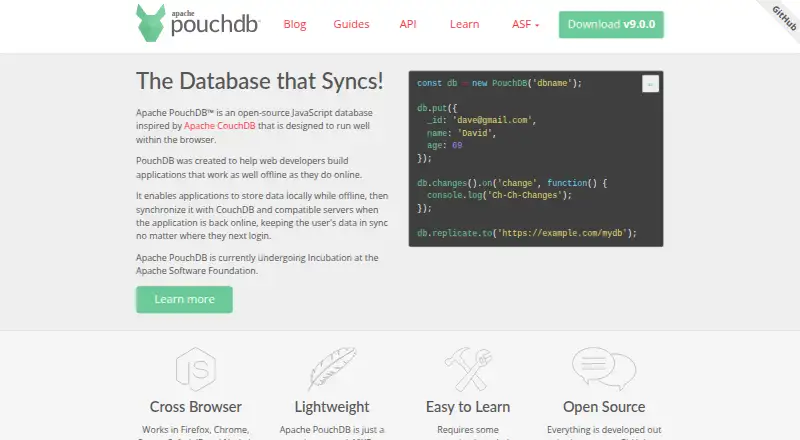
PouchDB is a free, open-source JavaScript database for applications that need local data storage and synchronization with CouchDB-compatible servers. It can keep application data available offline and synchronize local and remote databases after a connection returns. Its replication API can follow future changes and, when configured, retry after connection failures. PouchDB runs in browsers and Node.js, as well as environments including Cordova, PhoneGap, NW.js, Electron, and Chrome apps. Browser storage defaults to IndexedDB; Node.js defaults to LevelDB. Documents can contain image or audio attachments stored as base64 data or Blobs. The library includes a map/reduce API; Mango queries require the separate pouchdb-find plugin. Its asynchronous API supports callbacks, promises, and async functions. PouchDB describes itself as framework-agnostic and names Angular, React, Ember, and Backbone as examples. Listed compatible servers include CouchDB 1.x, 2.x, and 3.x, Cloudant, and PouchDB Server. Replication depends on the CouchDB replication protocol, so it cannot sync with a backend that does not speak that protocol. The project homepage says Apache PouchDB is undergoing incubation at the Apache Software Foundation.
Who it suits
It suits JavaScript developers building applications that need local, offline-capable data and synchronization with CouchDB-compatible servers. Its browser, Node.js, and named application environments give teams several deployment contexts to consider.
What it does well
- Stores application data locally while offline.
- Replication can retry after connection failures when configured.
- Supports browsers, Node.js, and several app environments.
- Documents can contain image or audio attachments.
What to know first
- Cannot replicate with backends lacking the CouchDB protocol.
- Mango queries require a separate plugin.
- Cordova SQLite can allow more storage than IndexedDB and WebSQL.
Plans
| Plan | Billed and limits | Price |
|---|---|---|
| Free and open source | — | Free |
As pouchdb.com lists them, read 8 Oct 2026. The maker's own page has the final word.
Getting started
- Visit https://pouchdb.com/.
- Choose a supported environment, such as a browser or Node.js.
- Use the free, open-source database in the application.
- Connect replication to a CouchDB-protocol-compatible server.
Overview
PouchDB is an open-source JavaScript database for applications that keep data on a device and synchronize it with CouchDB-compatible servers. It is a strong fit for developers building offline-capable software in JavaScript environments. Choose it when local storage and protocol-compatible replication are central requirements; look elsewhere if your backend uses a different sync protocol.
Key features
Applications can continue storing data while offline and synchronize with a remote database after reconnecting. The replication API can follow future changes and, when configured, retry after connection failures. That combination suits software used with unreliable connectivity, but it does not make PouchDB a universal sync layer: the remote backend must speak the CouchDB replication protocol.
Storage defaults vary by runtime: browsers use IndexedDB, while Node.js uses LevelDB. PouchDB can also be used in Cordova, PhoneGap, NW.js, Electron, and Chrome apps. Cordova SQLite can allow more storage than IndexedDB and WebSQL limits, which is relevant when an application must retain a larger local dataset. Storage capacity otherwise depends on the underlying browser or platform.
The built-in map/reduce API supports queries. Mango queries require the separate pouchdb-find plugin, so teams choosing Mango should plan for an additional dependency. Documents can contain image or audio attachments, stored as base64 data or Blobs. The asynchronous API supports callbacks, promises, and async functions, giving JavaScript teams more than one way to integrate database operations.
PouchDB describes itself as framework-agnostic and names Angular, React, Ember, and Backbone as examples. Its project homepage points users to GitHub Discussions, Slack, and Stack Overflow for discussion. The project is undergoing incubation at the Apache Software Foundation.
Pricing
PouchDB is free and open source: the Free and open source plan costs nothing. It is a straightforward fit for individual developers and teams that can operate the database components themselves; the deployment model is self-hosted. There are no paid tiers or subscription terms to weigh in the plan information provided.
The free price does not remove practical limits imposed by storage adapters or server compatibility. Applications using browser storage remain subject to IndexedDB limits, while Cordova SQLite can allow unlimited storage compared with IndexedDB and WebSQL limits. PouchDB itself does not provide transactions.
Platforms
The listed platform coverage includes Android, iOS, Linux, macOS, self-hosted deployments, web, and Windows. Runtime support spans browsers and Node.js, with additional use in Cordova, PhoneGap, NW.js, Electron, and Chrome apps. This breadth is useful for JavaScript applications crossing device and server environments, though the storage adapter and replication destination still shape what each deployment can do.
Who it's for
PouchDB suits developers who want local JavaScript data storage with offline operation and can pair it with CouchDB or another compatible server. It is less suitable for teams that need backend-agnostic replication, built-in Mango queries without an extra plugin, or transaction support.
Pros and cons
- Pro: Offline storage and replication support keep applications useful through connectivity gaps.
- Pro: Browser and Node.js defaults, plus several app runtimes, support varied JavaScript deployments.
- Pro: Free, open-source software avoids a subscription charge.
- Con: Replication depends on the CouchDB protocol, ruling out incompatible backends.
- Con: Mango requires a separate plugin, and PouchDB does not provide transactions.
- Con: Browser storage limits can matter for data-heavy apps.
Alternatives
Apache CouchDB is worth considering when the priority is the self-hosted server database itself, rather than a JavaScript database for local application storage. JayDB may suit readers comparing a freemium database with a stated 1 GB storage allowance and monthly read and write quotas. RavenDB is another database option, with Developer and Community plans described in terms of cores, RAM, and nodes.
eXist-db, Firestore, MarkLogic, Apache AsterixDB, and Azure DocumentDB are also alternatives to compare. Document Databases and Embedded Databases offer broader category comparisons.
Verdict
Choose PouchDB for a free JavaScript local database when offline use and synchronization with a CouchDB-protocol server are the main goals. Its runtime range and replication model are compelling for that job. Choose another tool if your backend cannot speak that protocol, you need transactions, or you want Mango queries without a separate plugin.
Verdict
PouchDB is a free option for local JavaScript data storage with replication to compatible servers. Check server protocol compatibility, and account for the separate plugin needed for Mango queries.
Questions
Is PouchDB free?
Yes. PouchDB is free and open source, and its listed plan is free.
Which platforms and environments does it support?
Listed platforms include Android, iOS, Linux, macOS, self-hosted, web, and Windows. It runs in browsers and Node.js and can also be used in Cordova, PhoneGap, NW.js, Electron, and Chrome apps.
Can PouchDB work offline?
Yes. Applications can store data locally while offline and synchronize after reconnecting.
Which servers can it replicate with?
Replication requires a server that speaks the CouchDB replication protocol. The adapters page lists tested support for CouchDB 1.x, 2.x, and 3.x, Cloudant, and PouchDB Server.
Does it include Mango queries?
No. PouchDB includes a map/reduce API; Mango queries are available through the separate pouchdb-find plugin.
Is PouchDB open source?
Yes. It is open source, and its homepage says Apache PouchDB is undergoing incubation at the Apache Software Foundation.
Facts from PouchDB's own pages
- API
- PouchDB provides an asynchronous API that supports callbacks, promises, and async functions. · pouchdb.com, 8 Oct 2026
- Attachments
- Documents can contain attachments such as images and audio files, stored as base64 data or Blobs. · pouchdb.com, 8 Oct 2026
- Compatibility limit
- PouchDB cannot replicate with a backend that does not speak the CouchDB replication protocol. · pouchdb.com, 8 Oct 2026
- Compatible servers
- The adapters page lists tested support for CouchDB 1.x, 2.x, and 3.x, Cloudant, and PouchDB Server. · pouchdb.com, 8 Oct 2026
- Environments
- PouchDB runs in browsers and Node.js, and can be used in Cordova, PhoneGap, NW.js, Electron, and Chrome apps. · pouchdb.com, 8 Oct 2026
- Integrations
- The project describes itself as framework-agnostic and names Angular, React, Ember, and Backbone as examples. · pouchdb.com, 8 Oct 2026
- Offline use
- Applications can store data locally while offline and synchronize it when they reconnect. · pouchdb.com, 8 Oct 2026
- Project status
- The homepage says Apache PouchDB is undergoing incubation at the Apache Software Foundation. · pouchdb.com, 8 Oct 2026
- Purpose
- PouchDB is an open-source JavaScript database designed to store data locally and sync it with CouchDB and compatible servers. · pouchdb.com, 8 Oct 2026
- Queries
- PouchDB includes a map/reduce API, while its Mango query API is available through a separate pouchdb-find plugin and is not shipped by default. · pouchdb.com, 8 Oct 2026
- Replication
- Its replication API can sync local and remote databases, track future changes, and retry after connection failures when configured to do so. · pouchdb.com, 8 Oct 2026
- Security and compliance
- The opened official pages describe HTTPS database URLs as supported but do not state a security certification or compliance standard. · pouchdb.com, 8 Oct 2026
- Storage
- PouchDB uses IndexedDB in browsers by default and LevelDB in Node.js by default. · pouchdb.com, 8 Oct 2026
- Storage limit
- The adapters page says Cordova SQLite can allow unlimited storage compared with IndexedDB and WebSQL storage limits. · pouchdb.com, 8 Oct 2026
- Support
- The project homepage points users to GitHub Discussions, Slack, and Stack Overflow for discussion. · pouchdb.com, 8 Oct 2026
Where PouchDB stands on Freedom251
- Embedded Databases#15 of 30
- Document Databases#14 of 28