Freedom251 › Embedded Databases

ObjectBox
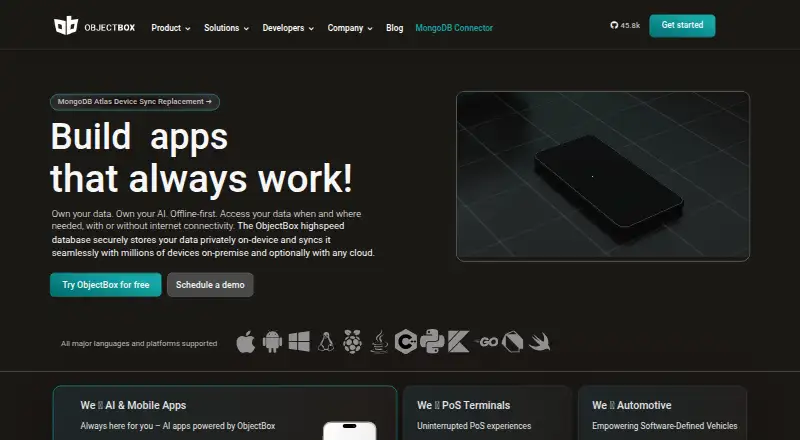
What ObjectBox is
ObjectBox is an embedded, object-oriented NoSQL database for mobile applications and IoT devices. Its database offers native object APIs, relationships, reactive observers, ACID transactions, and automatic schema migration. ObjectBox Sync can move data between devices and a backend or server, including in offline-first use cases. The product lists APIs for Java, Kotlin, Swift, Flutter/Dart, Go, Python, and C/C++, and supports Android, iOS, Linux, Windows, and macOS. Its FAQ says vector search is supported without a set limit on embedding-column dimensions. ObjectBox supports direct syncing to MongoDB; connectors for other backend databases may require custom development. The Sync Server can be self-hosted on POSIX systems and cloud providers, but ObjectBox does not currently provide cloud hosting. The core database plan is free; Sync pricing is quoted per project. The company describes its focus as mobile and IoT development, particularly decentralized systems of restricted devices and offline scenarios. Mesh Sync is available for Android Java/Kotlin and Flutter/Dart starting with version 6.0.0-beta, and its APIs may change before final release.
Who it suits
ObjectBox suits mobile and IoT developers building offline-capable or decentralized systems. Teams that need synchronized data can consider Sync, with project-specific pricing and self-hosting options.
What it does well
- Core database plan is free
- Supports ACID transactions and automatic schema migration
- APIs span seven listed language groups
- Vector search has no stated embedding-dimension limit
- Sync Server can be self-hosted
What to know first
- ObjectBox does not currently provide cloud hosting
- Other backend database connectors may need custom development
- Mesh Sync APIs may change before final release
Limits
The free ObjectBox Database plan includes the core database and fundamental capabilities, with a listed maximum database size of 1 GB. Sync has per-project personalized pricing; ObjectBox does not currently provide cloud hosting. Mesh Sync is available for Android Java/Kotlin and Flutter/Dart starting with version 6.0.0-beta, and its APIs may change before final release.
Plans
| Plan | Billed and limits | Price |
|---|---|---|
| ObjectBox Database | No cost · Core database; fundamental capabilities | Free |
| ObjectBox Sync | Per project; personalized quote · Pricing varies by users, devices, sync instances, business model, support, and additional needs | On request |
As objectbox.io lists them, read 29 Sept 2026. The maker's own page has the final word.
Getting started
- Visit https://objectbox.io/.
- Choose the free ObjectBox Database plan for the core database.
- Select the API for your language and a supported platform.
- For synchronization, request a per-project quote for ObjectBox Sync.
- Set up the Sync Server on a POSIX system or cloud provider if using Sync.
ObjectBox is an embedded database and synchronization system for software that stores data on mobile and IoT devices. It is best suited to teams building offline-capable or decentralized applications. The free database is a strong starting point, but its 1 GB ceiling and separately quoted Sync make scale and deployment important considerations.
Overview
ObjectBox uses a document model with an API query interface, keeping data within an application rather than requiring a separate database server. That design is a practical fit for device-based software that needs local data access, including when connectivity drops. The 1 GB maximum database size is a firm constraint for applications with growing local datasets.
Sync can move data between devices and a backend or server. Teams can run the Sync Server on POSIX systems and cloud providers, but ObjectBox does not offer cloud hosting. That gives deployment control to teams willing to manage the server themselves; it is less convenient for those seeking a hosted service.
Key features
Database capabilities
Native object APIs and object relationships let developers work with application data directly. ACID transactions, reactive observers and automatic schema migration add useful foundations for maintaining consistent, responsive applications as data structures evolve. ObjectBox also supports vector search without a limit on embedding-column dimensions, which may suit applications that need to store and search embeddings.
Synchronization and security
Sync targets offline-first use cases and connects devices with a backend or server. Direct synchronization to MongoDB is supported; connections to other backend databases may require custom work. The Sync Server supports JWT authentication and TLS when supplied with a certificate. Its no-authentication mode is explicitly insecure, so teams should configure authentication and transport security for deployments that need protection.
Languages and current limits
APIs are available for Java, Kotlin, Swift, Flutter/Dart, Go, Python and C/C++, giving teams several ways to adopt the database across application stacks. Mesh Sync is currently available for Android Java/Kotlin and Flutter/Dart starting with version 6.0.0-beta, and its APIs may change before final release. That makes it a beta option rather than a settled basis for production plans.
Pricing
| Plan | Price | What it includes |
|---|---|---|
| ObjectBox Database | free; no cost | Core database and fundamental capabilities |
| ObjectBox Sync | Custom pricing; personalized quote per project | Pricing varies by users, devices, sync instances, business model, support and additional needs |
The free database makes it possible to start without a software charge, though the 1 GB size cap matters as local data grows. Sync is priced per project rather than at a published flat rate, so teams should expect to discuss their deployment and support needs before budgeting.
Platforms
ObjectBox supports Android, iOS, Linux, Windows, macOS, Raspberry Pi and POSIX systems. That range covers common mobile and desktop targets as well as embedded-device environments. The company is headquartered in Germany, Europe.
Who it's for
ObjectBox is a good fit for developers building mobile or IoT applications where local data, intermittent connectivity and synchronization across devices matter. It is particularly relevant to decentralized systems made up of restricted devices. Teams that need a larger local database, a managed Sync service, or a backend connector beyond MongoDB without custom integration should weigh those constraints before committing.
Pros and cons
- Pros: The core database is free, with object-oriented APIs, transactions, observers and schema migration included.
- Pros: Sync addresses offline-first movement of data between devices and servers, and the server can be self-hosted.
- Pros: A broad language API selection and vector search support make it adaptable across several application stacks and data use cases.
- Cons: The database is capped at 1 GB, which can rule it out for applications with larger local datasets.
- Cons: Sync requires a project-specific quote, and teams needing hosting must operate their own Sync Server.
- Cons: MongoDB is the directly supported backend database connector; other integrations may need custom development.
- Cons: Mesh Sync remains in beta for the supported language targets, with APIs subject to change.
Alternatives
For more options, browse Mobile Databases or Embedded Databases.
- Espresso is an alternative if the need is Android UI testing rather than an embedded database; its free plan covers a single target app.
- Hive is another free-plan option for teams that can work within its 200MB storage and 10-member workspace limits.
- RxDB is worth considering when web support matters; its free plan includes core functionality, replication and realtime sync, with a limit of 13 open collections.
- Ditto may suit projects that can use its free tier of 10 cloud device connections, 2GB storage and 5GB data transfer, accepting no SLA and limited support.
- Realm offers a free open-source database option; MongoDB acquired Realm and renamed its technology MongoDB Atlas Device SDKs.
- Sparksee may suit academic users able to apply with a valid school or university ID for its free academic licence.
- SQLDelight is a free open-source Kotlin SQL code generation library, rather than a direct match for ObjectBox's database-and-sync offering.
- WCDB is a free open-source mobile database framework for teams seeking that alternative.
Verdict
Choose ObjectBox when a mobile or IoT application needs a local database plus a path to synchronize offline-first data, and your team can operate the Sync Server if necessary. Its free core, broad language support and embedded design are compelling, but the 1 GB cap and project-priced, self-hosted Sync make it a poorer fit for larger datasets or teams that want managed synchronization.
Verdict
ObjectBox combines an embedded database with synchronization options for mobile and IoT use cases. The core database is free, while Sync is quoted per project and requires self-hosting if cloud hosting is needed.
Questions
Is ObjectBox free?
Yes. The ObjectBox Database plan costs nothing and includes the core database and fundamental capabilities.
How much does ObjectBox Sync cost?
Sync is priced per project through a personalized quote. Pricing varies according to users, devices, sync instances, business model, support, and additional needs.
Which platforms does ObjectBox support?
Supported platforms include Android, iOS, Linux, Windows, macOS, Raspberry Pi, and POSIX systems.
Can ObjectBox synchronize data?
Yes. ObjectBox Sync synchronizes data between devices and a backend or server, including for offline-first use cases.
Can I use ObjectBox with another backend database?
ObjectBox supports directly syncing to MongoDB. Connectors for other backend databases may need to be custom built.
Does ObjectBox provide cloud hosting?
No. Its Sync Server can be self-hosted on POSIX systems and cloud providers, but ObjectBox does not currently provide cloud hosting.
Facts from ObjectBox's own pages
- Certification
- The company’s About page states that ObjectBox is ISO-certified and links to its quality policy. · objectbox.io, 29 Sept 2026
- Database features
- The database offers native object APIs, object relationships, reactive observers, ACID transactions, and automatic schema migration. · objectbox.io, 29 Sept 2026
- Data sync
- ObjectBox Sync synchronizes data between devices and a backend or server, including for offline-first use cases. · objectbox.io, 29 Sept 2026
- Headquarters
- Germany, Europe · objectbox.io, 28 Sept 2026
- Hosting
- The Sync Server can be self-hosted on POSIX systems and cloud providers; the FAQ says ObjectBox does not currently provide cloud hosting. · objectbox.io, 29 Sept 2026
- Integrations
- ObjectBox says it supports directly syncing to MongoDB; other backend database connectors may need to be custom built. · objectbox.io, 29 Sept 2026
- Intended users
- ObjectBox describes its focus as mobile and IoT development, particularly decentralized systems of restricted devices and offline scenarios. · objectbox.io, 29 Sept 2026
- Languages
- ObjectBox lists APIs for Java, Kotlin, Swift, Flutter/Dart, Go, Python, and C/C++. · objectbox.io, 29 Sept 2026
- Limits
- The FAQ says Mesh Sync is currently available for Android Java/Kotlin and Flutter/Dart starting with version 6.0.0-beta, with APIs potentially changing before final release. · objectbox.io, 29 Sept 2026
- Platforms
- ObjectBox lists Android, iOS, Windows, macOS, Linux, POSIX systems, and Raspberry Pi among supported platforms or devices. · objectbox.io, 29 Sept 2026
- Product
- ObjectBox is an embedded, object-oriented NoSQL database for mobile apps and IoT devices. · objectbox.io, 29 Sept 2026
- Security
- ObjectBox Sync Server supports JWT authentication and can use TLS by supplying a certificate; its documentation describes no-authentication mode as insecure. · sync.objectbox.io, 29 Sept 2026
- Support
- The FAQ directs questions to documentation and Stack Overflow, and says professional support is offered to paying customers. · objectbox.io, 29 Sept 2026
- Vector search
- The FAQ says ObjectBox supports vector search and that there are no limits on embedding-column dimensions. · objectbox.io, 29 Sept 2026
Where ObjectBox stands on Freedom251
- Embedded Databases#13 of 30
- Mobile Databases#13 of 26