
Firestore
What Firestore is
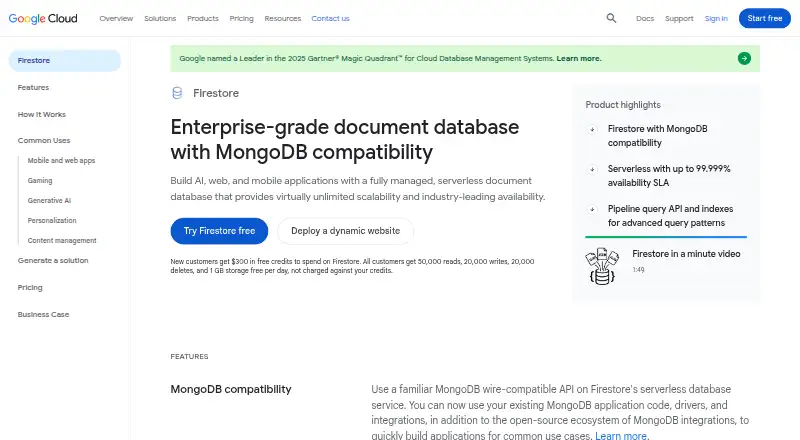
Firestore is a managed, serverless document database for building AI, web, and mobile applications. It stores flexible JSON data and supports vector and full-text search, geospatial queries, and ACID transactions on JSON or BSON-compatible documents. Client SDKs for iOS, Android, and web provide real-time updates and sync data for offline access. For generative AI application work, named integrations include Google AI Studio, remote MCP, LangChain, and LlamaIndex. Firestore supports automatic multi-region replication with strong consistency and states 99.999% SLA-backed availability for multi-region deployments. It connects identity-based access controls with Cloud IAM, Cloud Identity Platform, and Firebase Authentication, and supports customer-managed encryption keys through Cloud KMS. Its free quota covers one database per project and includes 1 GiB of storage, daily read, write, and delete quotas, and 10 GiB of monthly outbound transfer. New customers receive $300 in credits separately from daily free usage. The Enterprise edition supports a MongoDB wire-compatible API. Server libraries bypass Security Rules, so server access needs IAM controls.
Who it suits
Firestore suits teams building AI, web, or mobile applications that need a managed document database. Its client SDKs and offline syncing may also suit apps that need real-time data access on iOS, Android, or web.
What it does well
- Supports vector, full-text, and geospatial queries.
- ACID transactions on JSON or BSON-compatible documents.
- Client SDKs provide real-time updates and offline syncing.
- Multi-region deployments state 99.999% SLA-backed availability.
- Free quota includes 1 GiB of stored data.
What to know first
- Free quota applies to one database per project.
- Named databases require billing and do not qualify for free quota.
- Server client libraries bypass Firestore Security Rules.
- Server access must be controlled with IAM.
Limits
The free quota is limited to one database per project and includes 1 GiB stored data, 50,000 reads, 20,000 writes, and 20,000 deletes per day, plus 10 GiB outbound transfer per month. Named databases require billing. Quotas reset daily around midnight Pacific time.
Plans
| Plan | Billed and limits | Price |
|---|---|---|
| Standard edition — document reads | 50,000 document reads per day | On request |
| Standard edition — document writes | 20,000 document writes per day | On request |
| Standard edition — document deletes | 20,000 document deletes per day | On request |
| Standard edition — stored data | 1 GiB stored data | On request |
| Free quota | Daily quotas reset around midnight Pacific time; outbound transfer quota is monthly · 1 GiB stored data · 50,000 document reads/day · 20,000 writes/day · 20,000 deletes/day · 10 GiB outbound transfer/month · one free database per project | Free |
| Standard edition pay-as-you-go | Usage is metered daily; listed default rate beyond free quota · Document reads $0.03 per 100,000 · writes $0.09 per 100,000 · deletes $0.01 per 100,000 · stored data $0.000205479/GiB · restore and clone $0.20/GiB | $0.03 a month |
| Standard edition | Usage-based; charges accrue daily and depend on reads, writes, deletes, storage, and network use. · Document reads: $0.03 per 100,000 documents · Document writes: $0.09 per 100,000 documents · Document deletes: $0.01 per 100,000 documents · Free quota: one database per project, 1 GiB stored data, 50,000 reads/day, 20,000 writes/day, 20,000 deletes/day, 10 GiB outbound transfer/month | On request |
| Enterprise edition | Usage-based; operations are charged by read, write, and real-time update units, and storage and network use are billed separately. · Read units: Starting at $0.05 per 1 million read units (4 KB tranches) · Write units: Starting at $0.26 per 1 million write units (1 KB tranches) · Real-time Update units: Starting at $0.30 per 1 million write units (1 KB tranches) · SSD storage: Starting at $0.24 Per GB/month | On request |
As cloud.google.com lists them, read 22 Sept 2026. The maker's own page has the final word.
Getting started
- Open the Firestore website.
- Choose a cloud deployment for your application.
- Start with the free quota or use the $300 in credits available to new customers.
- Use the Android, iOS, or web client SDKs for real-time updates and offline syncing.
- For server access, control access with IAM.
Firestore is a managed cloud document database for teams building mobile, web, server, and AI applications. It suits projects that need flexible JSON data, live client updates, and offline synchronization more than teams seeking a self-hosted database. The free quota lowers the entry barrier, but usage billing and server-side IAM design become important as traffic grows.
Overview
Firestore stores JSON documents in a serverless service that scales across mobile, web, and backend development. Queries cover vector, full-text, and geospatial search, while ACID transactions support coordinated changes to JSON or BSON-compatible data. That combination is broad enough for search-heavy applications, though every read, write, delete, storage, and network use can affect cost.
Android, iOS, and web client SDKs deliver real-time updates and automatically synchronize data for offline access. This is a strong fit for applications that must remain useful through intermittent connections. Integrations named for generative-AI work include Google AI Studio, remote MCP, LangChain, and LlamaIndex.
Key features
- Flexible document model: JSON storage and scalable document handling suit evolving application schemas.
- Search and transactions: Vector, full-text, and geospatial queries plus ACID transactions reduce the need to split related application functions across services.
- Real-time and offline clients: Mobile and web SDKs keep interfaces current and synchronize offline changes, a meaningful advantage for connected-client applications.
- MongoDB compatibility: The Enterprise edition offers a MongoDB wire-compatible API, so existing MongoDB code, drivers, and integrations can be reused.
- Availability and replication: Automatic multi-region replication provides strong consistency, with a stated 99.999% SLA-backed availability level for multi-region deployments.
- Security and encryption: Cloud IAM, Cloud Identity Platform, and Firebase Authentication support identity-based controls and validation. Data is encrypted before being written to disk, with customer-managed keys available through Cloud KMS.
- Server access caveat: Server client libraries bypass Firestore Security Rules and use Google Application Default Credentials. Server workloads therefore require careful IAM controls rather than relying on client-side rules.
Pricing
Firestore uses usage-based billing, with a free quota and a free trial. New customers receive $300 in credits; those credits are separate from the daily free usage. The free quota resets daily around midnight Pacific time and applies to exactly one database per project. Named databases require billing and do not qualify.
| Plan | Price and allowance | Best fit |
|---|---|---|
| Free quota | 0.00 USD; 1 GiB stored data, 50,000 document reads/day, 20,000 writes/day, 20,000 deletes/day, and 10 GiB outbound transfer/month. | Prototypes, small applications, and evaluation within strict caps. |
| Standard edition | Usage-based. $0.03 per 100,000 document reads, $0.09 per 100,000 writes, and $0.01 per 100,000 deletes; storage and network are billed separately. | Production document workloads that do not need the Enterprise API. |
| Enterprise edition | Usage-based. Read units start at $0.05 per 1 million 4 KB read units; write units start at $0.26 per 1 million 1 KB write units. Storage and network are separate. | Teams needing MongoDB wire compatibility or enterprise-scale usage accounting. |
The daily free limits are useful for low-volume work but can be exceeded quickly by real-time or search-intensive applications. Budgeting must include storage and transfer, not only operation counts.
Platforms
Firestore is delivered as a managed cloud service with Android, iOS, web, and API access. It is not presented as a self-hosted deployment.
Who it's for
Choose Firestore for mobile and web products that need live updates, offline access, flexible documents, and managed multi-region availability. It also suits AI applications that can use its vector search and named generative-AI integrations. Look elsewhere if self-hosting is essential, if a simple fixed-cost database is preferable, or if your architecture cannot accommodate IAM-managed server access.
Pros and cons
Pros
- Real-time updates and offline synchronization are built into the Android, iOS, and web client approach.
- Vector, full-text, geospatial search, and ACID transactions cover varied application requirements.
- Automatic multi-region replication and strong consistency target demanding availability needs.
- The free quota and $300 trial credits provide a practical starting point for small projects.
- Enterprise MongoDB compatibility can reduce migration work for existing applications.
Cons
- Usage-based pricing makes high read, write, transfer, or storage volumes harder to forecast.
- The free quota covers only one database per project and excludes named databases.
- Server libraries bypass Security Rules, placing responsibility for server protection on IAM configuration.
Alternatives
For a broader directory of document-focused products, see Document Databases; compare the wider Database Software category or focus on Mobile Databases.
- JayDB is worth considering when you want a freemium option spanning desktop, mobile, web, API, and self-hosted platforms, with a permanent free plan.
- PouchDB is a free, open-source choice for teams preferring broad platform support and self-hosting.
- RavenDB offers freemium developer and community plans for API, web, and self-hosted deployments.
- Apache CouchDB is a free, open-source, self-hosted database for single-node or clustered servers.
- eXist-db is free open-source software for academic, non-commercial, and commercial use.
- MarkLogic provides freemium developer and enterprise editions, including a developer allowance of up to 1TB for noncommercial use.
- Apache AsterixDB is free open-source software for self-managed big-data clusters.
- Azure DocumentDB offers a free-for-life cluster tier with 32 GB storage and one free database server per subscription.
Verdict
Firestore is a strong choice for developers building cloud-backed mobile, web, and AI applications that benefit from flexible documents, real-time behavior, and offline sync. Its main reasons to choose it are managed scaling, rich querying, and a useful free starting tier. Look elsewhere when predictable fixed pricing, self-hosting, or simpler server permission boundaries matter more than those capabilities.
Verdict
Firestore combines flexible document storage with search, transactions, real-time updates, and offline syncing. Check the database quota and server-side IAM requirements when assessing its fit.
Questions
Is Firestore free?
Yes. The free quota is no charge within its stated limits and applies to one database per project.
What does the free quota include?
It includes 1 GiB stored data, 50,000 document reads, 20,000 writes, and 20,000 deletes per day, plus 10 GiB outbound transfer per month.
Is there a free trial?
Yes. New customers receive $300 in credits to spend on Firestore; the listed daily free usage is separate.
Which platforms have client SDKs?
Client SDKs for Android, iOS, and web provide real-time updates and automatic syncing for offline access.
Does Firestore support MongoDB?
The Enterprise edition supports a MongoDB wire-compatible API and existing MongoDB application code, drivers, and integrations.
How does server access work with security rules?
Server client libraries bypass Firestore Security Rules and use Google Application Default Credentials, so server access must be controlled with IAM.
Facts from Firestore's own pages
- Chrome Web Store listing
- A third-party Firestore DevTools extension had 3 users and was updated August 31, 2026; the listing did not show a star rating. · chromewebstore.google.com, 15 Oct 2026
- Compliance
- Google Cloud states that Firestore is covered by its ISO/IEC 27017 certification scope. · cloud.google.com, 15 Oct 2026
- Customer-managed keys
- Customers can use Cloud KMS customer-managed encryption keys, with no additional Firestore charge beyond normal pricing. · docs.cloud.google.com, 15 Oct 2026
- Data model
- Firestore is a flexible, scalable JSON database for mobile, web, and server development. · cloud.google.com, 29 Sept 2026
- Documentation depth
- The documentation set includes developer guides, API references, source repositories, issue trackers, Stack Overflow links, samples, and library integrations. · firebase.google.com, 15 Oct 2026
- Encryption
- Firestore encrypts data at rest automatically and uses TLS for data in transit. · cloud.google.com, 15 Oct 2026
- Firebase integration
- Firestore integrates with Firebase SDKs and the Firebase console for mobile and web backends. · docs.cloud.google.com, 15 Oct 2026
- Firestore Lite
- Firebase offers Firestore Lite, a lightweight REST-only web SDK. · firebase.google.com, 15 Oct 2026
- Free plan
- Yes · cloud.google.com, 22 Sept 2026
- Free tier limits
- The free quota applies to one database per project; named databases require billing and do not qualify for the free quota. · cloud.google.com, 29 Sept 2026
- Integrations
- The product page names Google AI Studio, remote MCP, LangChain, and LlamaIndex integrations for building generative AI applications. · cloud.google.com, 29 Sept 2026
- Limit: cost
- G2 reviewers say pricing can require careful query optimization and may make them reconsider usage. · g2.com, 15 Oct 2026
- Limit: price predictability
- A TrustRadius reviewer said the free plan is generous but costs rise quickly after a threshold and pricing is hard to predict. · trustradius.com, 15 Oct 2026
- Limit: query flexibility
- A G2 reviewer criticized query flexibility because queries depend on prebuilt indexes. · g2.com, 15 Oct 2026
- Limit: support and billing
- Trustpilot reviewers repeatedly reported billing disputes, unclear cost safeguards, and difficulty reaching effective human support for Google Cloud services. · trustpilot.com, 15 Oct 2026
- Maker founded
- Google was founded in 1998. · gartner.com, 15 Oct 2026
- Maker legal name
- Google is listed by Crunchbase as headquartered in Mountain View, California, United States. · crunchbase.com, 15 Oct 2026
- Maker ownership
- Google is a public company and Firestore is a Google Cloud service. · gartner.com, 15 Oct 2026
- MongoDB compatibility
- Firestore provides a MongoDB-compatible API and supports MongoDB client tools such as mongosh, mongoimport, and Compass. · docs.cloud.google.com, 15 Oct 2026
- Node.js API
- The official Node.js server client is installed with npm package @google-cloud/firestore and is documented with an API reference. · github.com, 15 Oct 2026
- No self-hosting stated
- The official overview describes Firestore as fully managed serverless infrastructure accessed through Google Cloud interfaces. · docs.cloud.google.com, 15 Oct 2026
- Open-source SDK license
- The Firebase JavaScript SDK repository is released under Apache License 2.0, while included components can carry their own licenses. · github.com, 15 Oct 2026
- Praise: ease and integration
- G2 reviewers repeatedly describe Firestore as easy to adopt and well integrated with Google Cloud services. · g2.com, 15 Oct 2026
- Praise: Firebase backend
- A TrustRadius reviewer praised using Firebase and Firestore together for authentication, administration, and Angular/Node web-app transactions. · trustradius.com, 15 Oct 2026
Where Firestore stands on Freedom251
- Mobile Databases#6 of 26
- Database Software#19 of 74
- Document Databases#9 of 28
- Databases And Backend#11 of 33
- NoSQL Databases#11 of 30