Freedom251 › Document Databases

JayDB
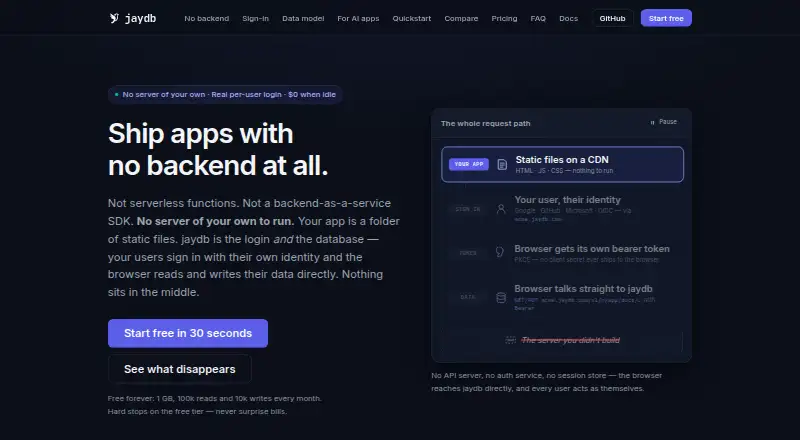
What JayDB is
JayDB is a JSON document database with per-user sign-in, intended for apps that need user, session, or tenant data without an app-owned backend. It is available as managed cloud software or as a self-hosted Go engine under the MIT license. Documents are JSON, MsgPack, or raw data stored at slash-separated paths; the first write creates the namespace. Its REST HTTP API supports GET, PUT, DELETE, and prefix listing, and documents can be up to 5 MB. ETag-based compare-and-swap lets a client detect changes since a document was read; the server can reject a stale write with HTTP 412. Browser apps can sign in through OIDC Authorization Code with PKCE, and listed identity providers include Google, GitHub, Microsoft, generic OIDC, and custom OAuth2. The official zero-dependency @jaydb/cloud SDK supports authentication, token refresh, typed document access, and compare-and-swap. The free plan includes 1 GB of storage, 100,000 reads and 10,000 writes per month, then hard-stops usage at those allowances. Metered rates are $0.05 per GB-month of storage, $0.20 per million reads, and $0.50 per million writes. Prepaid packs are $5 once for $6.50 of usage and $10 once for $15 of usage.
Who it suits
JayDB suits developers building AI-generated or static apps that need data associated with a user, session, or tenant. It also fits multi-user or worker-shared documents when a JSON document model and per-user sign-in meet the app's needs.
What it does well
- Offers managed cloud and a self-hosted MIT-licensed Go engine.
- Free plan includes 1 GB, 100,000 reads, and 10,000 writes monthly.
- REST API supports GET, PUT, DELETE, and prefix listing.
- PKCE sign-in and several identity provider options are supported.
- Official SDK includes token refresh and compare-and-swap operations.
What to know first
- No secondary indexes, joins, or full-text search.
- No transactions or atomic writes across multiple documents.
- No vector search or aggregation.
- Sustained writes to one hot key can lead to retry buildup.
Limits
The free plan allows 1 GB stored, 100,000 reads per month, and 10,000 writes per month; usage hard-stops at those amounts. Metered use costs $0.05 per GB-month stored, $0.20 per million reads, and $0.50 per million writes.
Plans
| Plan | Billed and limits | Price |
|---|---|---|
| Free | monthly, forever · 1 GB storage · 100,000 reads/month · 10,000 writes/month · hard stop at allowance · no credit card | Free |
| Storage metering | per GB-month · Metered per megabyte-hour | $0.05 a month |
| Read metering | per million reads · Single-read metering | $0.20 a month |
| Write metering | per million writes · Single-write metering | $0.50 a month |
| Usage pack | one-time prepayment · Prepays $15 of metered usage · 1.5× discount | $10, paid once |
| $10 prepaid pack | Prepays $15 of metered usage · 1.5× discount · same metered usage | $10, paid once |
| $5 prepaid pack | Prepays $6.50 of metered usage · 1.3× discount · same metered usage | $5, paid once |
As jaydb.com lists them, read 15 Oct 2026. The maker's own page has the final word.
Getting started
- Open the JayDB website.
- Choose the managed service or run the self-hosted Go engine.
- For a self-hosted deployment, select S3, S3-compatible storage, or local disk.
- Use the REST API or the official @jaydb/cloud SDK.
- For browser sign-in, configure OIDC with Authorization Code and PKCE.
- Start on the free plan or add a prepaid usage pack.
Overview
JayDB combines per-user sign-in with a JSON document store, giving static and AI-built apps a way to keep user, session, or tenant data without an app-owned backend. It is a focused choice for apps that can address documents by path; workloads built around querying relationships or updating several records together need a different database.
Key features
Path-based documents and HTTP
Documents live at slash-separated paths, and the first write creates the namespace automatically. The data plane uses standard REST HTTP for GET, PUT, DELETE, and prefix listing, with JSON, MsgPack, and Raw document formats. This gives clients a compact set of ways to read and change known documents, but JayDB has no secondary indexes, joins, foreign-key constraints, full-text search, or aggregation. It also has no vector search or transactions, so it is a poor fit for flexible discovery, relational data, or workflows requiring atomic changes across documents. Documents can be up to 5 MB.
Sign-in and SDK
Each tenant gets an OIDC issuer, and browser apps can use Authorization Code with PKCE without putting a client secret in the app. Supported identity integrations include Google, GitHub, Microsoft, generic OIDC, and custom OAuth2 providers. The official zero-dependency @jaydb/cloud SDK handles OIDC and PKCE authentication, token refresh, typed document access, and compare-and-swap operations. That combination is useful when an app needs user-scoped storage and wants to avoid building its own sign-in and data service.
Concurrency and hosting
ETag-based compare-and-swap can reject a write with HTTP 412 if a document changed after it was read, helping clients avoid silently overwriting one another. It does not provide multi-document atomicity, and sustained concurrent writes to a single hot key can cause retries to pile up. The managed cloud option uses AWS S3 or compatible storage for durability. The MIT-licensed Go engine can instead be embedded or run as a standalone server with S3, Cloudflare R2, MinIO, or local disk storage, giving teams a self-hosting route as well as managed hosting.
Pricing
JayDB is freemium, with no free trial. The Free plan costs nothing, billed Free every month, forever. It includes 1 GB stored, 100,000 reads per month, and 10,000 writes per month; usage hard-stops at those allowances. That is a useful way to start a small app, but the hard stops make it unsuitable for workloads that cannot tolerate an exhausted quota.
For paid usage, storage costs $0.05 per GB-month, reads cost $0.20 per million, and writes cost $0.50 per million. Deletes are free, and egress has no per-GB line item under fair use. The $5 prepaid pack costs $5, paid once and prepays $6.50 of metered usage, a 1.3× discount. The $10 prepaid pack costs $10, paid once and prepays $15 of metered usage, a 1.5× discount. These packs suit users who want a discounted balance for the same metered usage rather than a different feature tier.
Platforms
JayDB supports Android, iOS, Linux, macOS, Windows, web, and API use, as well as self-hosted deployment. Its managed-cloud and self-hosted options let teams choose between outsourcing operation and running the Go engine themselves.
Who it's for
JayDB is best suited to AI-built apps, multi-user or worker-shared documents, and state tied to a user, session, or tenant. It makes sense when data can be organized into individual documents and accessed through known paths. Choose another database when search, joins, indexes, aggregation, vector search, or atomic multi-document updates are core requirements.
Pros and cons
- Per-tenant OIDC and PKCE: browser apps can use sign-in without shipping a client secret, with several identity-provider options.
- Small, standard HTTP surface: REST operations and automatic namespace creation suit apps that need direct document access without a custom backend.
- Managed or self-hosted: the MIT-licensed Go engine can use S3-compatible storage or local disk.
- Hard limits on the free plan: reaching a monthly allowance stops usage rather than simply moving it onto metered billing.
- Narrow data model: no indexes, search, joins, aggregation, or cross-document transactions rules out many query-heavy and consistency-sensitive applications.
- Hot-key contention: sustained concurrent writes to one document can lead to accumulating retries.
Alternatives
Document Databases is a useful starting point for comparing other document-store options.
- PouchDB is a free option with Android, iOS, Linux, macOS, self-hosted, web, and Windows platforms.
- RavenDB is a freemium alternative with Developer and Community plans and support for API, Linux, macOS, self-hosted, web, and Windows.
- Apache CouchDB is free, open-source software for self-hosting on servers or VMs, as a single node or cluster.
- eXist-db is a free open-source option for academic, non-commercial, and commercial applications.
- Firestore is a freemium alternative with a free trial and Android, API, iOS, and web support.
- MarkLogic is a freemium alternative with a free trial and Developer and Enterprise plans.
- Apache AsterixDB is free open-source software for a self-managed cluster.
- Azure DocumentDB is a freemium option with a Free Tier that includes 32 GB of storage and one free database server per subscription.
Verdict
Choose JayDB for an app that needs per-user sign-in and straightforward JSON documents, with the choice of managed hosting or self-hosting. Its focused REST model and tenant-specific identity are the main reasons to pick it; the lack of query features and cross-document transactions is the reason to look elsewhere when data relationships or coordinated updates matter.
Verdict
Choose JayDB when an app needs per-user sign-in and straightforward JSON documents, with managed hosting or a self-hosted option. Look elsewhere if the data model requires joins, indexes, search, aggregation, vector search, or atomic changes across documents.
Questions
Is JayDB free?
Yes. Its free plan costs 0.00 USD and includes 1 GB stored, 100,000 reads per month, and 10,000 writes per month.
What do prepaid packs cost?
The $5 pack is a one-time purchase that prepays $6.50 of metered usage. The $10 pack prepays $15 of usage.
Can JayDB be self-hosted?
Yes. Its Go engine is MIT-licensed and can run as a standalone server or be embedded, using S3, S3-compatible storage, or local disk.
What platforms are listed?
The listed platforms are Android, API, iOS, Linux, macOS, self-hosted, web, and Windows.
Which sign-in providers are supported?
The listed options are Google, GitHub, Microsoft, generic OIDC, and custom OAuth2 identity providers.
Does JayDB support transactions?
No. Transactions are listed as unavailable, and JayDB does not provide atomic writes across multiple documents.
Facts from JayDB's own pages
- AI tooling
- The independent @jaydb/mcp package exposes get, put, delete, list and health tools for Cursor, Claude Desktop, Antigravity and Cline. · npmjs.com, 15 Oct 2026
- API
- The data plane uses standard REST HTTP and supports GET, PUT, DELETE, and prefix listing. · jaydb.com, 7 Oct 2026
- Authentication
- Each tenant exposes an OIDC issuer and supports Authorization Code with PKCE, so browser clients do not need embedded secrets. · jaydb.com, 15 Oct 2026
- Caching
- Recently used documents are served from an in-memory cache and concurrent misses are coalesced into one object-storage read. · jaydb.com, 15 Oct 2026
- Company identity
- The pages reviewed do not state a legal maker name, headquarters or founding year for JayDB. · jaydb.com, 15 Oct 2026
- Concurrency
- HTTP ETags provide optimistic compare-and-swap writes, with failed version checks returning HTTP 412. · jaydb.com, 15 Oct 2026
- Concurrency limit
- The pricing page says sustained concurrent writes to one hot key can cause retries to pile up. · jaydb.com, 7 Oct 2026
- Data model
- Keys are slash-separated paths that hold JSON documents, and the first write creates the namespace automatically. · jaydb.com, 7 Oct 2026
- Documentation depth
- The documentation site covers quickstart, architecture, CAS, read-modify-write, REST endpoints, embedded Go usage, clustering, metrics and an LLM-readable API specification. · jaydb.com, 15 Oct 2026
- Document model
- Data is stored as JSON documents addressed by slash-separated hierarchical paths inside namespaces. · jaydb.com, 15 Oct 2026
- Durability
- Durable data is kept in AWS S3 or compatible object storage such as Cloudflare R2, MinIO or Wasabi. · jaydb.com, 15 Oct 2026
- Frontend SDK
- JayDB publishes a zero-dependency browser package named @jaydb/cloud with typed document operations, token refresh and CAS support. · jaydb.com, 15 Oct 2026
- Go embedding
- The engine can be imported as a pure Go library and run in-process without network hops. · jaydb.com, 15 Oct 2026
- Identity integrations
- The site lists Google, GitHub, Microsoft, generic OIDC, and custom OAuth2 identity providers. · jaydb.com, 7 Oct 2026
- Identity providers
- The hosted service can connect Google, GitHub, Microsoft, generic OIDC and custom OAuth2 identity providers. · jaydb.com, 15 Oct 2026
- Independent site check
- Scamadviser reports a valid SSL certificate and a DNSFilter safe label for jaydb.com. · scamadviser.com, 15 Oct 2026
- Independent site limitation
- Scamadviser reports that the domain owner identity is hidden in WHOIS, traffic rank is low and the domain is young. · scamadviser.com, 15 Oct 2026
- Intended users
- The site presents JayDB for AI-built apps, multi-user or worker-shared documents, and state tied to a user, session, or tenant. · jaydb.com, 7 Oct 2026
- License
- The project states that its open-source engine is released under the MIT license. · jaydb.com, 15 Oct 2026
- Limit: contention
- JayDB warns that sustained concurrent writes to one hot key can cause retries to pile up and may favor a lock-based database. · jaydb.com, 15 Oct 2026
- Limit: free usage
- Free-tier requests stop with a rate-limit response after the storage, read or write allowance is reached rather than generating overage billing. · jaydb.com, 15 Oct 2026
- Limit: query features
- The product page says JayDB has no field-based secondary indexes, joins, foreign-key constraints, full-text search or aggregation. · jaydb.com, 15 Oct 2026
- Limit: transactions
- The product page says writes cannot be made atomically across multiple documents. · jaydb.com, 15 Oct 2026
- MCP package license
- The @jaydb/mcp npm package is published under MIT and provides a local-server option using npx. · npmjs.com, 15 Oct 2026
Where JayDB stands on Freedom251
- Document Databases#1 of 28