Freedom251 › Direct Mail Automation Software

PostPilot
What PostPilot is
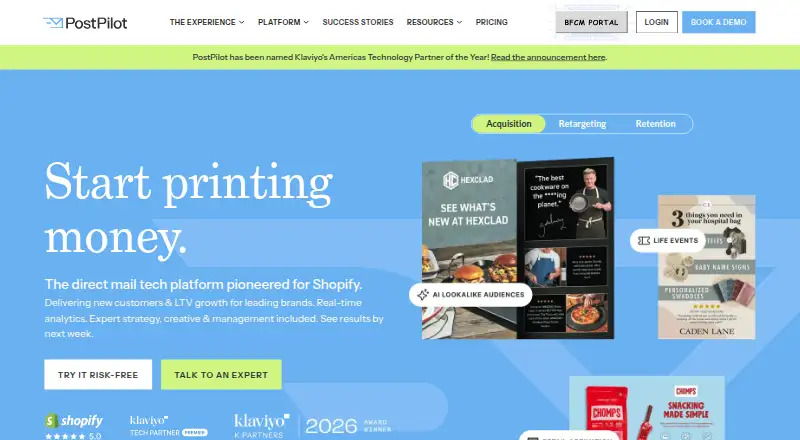
PostPilot is a direct mail platform for ecommerce brands using postcard and catalog campaigns to acquire, retarget, and retain customers. Campaign options include prospecting, retargeting, abandoned carts, loyalty, subscriptions, winback, and retail. MailMatch connects email addresses to physical mailing addresses, while AcquisitionAI finds lookalike prospects and SiteMatch retargets anonymous site browsers. Reporting includes real-time campaign dashboards, holdout-tested iROAS measurement, and cross-channel attribution. Integrations include Shopify, Klaviyo, Yotpo, Attentive, Omnisend, Recharge, Loyalty Lion, and Loop Subscriptions; an open API connects data from other systems. PostPilot automatically tracks Shopify customers who receive a postcard or handwritten card for 60 days, and there is no sending minimum. The free plan has no platform cost, but postcards and postage are paid separately. Growth costs $82.50 a month with annual billing or 99 USD per month with monthly billing. AcquisitionAI Prospecting carries a 0.07 USD per-recipient data fee. The platform is available on the web and through an API.
Who it suits
PostPilot suits ecommerce brands using direct mail for acquisition, retargeting, or customer retention. Its plans describe Growth for brands doing $1m–$3m/year in sales, Pro for up to 50,000 monthly mailpieces, and Enterprise for more than 50,000.
What it does well
- No sending minimum.
- Free plan has no platform cost.
- Campaigns include prospecting, loyalty, and winback.
- Open API can connect other systems.
- Real-time dashboards include cross-channel attribution.
What to know first
- Postcards and postage cost extra on the free plan.
- AcquisitionAI Prospecting data costs $0.07 per recipient.
- Shopify recipient tracking is limited to 60 days.
- Enterprise pricing is custom and not listed.
Limits
The free plan has no platform cost, but postcards and postage are charged separately. AcquisitionAI Prospecting carries a $0.07 per-recipient data fee.
Plans
| Plan | Billed and limits | Price |
|---|---|---|
| Free | No commitment; no cost to get started · Full platform · 10+ analytics reports · customer socio-demographic reports · category benchmarks | Free |
| Pro Services | $419/mo annual billing or $499/mo monthly; two months free annually · 64¢ or less per piece by volume · up to 50,000 mailpieces/month · dedicated account manager · data science · unlimited creative · full PostPilot AI suite · SiteMatch and MailMatch | $419 a month |
| Pro | $419/mo annual billing; $499/mo monthly billing · 64¢ or less per mailpiece including postage, based on volume · built for up to 50,000 mailpieces/month | $419 a month |
| Growth | $82.50/mo annual billing; $99/mo monthly billing · Cards from 68¢ including postage · built for brands doing $1m–$3m/yr in sales | $82.50 a month |
| Growth Services | $82.50/mo annual billing or $99/mo monthly; two months free annually · Cards from 68¢ with postage · brands doing $1m–$3m/year · automated retargeting and retention · Amazon Seller Central integration · strategy call · monthly design | $82.50 a month |
| Enterprise | Custom · Built for brands sending 50,000+ mailpieces/month · custom volume pricing | On request |
| Enterprise Services | Custom pricing · 50,000+ mailpieces/month · dedicated account manager and coordinator · data science team · early access · unlimited creative · migration and management · custom reporting and development | On request |
As postpilot.com lists them, read 15 Oct 2026. The maker's own page has the final word.
Getting started
- Visit the PostPilot website.
- Choose the free plan or a paid plan.
- Use the web platform or connect through the API.
- Connect a listed service such as Shopify or Klaviyo if needed.
- Create a direct mail campaign and select its campaign type.
PostPilot is a direct-mail platform for ecommerce brands, connecting postcard and catalog campaigns with customer and site data. It is strongest for merchants coordinating acquisition and retention across several campaign types; occasional senders may find its paid tiers more than they need.
Overview
PostPilot supports prospecting, retargeting, abandoned-cart, loyalty, subscription, winback, and retail campaigns. That range makes it a fit for brands building mail into an ongoing customer program, rather than a one-off mailing workflow. There is no sending minimum, so a brand can mail a single card, though card and postage costs apply even on the free plan.
Key features
Audience building and personalization
MailMatch connects email addresses to physical mailing addresses using PostPilot’s proprietary algorithm and dataset. AcquisitionAI finds prospects through lookalike audiences, while SiteMatch retargets anonymous site browsers. Together, these tools make PostPilot particularly relevant to ecommerce marketers seeking to extend digital audiences into physical mail. AcquisitionAI prospecting data costs $0.07 per recipient, a variable charge to account for when targeting large audiences. The platform supports one-to-one personalization and address verification.
Measurement and connections
Real-time dashboards, holdout-tested iROAS measurement, and cross-channel attribution give marketing teams ways to evaluate mail’s contribution. Shopify customer recipients are automatically tracked for 60 days. PostPilot connects with services including Shopify, Klaviyo, Yotpo, Attentive, Omnisend, Recharge, Loyalty Lion, and Loop Subscriptions, and offers an open API for connecting other systems. The company says aggregated, anonymized transactional data trains its AI products; customers cannot access or specifically benefit from another customer’s data.
Mail formats include 4x6, 6x9, and 6x11 postcards, handwritten cards, Cardalogs, and A5 pieces. The breadth is useful for teams varying their mail creative, while the API and ecommerce integrations are more compelling for data-led campaigns than for simple print-and-send needs.
Pricing
PostPilot is freemium, but free means access to the platform rather than free mail. Every plan requires payment for postcards and postage, and the paid tiers add a subscription charge.
| Plan | Price and terms | Best fit |
|---|---|---|
| Free | free; no cost to start, pay only for postcards and postage; full platform and 10+ analytics reports. | Brands evaluating the platform or sending occasionally. It avoids a subscription but not per-piece costs. |
| Growth | $82.50 a month billed annually, or $99/mo monthly billing; cards from 68¢ including postage. | Brands doing $1m–$3m/year in sales. It is the entry paid tier, with a lower card price than the free-plan description, but requires a recurring fee. |
| Pro | $419 a month billed annually, or $499/mo monthly billing; 64¢ or less per mailpiece including postage, based on volume. | Brands sending up to 50,000 mailpieces monthly. Its volume-based per-piece price may suit higher throughput, but the subscription is substantially higher. |
| Enterprise | Custom pricing; custom volume pricing. | Brands sending more than 50,000 mailpieces monthly. |
Growth and Pro are priced for different sales and mailing scales, so the cheaper annual Growth rate is not necessarily the better fit for a high-volume sender. The published paid-from price is $82.50 a month on annual billing. No trial is needed to start with the free plan, and the pricing FAQ says there is no minimum order.
Platforms
PostPilot is available on web and through an API. The API is useful for teams connecting campaign data from systems beyond the named integrations; teams seeking only a basic web mail tool may not need that flexibility.
Who it's for
PostPilot suits ecommerce brands that want to coordinate customer acquisition, re-engagement, and retention through direct mail, particularly those already using ecommerce and marketing platforms such as Shopify or Klaviyo. Growth is aimed at brands with $1m–$3m in annual sales, while Pro and Enterprise address larger mailing volumes. A small business testing a few pieces can start free, but should budget for the cards and postage.
Pros and cons
- Pros: One platform covers prospecting through winback and retail campaigns, rather than only sending mail.
- Pros: Dashboards, holdout-tested iROAS, cross-channel attribution, and 60-day Shopify recipient tracking support campaign evaluation.
- Pros: No minimum send and a full-featured free platform lower the barrier to trying direct mail.
- Cons: Free does not include cards or postage, and Growth and Pro add monthly costs.
- Cons: AcquisitionAI prospecting data costs $0.07 per recipient, adding expense as audiences scale.
- Cons: The defined Growth and Pro sales or volume targets may not suit organizations outside those ranges; Enterprise requires custom pricing.
Alternatives
Direct Mail Automation Software is the broader category to browse when comparing more options. Choose DocuPost instead if a free web/API plan with one user, letters and postcards, no send limits, and pay-per-mailpiece pricing better fits your workflow. Inkit is another freemium web/API option, with a free tier that includes three signature requests monthly, one seat, and 10GB of storage.
Consider Lob Address Verification if the priority is address verification, or Postalytics if unlimited campaigns, templates, and lists on a one-user free plan are more important. Sincerely offers a free audit plan that cannot mail, while Stannp has a free tier with one user, one template, 50,000 contacts, and 20 virtual printer items monthly. thanks.io offers pay-as-you-go with no monthly subscription fee, and ZAP~POST is another option to compare.
Verdict
PostPilot is a strong choice for ecommerce brands that want direct mail tied to customer data, multiple campaign goals, and measurable performance across channels. Its range of audience tools and campaign reporting is the main reason to choose it; the reasons to look elsewhere are equally clear for smaller or price-sensitive senders: mailed pieces cost extra even on Free, AI prospecting carries a recipient fee, and paid plans become costly as monthly volume rises.
Verdict
PostPilot covers a wide range of ecommerce direct mail campaigns, with integrations, reporting, and API access. The free plan still requires payment for postcards and postage, and paid options include per-recipient or monthly costs.
Questions
Is PostPilot free?
Yes. Its Free plan has no platform cost, and customers pay for postcards and postage.
How much does Growth cost?
Growth is $82.50 per month with annual billing or $99 per month with monthly billing.
What platforms does PostPilot support?
PostPilot is available on the web and through an API.
Is there a minimum number of cards to send?
No. The pricing FAQ says customers can send one card or one million.
Which services does PostPilot integrate with?
Listed integrations include Shopify, Klaviyo, Yotpo, Attentive, Omnisend, Recharge, Loyalty Lion, and Loop Subscriptions.
What does AcquisitionAI Prospecting cost?
Its data fee is $0.07 per recipient.
Facts from PostPilot's own pages
- Acquisition targeting
- AcquisitionAI uses large third-party attribute and intent datasets to find prospects resembling a brand’s best customers, with audience creation described as taking hours. · postpilot.com, 15 Oct 2026
- AI
- AcquisitionAI is described as a lookalike engine for finding prospects, and SiteMatch retargets anonymous site browsers. · postpilot.com, 3 Oct 2026
- AI data use
- PostPilot says aggregated and anonymized transactional data is used to train its AI products and that customers cannot access or specifically benefit from another customer's data. · postpilot.com, 3 Oct 2026
- AI usage fee
- The AI FAQ lists an AcquisitionAI Prospecting data fee of $0.07 per recipient. · postpilot.com, 3 Oct 2026
- Analytics
- The service provides real-time campaign dashboards, holdout-tested incremental ROAS measurement and cross-channel attribution. · postpilot.com, 15 Oct 2026
- API
- PostPilot says it offers an open API to connect data from other systems to direct mail campaigns. · postpilot.com, 3 Oct 2026
- API documentation depth
- Help articles include endpoint paths, JSON examples, segment setup instructions, custom-field use, troubleshooting guidance and flow-versus-segment differences. · help.postpilot.com, 15 Oct 2026
- API limitation
- Flows are being deprecated for new API campaigns, while Recharge, Omnisend, Loyalty Lion and LifeMatch birthday campaigns still require flows. · help.postpilot.com, 15 Oct 2026
- API security controls
- API connection URLs contain bearer-like connection tokens; users can disable or regenerate URLs, which invalidates previous URLs, and inspect the last 48 hours of calls. · help.postpilot.com, 15 Oct 2026
- Campaigns
- The platform supports prospecting, retargeting, abandoned cart, loyalty, subscription, winback, and retail campaigns. · postpilot.com, 3 Oct 2026
- Capterra-listed capabilities
- Capterra lists campaign management, event-triggered actions, import/export, delivery tracking, analytics, printing-services integration, design management and mailer templates. · capterra.com, 15 Oct 2026
- CartMatch
- CartMatch targets abandoned-cart customers, including people whose postal address is not known. · crunchbase.com, 15 Oct 2026
- Category benchmarks
- Category Insights uses anonymized data from other stores and requires at least 10 brands in a category before reporting is shown. · postpilot.com, 15 Oct 2026
- Company legal name
- Crunchbase identifies the legal name as PostPilot, Inc. and operating status as active. · crunchbase.com, 15 Oct 2026
- Company size and headquarters
- LinkedIn lists PostPilot as privately held, headquartered in New York, with 51–200 employees. · linkedin.com, 15 Oct 2026
- Customer insights
- Customer Insights uses aggregated third-party datasets with thousands of attributes to describe characteristics of a brand’s customers. · postpilot.com, 15 Oct 2026
- Data-use requirement
- PostPilot AI requires opt-in to use aggregated and anonymized transactional data for model training; customers can opt out and continue ordinary campaigns, but AI features then become unavailable. · postpilot.com, 15 Oct 2026
- Design tools
- Users can choose customizable templates, use a drag-and-drop editor, personalize fields or upload finished artwork; monthly plans include professional design services. · postpilot.com, 15 Oct 2026
- Founded-year discrepancy
- LinkedIn lists 2015 as the founding year, while Inc.’s company profile lists 2018. · linkedin.com, 15 Oct 2026
- Funding
- A June 5, 2024 announcement says PostPilot received its first major equity transaction from Summit Partners with participation by Klaviyo founders Andrew Bialecki and Ed Hallen; the amount was not disclosed. · prweb.com, 15 Oct 2026
- Handwritten cards
- PostPilot says its handwritten cards use robotic real-pen writing with variable letter spacing and indentation so cards differ from one another. · postpilot.com, 15 Oct 2026
- Independent company profile
- Inc. describes PostPilot as creating and sending personalized automated direct mail and handwritten notes, with 2018 founding, New York location and 51–200 employees. · inc.com, 15 Oct 2026
- Integrations
- The integration directory lists 14 integrations and highlights Shopify, Klaviyo, Attentive, Postscript, Yotpo, Orita, Swym, StayAI, Skio, Smile and Digioh. · postpilot.com, 15 Oct 2026
- LifeMatch
- LifeMatch currently supports birthday campaigns and the company says additional milestones such as marriage and having children are planned. · postpilot.com, 15 Oct 2026
Where PostPilot stands on Freedom251
- Direct Mail Automation Software#7 of 28