Freedom251 › Business Phone Systems
PortSIP PBX
What PortSIP PBX is
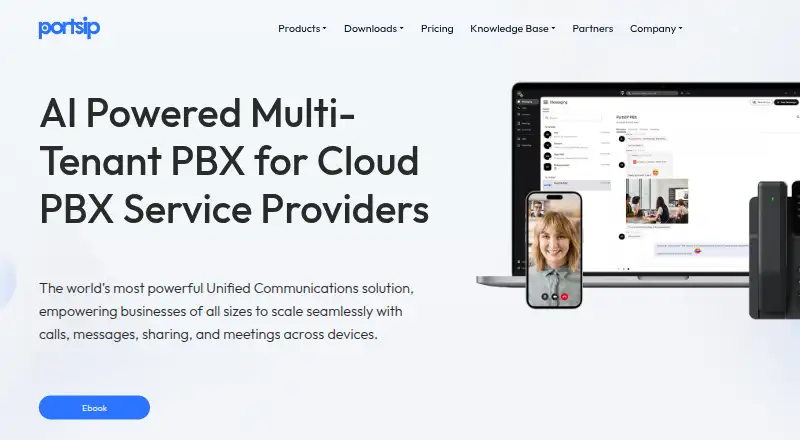
PortSIP PBX is a multi-tenant communications platform for service providers and MVNOs building Cloud PBX, UCaaS, CPaaS, or CCaaS services. It brings calling, SMS, WhatsApp, team messaging, contact center tools, and voice and video meetings together. Call handling includes custom routing, an auto attendant, voicemail transcription, and support for multiple business numbers. The contact center includes skill-based routing, queue strategies, live wallboards, analytics, callback, and real-time monitoring and training tools. AI functions include call and voicemail transcription, generated notes and summaries, and sentiment analysis.
Organizations can deploy PortSIP PBX in a customer data center, on premises, or on Azure, AWS, or Google Cloud, including through Docker. PortSIP says a deployment can support 50,000–100,000 simultaneous online users. Microsoft 365 integration supports user provisioning, single sign-on in web and native apps, and directory and contact synchronization. Developer tools include REST APIs, Pub/Sub, messaging APIs, webhooks, a calling SDK, and call control APIs. PortSIP PBX and its apps support SRTP and DTLS-SRTP media encryption, with AES-256 when enabled. A free edition costs nothing and includes all features, up to 3 extensions, and up to 2 simultaneous calls. Desktop and mobile apps are available across Android, iOS, Linux, Windows, and web; the Linux PBX is installed using Docker on Debian or Ubuntu.
Who it suits
PortSIP PBX suits service providers and MVNOs that need a communications platform spanning telephony, messaging, meetings, and contact center operations. Its deployment choices, developer APIs, and Microsoft 365 integration also suit organizations building or connecting communication services.
What it does well
- Free Edition includes all features.
- Custom call routing and an auto attendant are included.
- Contact center tools include skill-based routing and live wallboards.
- Deploy on premises, in a data center, or on major cloud platforms.
- Microsoft 365 integration includes provisioning, SSO, and contact synchronization.
What to know first
- Free Edition is limited to 3 extensions and 2 simultaneous calls.
- Licensed Edition prices are available by quote only.
- Linux PBX installation uses Docker and lists Debian and Ubuntu.
Limits
The Free Edition costs nothing and allows up to 3 extensions and 2 simultaneous calls. Licensed editions include all features, are licensed by extension users, and require a quote for pricing.
Plans
| Plan | Billed and limits | Price |
|---|---|---|
| Free Edition | Up to 2 simultaneous calls · 3 extensions · all features included | Free |
| Licensed Edition — Perpetual | Access to all features · License based on extension users | On request |
| Licensed Edition — Annual | Access to all features · License based on extension users | On request |
| Perpetual license | Quote required · Licensed by extension users · 1:1 simultaneous call ratio · all features included | On request |
| Annual license | Quote required · Licensed by extension users · 1:1 simultaneous call ratio · all features included | On request |
As portsip.com lists them, read 11 Oct 2026. The maker's own page has the final word.
Getting started
- Visit the PortSIP website.
- Choose the Free Edition or request a quote for a licensed edition.
- For a Linux PBX, use Docker on Debian or Ubuntu.
- Choose a supported client platform, including Android, iOS, Linux, web, or Windows.
- Connect Microsoft 365 if you need its provisioning, SSO, and directory synchronization features.
PortSIP PBX is a multi-tenant communications platform for service providers and MVNOs building voice, messaging, and contact-center services. It fits operators that need deployment control, broad communications features, and developer interfaces. Its free edition includes all features, but the two-call limit and quote-based paid licenses make growth planning essential.
Overview
PortSIP combines Cloud PBX, UCaaS, CPaaS, and CCaaS in one platform, bringing together calling, SMS, WhatsApp, team messaging, voice and video meetings, and contact-center functions. That breadth gives providers a base for offering several kinds of communications service. A small organization that only needs routine business calling may find the platform broader than its needs.
Operators can deploy it in a customer data center, on premises, or on Azure, AWS, or Google Cloud, with Docker deployment. PortSIP says a single deployment can support 50,000–100,000 simultaneous online users, making the stated scale relevant to service providers. The Linux PBX installation uses Docker, and the download page names Debian and Ubuntu, so deployment calls for infrastructure capability.
Key features
Calling and contact center
Custom call routing and an auto attendant provide control over how calls reach people, while voicemail transcription can make messages easier to review. Contact-center tools include skill-based routing, queue strategies, live wallboards, analytics, callbacks, and real-time monitoring and training. This is a substantial set for operators serving support teams; smaller teams may have little use for the contact-center depth.
AI, integrations, and security
AI functions cover call and voicemail transcription, generated notes and summaries, and sentiment analysis. Microsoft 365 integration supports user provisioning, single sign-on in web and native apps, and directory and contact synchronization. REST APIs, Pub/Sub, messaging APIs, webhooks, a calling SDK, and call-control APIs give developers several ways to connect services or build on the platform.
PortSIP PBX and its apps support SRTP and DTLS-SRTP media encryption, with AES-256 when enabled. PortSIP also lists GDPR, EU standard contractual clauses, EU-US and Swiss-US privacy frameworks, and APEC privacy programs among its compliance options. The product page advertises 24 x 7 support, a useful provision for operators running communications services across time zones.
Pricing
The Free Edition costs nothing and includes all features, three extensions, and up to two simultaneous calls. That makes it a practical way to evaluate the platform or serve a very small installation, but the call ceiling is firm: feature access does not remove the capacity limit.
Licensed Edition — Perpetual and Licensed Edition — Annual both include all features and are priced by extension users, with custom pricing. The Perpetual license and Annual license are also quoted by extension users, include all features, and use a 1:1 simultaneous-call ratio. Buyers should compare the two licensing terms with PortSIP and size extensions against expected concurrent calls before moving beyond the free caps; no published price allows a straightforward cost comparison.
Platforms
PortSIP supports Android, iOS, Linux, web, and Windows, as well as self-hosted deployments and an API. Desktop and mobile apps are available. This mix suits organizations that need user access across common desktop and mobile systems alongside control over where the PBX runs.
Who it's for
PortSIP is best suited to service providers and MVNOs building multi-tenant communications services, particularly those that need contact-center features, APIs, and a choice of hosting environments. Its scale claim and deployment flexibility are relevant to operators managing their own infrastructure. Organizations seeking a simple, ready-to-use phone service may be better served by a narrower product.
Pros and cons
Pros
- All features are included in the free edition, allowing evaluation without withholding the broader toolset.
- Deployment can run on premises, in a customer data center, or on major cloud platforms, with Docker support.
- Contact-center tools, AI functions, Microsoft 365 integration, and developer APIs cover varied operator needs.
- PortSIP states that a deployment can support 50,000–100,000 simultaneous online users.
Cons
- The free edition stops at three extensions and two simultaneous calls, limiting its usefulness for growing teams.
- Paid license prices require a quote, so buyers cannot readily estimate costs from the published plans.
- Docker-based Linux installation and the range of deployment choices favor teams with infrastructure skills over organizations seeking a turnkey phone service.
Alternatives
Business Phone Systems is a useful category to browse when comparing options for general business calling.
Choose Microsoft Teams if your priority is meetings and collaboration across desktop and mobile platforms: its free plan allows 100 participants, 60-minute group meetings, and 5 GB of cloud storage. Choose 3CX if a smaller free phone system is a closer fit; its 4SC Basic Free plan supports 10 users and four simultaneous calls, with manual annual renewal.
VitalPBX is another free PBX option, with a Community plan supporting 12 extensions and two VitXi WebRTC clients. Zadarma offers a free Standard plan for five users, with four voice menus and 200 MB of storage. Freshcaller may suit teams comparing a cloud call-center option; its Free plan provides unlimited agents at $0/agent/month plus per-minute charges, billed annually.
OnSIP offers a free plan for up to 100 users with unlimited extensions, though phone-number dialing is unavailable. Talkroute is another business phone option to compare, with a Basic plan for one user, one phone number, one mailbox, and 500 text messages per month. CallHippo has a free Basic plan for the first six months after signup.
Verdict
Choose PortSIP PBX if you operate a service provider or MVNO and need a scalable, multi-tenant platform with deployment choice, contact-center tools, and developer access. Its free edition exposes the full feature set, but only up to two simultaneous calls; organizations expecting more capacity should get a license quote and confirm the extension-based terms. Teams wanting straightforward business calling without infrastructure responsibilities should look elsewhere.
Verdict
Choose PortSIP PBX if you need a broad communications platform with a free edition and multiple deployment options. The free edition has firm extension and simultaneous-call caps, while license prices require a quote, so organizations planning beyond those limits should review licensing with PortSIP.
Questions
Is PortSIP PBX free?
Yes. The Free Edition costs nothing and includes all features, up to 3 extensions, and up to 2 simultaneous calls.
How much do the licensed editions cost?
Prices are not provided for the perpetual or annual licensed editions. Perpetual and annual licenses require a quote and are based on extension users.
Which platforms does PortSIP PBX support?
Listed platforms are Android, API, iOS, Linux, self-hosted, web, and Windows. The Linux PBX download page lists Debian and Ubuntu and uses Docker installation.
Who makes PortSIP PBX?
The site footer identifies the company as PortSIP Solutions, Inc.
Does PortSIP PBX integrate with Microsoft 365?
Yes. The integration supports user provisioning, SSO in web and native apps, and directory and contact synchronization.
What deployment options are available?
PortSIP PBX can run in a customer data center, on premises, or on Azure, AWS, and Google Cloud, with Docker deployment.
Facts from PortSIP PBX's own pages
- AI
- AI features include call and voicemail transcription, generated notes and summaries, and sentiment analysis. · portsip.com, 11 Oct 2026
- Auto attendant
- Yes · portsip.com, 22 Sept 2026
- Business numbers
- multiple · portsip.com, 22 Sept 2026
- Call routing
- custom · portsip.com, 22 Sept 2026
- Communications
- The platform combines call routing, SMS, WhatsApp, team messaging, contact center, and voice and video meetings. · portsip.com, 11 Oct 2026
- Contact center
- Contact center features include skill-based routing, queue strategies, live wallboards, analytics, callback, and real-time monitoring and training tools. · portsip.com, 11 Oct 2026
- Deployment
- PortSIP PBX can run in a customer data center, on premises, or on Azure, AWS, and Google Cloud, with Docker deployment. · portsip.com, 11 Oct 2026
- Desktop and mobile apps
- Yes · portsip.com, 22 Sept 2026
- Developer APIs
- The product offers REST APIs, Pub/Sub, messaging APIs, webhooks, a calling SDK, and call control APIs. · portsip.com, 11 Oct 2026
- Free plan
- Yes · portsip.com, 22 Sept 2026
- Included users
- 3 · portsip.com, 22 Sept 2026
- Integrations
- Microsoft 365 integration supports user provisioning, SSO in web and native apps, and directory and contact synchronization. · portsip.com, 11 Oct 2026
- Maker
- The site footer identifies the company as PortSIP Solutions, Inc. · portsip.com, 11 Oct 2026
- Platform requirements
- The PBX download page lists Debian and Ubuntu and says the Linux PBX is installed using Docker. · portsip.com, 11 Oct 2026
- Privacy and compliance
- PortSIP lists GDPR, EU standard contractual clauses, EU-US and Swiss-US privacy frameworks, and APEC privacy programs among its compliance options. · portsip.com, 11 Oct 2026
- Product
- PortSIP PBX is a multi-tenant communications platform for service providers and MVNOs offering Cloud PBX, UCaaS, CPaaS, and CCaaS services. · portsip.com, 11 Oct 2026
- Scale
- PortSIP says one deployment can support 50,000–100,000 simultaneous online users. · portsip.com, 11 Oct 2026
- Security
- PortSIP PBX and its apps support SRTP and DTLS-SRTP media encryption, with AES-256 when enabled. · support.portsip.com, 11 Oct 2026
- Support
- The product page advertises 24 x 7 support. · portsip.com, 11 Oct 2026
- Voicemail transcription
- Yes · portsip.com, 22 Sept 2026
Where PortSIP PBX stands on Freedom251
- Business Phone Systems#3 of 167
- Call Management system#8 of 30
- IP PBX Software#6 of 19