Freedom251 › Conversational AI Platforms

Pipecat
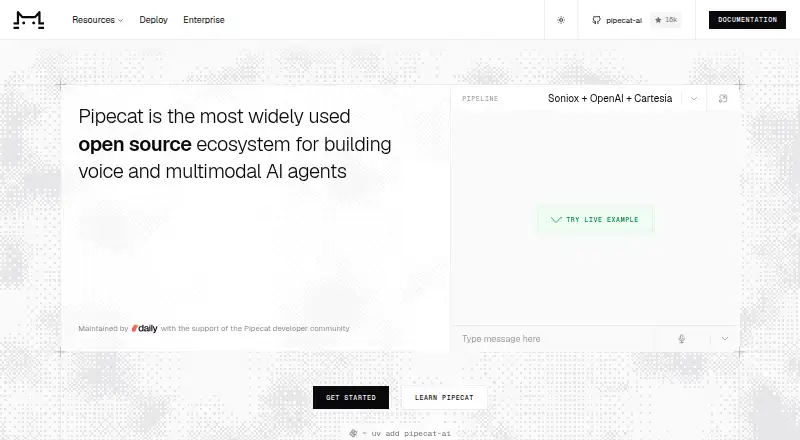
What Pipecat is
Pipecat is an open-source ecosystem for building voice and multimodal AI agents. Its pipelines coordinate voice, video, text, and images, with frame-level control over conversation steps. Frames stream through the pipeline as they are produced, allowing an agent to begin responding while a user is still speaking. The framework includes interruption handling, turn detection, smart context management, subagent handoffs, and Pipecat Flows. Its homepage says it integrates with more than 200 providers and services for speech, language, and vision.
The listed transports include WebRTC, SIP, and PSTN. Pipecat also lists client SDKs, a UI kit, metrics, traces, and OpenTelemetry. It can run on self-managed infrastructure wherever Python runs or be deployed to Pipecat Cloud, which provides scaling and observability. Cloud features include multi-region autoscaling, monitoring and telemetry, recordings, persistent storage for session transcriptions, and simulation and evaluation integrations. Pipecat Cloud lists integrated PSTN and SIP telephony, Krisp noise cancellation, and connections to more than 80 service providers. Pipecat Enterprise offers Cloud in a customer's AWS, Azure, or GCP environment, with enterprise support.
Who it suits
Pipecat suits developers building voice or multimodal agents who want an open-source framework and a choice between self-managed infrastructure and cloud deployment. Teams working with telephony, real-time conversations, or enterprise deployment in AWS, Azure, or GCP may find its listed transports and deployment options relevant.
What it does well
- Open-source ecosystem with a free plan.
- Coordinates voice, video, text, and images.
- Integrates with more than 200 providers and services.
- Offers self-managed and cloud deployment options.
- Supports inbound calls, outbound calls, and human handoff.
What to know first
- Pipecat Cloud hosting is usage-based.
- Third-party services connected with customer keys are billed by their providers.
Limits
The listed Pipecat Cloud prices include $0.001 per participant minute for Daily WebRTC voice and $0.004 per participant minute for voice and video. Hosting is usage-based, with agent-1x at $0.01 per active minute and $0.0005 per reserved minute, agent-2x at $0.02 per active minute and $0.0010 per reserved minute, and agent-3x at $0.03 per active minute and $0.0015 per reserved minute. Third-party services connected with customer keys are billed by their provider.
Plans
| Plan | Billed and limits | Price |
|---|---|---|
| Pipecat framework | free open-source framework · BSD-2-Clause · self-host anywhere · third-party AI and transport costs separate | Free |
| Pipecat Cloud agent-1x reserved | per reserved agent-minute · 0.5 vCPU · 1 GB memory · always-on billing | Free |
| Pipecat Cloud | Usage-based; agent hosting is priced per active or reserved minute. · agent-1x: $0.01/min active, $0.0005/min reserved · agent-2x: $0.02/min active, $0.0010/min reserved · agent-3x: $0.03/min active, $0.0015/min reserved · Unlimited concurrency · 1:1 Daily WebRTC voice transport is free | $0.01 a month |
| Pipecat Cloud agent-1x active | per active agent-minute · 0.5 vCPU · 1 GB memory · voice agents | $0.01 a month |
| Pipecat Cloud agent-2x active | per active agent-minute · 1 vCPU · 2 GB memory · voice and video agents | $0.02 a month |
| Pipecat Cloud agent-3x active | per active agent-minute · 1.5 vCPU · 3 GB memory · voice and video plus additional processing | $0.03 a month |
| Pipecat Cloud Enterprise | custom enterprise pricing · bundled inference available · enterprise support | On request |
As pipecat.ai lists them, read 15 Oct 2026. The maker's own page has the final word.
Getting started
- Visit the Pipecat website.
- Choose a listed platform or run it on self-managed infrastructure wherever Python runs.
- Build a pipeline using the conversation features and transports you need.
- Deploy on your infrastructure or use Pipecat Cloud.
- For a customer-environment cloud deployment, review Pipecat Enterprise.
Verdict
Choose Pipecat if you need an open-source framework for real-time voice or multimodal agents, with self-managed or cloud deployment options. Consider the usage-based cloud charges and separate provider billing when planning to use connected services.
Questions
Is Pipecat free or open source?
Pipecat is listed as free, with an open-source pricing note and a free plan.
Which platforms are listed?
Android, API, iOS, Linux, macOS, self-hosted, web, and Windows are listed.
Can I run Pipecat myself?
Yes. It can run on self-managed infrastructure wherever Python runs.
What does Pipecat Cloud cost?
The plan is listed at $0.01 a month and is usage-based. Listed agent hosting rates range from $0.0005 to $0.0015 per reserved minute and from $0.01 to $0.03 per active minute, depending on agent size.
Does Pipecat support phone calls and handoff?
Yes. Inbound calls, outbound calls, and human handoff are listed.
What integrations and transports are listed?
The transports include WebRTC, SIP, and PSTN. Pipecat Cloud lists integrated PSTN and SIP telephony, Krisp noise cancellation, and bring-your-own-provider connections for more than 80 service providers.
Facts from Pipecat's own pages
- AWS Marketplace pricing
- AWS Marketplace lists Enterprise support at $5,000 per month and Healthcare Enterprise support at $5,500 per month, with usage charges extra. · aws.amazon.com, 15 Oct 2026
- Capabilities
- Its pipelines can coordinate voice, video, text, and images, with frame-level control over conversation steps. · pipecat.ai, 8 Oct 2026
- CLI
- The Pipecat CLI installs through the pipecat-ai package and can scaffold a runnable project with pipecat init. · github.com, 15 Oct 2026
- Client SDKs
- Official client SDKs are available for JavaScript, React, React Native, Swift, Kotlin, C++, and ESP32. · github.com, 15 Oct 2026
- Cloud compliance claim
- Pipecat Cloud is presented as supporting enterprise deployments with HIPAA and GDPR compliance claims. · ai.g2.com, 15 Oct 2026
- Cloud features
- Pipecat Cloud describes multi-region autoscaling, monitoring and telemetry, recordings, persistent storage for session transcriptions, and simulation and eval integrations. · daily.co, 8 Oct 2026
- Cloud integrations
- Pipecat Cloud lists integrated PSTN and SIP telephony, Krisp noise cancellation, and bring-your-own-provider connections for more than 80 service providers. · daily.co, 8 Oct 2026
- Company size
- LinkedIn lists Pipecat's company size as 1,001–5,000 employees. · linkedin.com, 15 Oct 2026
- Conversation features
- The framework includes interruption handling, turn detection, smart context management, subagent handoffs, and Pipecat Flows. · pipecat.ai, 8 Oct 2026
- Conversation handling
- Built-in capabilities include interruption handling, turn detection and context management. · pipecat.ai, 15 Oct 2026
- Deployment
- Pipecat can run on self-managed infrastructure wherever Python runs or be deployed to Pipecat Cloud, which provides scaling and observability. · pipecat.ai, 8 Oct 2026
- Documentation depth
- The documentation covers the framework, client SDKs, cloud deployment, API reference, quickstart and learning guides. · docs.pipecat.ai, 15 Oct 2026
- Enterprise deployment
- Pipecat Enterprise offers Pipecat Cloud deployed in a customer's environment, including AWS, Azure, and GCP, with enterprise support. · pipecat.ai, 8 Oct 2026
- Founded
- LinkedIn lists Pipecat as founded in 2024. · linkedin.com, 15 Oct 2026
- Independent architecture caution
- Ry Walker Research says deployment at scale is a recurring community pain point and that teams without DevOps capacity may need Pipecat Cloud. · rywalker.com, 15 Oct 2026
- Independent review score
- Delv gives Pipecat a 4.3 score and describes it as a Daily-maintained open-source Python framework. · delv.tools, 15 Oct 2026
- Installation
- The project documents uv add pipecat-ai and pip install pipecat-ai, with optional extras for service integrations. · github.com, 15 Oct 2026
- Integrations
- LinkedIn describes 60-plus LLM and service integrations, multi-vendor telephony, function calling, cross-platform libraries and HTTP, WebSocket and WebRTC networking. · linkedin.com, 15 Oct 2026
- License
- The main Pipecat repository is licensed under BSD-2-Clause. · github.com, 15 Oct 2026
- Limit: audio synchronization bug
- A GitHub issue reported delayed or misaligned user audio in recordings; maintainers marked it fixed in a pull request on January 27, 2026. · github.com, 15 Oct 2026
- Limit: infrastructure cost
- Delv notes that self-hosting at scale requires infrastructure work and that telephony integrations can create costs when misconfigured. · delv.tools, 15 Oct 2026
- Limit: learning curve
- Delv warns that async Python, media streaming, frame processors and transport layers create a steep learning curve. · delv.tools, 15 Oct 2026
- Limit: operational burden
- Delv says users remain responsible for deployment, scaling and monitoring because Pipecat is a framework rather than a hosted product. · delv.tools, 15 Oct 2026
- Maker
- Pipecat is maintained by Daily, whose website footer identifies the legal entity as Daily, Inc. · pipecat.ai, 15 Oct 2026
Where Pipecat stands on Freedom251
- Conversational AI Platforms#2 of 41
- AI Voice Agents#2 of 32