Freedom251 › Classroom Management Software
Piazza
What Piazza is
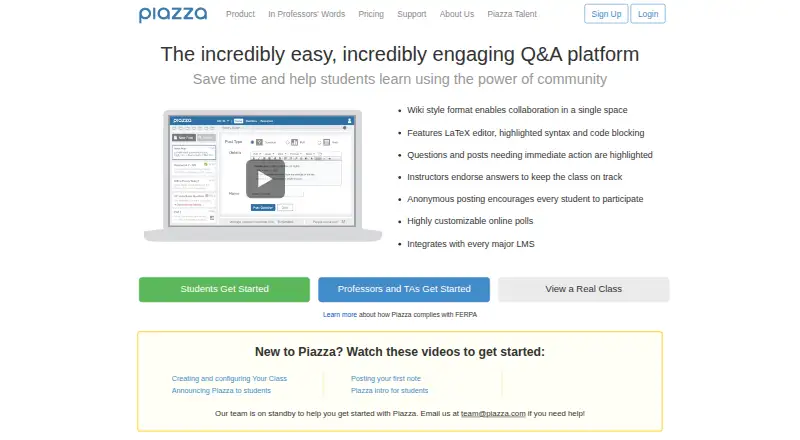
Piazza is a course Q&A platform where students, teaching assistants, and professors can discuss coursework. Its wiki-style format lets students and instructors build shared answers, with one student answer and one instructor answer for each question. Students can post under their names or anonymously to classmates; anonymous posts to instructors depend on instructor permission. Instructors can endorse questions and answers and review reports showing who asked, answered, edited, or read, as well as when questions arise during the term.
Course pages can hold announcements, course information, syllabi, assignments, lecture notes, and links. Piazza integrates with learning management systems including Blackboard, Moodle, Sakai, Desire2Learn, Canvas, Jenzabar, and Angel. Integrated rosters can automatically enroll users with appropriate roles and allow sign-in through the LMS. Web, iOS, and Android access is available, with class alerts in the mobile apps. Piazza offers a free plan; paid instructor licenses start at $379 a month, billed per term. K-12 classes and classes with up to 25 students do not require licenses.
Who it suits
Piazza suits students and teaching staff who need a shared space for coursework questions, class materials, and participation tracking. It may also suit instructors using one of its listed LMS integrations.
What it does well
- Community-edited Q&A includes student and instructor answers.
- Students can post anonymously to classmates.
- Course pages hold syllabi, assignments, notes, and links.
- LMS rosters can enroll users with appropriate roles.
- Mobile apps provide class alerts.
What to know first
- Paid instructor licenses start at $379 a month.
- Polls, statistics, and class locking require a paid license.
- Anonymous posts to instructors require instructor permission.
Limits
The free contribution-supported model has optional contribution prompts, while polls, statistics, and class locking require a paid license. Paid instructor licenses allow a maximum of 400 students for $379 a month or 700 students for $429 a month; the $479 a month license has unlimited class size. These instructor prices are billed per term.
Plans
| Plan | Billed and limits | Price |
|---|---|---|
| Contribution-supported | Free use; optional contribution prompts · Polls, statistics and class locking excluded · no ads | Free |
| Contribution-supported model | Optional contribution prompts · polls, statistics, and class locking require a paid license | Free |
| Department license (up to 3,000 students) | $12,000/year · Up to 3,000 students · unlimited classes per student | $12,000 a year |
| Department license | per year · Up to 3,000 students · unlimited classes per student in the department | $12,000 a year |
| Instructor license (up to 400 students) | $379(USD)/term · 400 student maximum · covers all students in instructor classes | $379, paid once |
| Instructor license — 400-student maximum | per term; payment is due 3 weeks after class start date · 400 student max class size | $379 a month |
| Instructor license — 700-student maximum | per term; payment is due 3 weeks after class start date · 700 student max class size | $429 a month |
| Instructor license (up to 700 students) | $429/term · 700 student maximum · covers all students in instructor classes | $429, paid once |
The first 8 of 12 plans, as piazza.com lists them, read 15 Oct 2026. The maker's own page has the final word. Every plan
Getting started
- Open https://piazza.com/.
- Use the web version or choose the iOS or Android app.
- Create or join a course; an integrated LMS can provide sign-in and roster enrollment.
- Use the free contribution-supported model or review the paid license options.
- Contact Piazza at [email protected] or 800-818-4124 for support.
Piazza is a coursework Q&A platform where students, teaching assistants, and professors can work through class questions together. It suits courses that need a shared place for answers and materials, especially when they use an LMS Piazza supports. Its strongest case is the combination of collaborative answers and instructor visibility; paid licenses are needed for some course controls and reporting features.
Overview
Piazza centers each question on a wiki-style exchange: students can contribute to one shared student answer, alongside a separate instructor answer. That structure can keep corrections and clarifications together rather than scattering them across replies. Students may post anonymously to classmates, and may post anonymously to the instructor if the instructor permits it; instructors can endorse questions and answers.
Course pages also bring announcements, course information, syllabi, assignments, lecture notes, and links into the same class space. Instructors can see who asks, answers, edits, or reads, and when questions arise during the term. That is useful for spotting participation patterns, though polls, statistics, and class locking require a paid license.
Key features
- Collaborative Q&A: A single student answer and a single instructor answer for each question give classes a shared reference point. This suits courses where students benefit from refining answers together, but is a less natural fit for discussion that depends on many separate responses.
- Course materials: Pages can host announcements, course information, syllabi, assignments, lecture notes, and links. Keeping these alongside questions makes Piazza more than a question board, though it is not presented as a replacement for every LMS function.
- Participation reports: Instructors can track who asks, answers, edits, or reads and when questions emerge. This offers a view of class engagement across the term; some related tools, including statistics, are behind a paid license.
- LMS connections: Piazza supports Blackboard, Moodle, Sakai, Desire2Learn, Canvas, Jenzabar, and Angel. Integration can automatically enroll roster members with appropriate roles and allow LMS sign-in, reducing separate account and enrollment steps for connected classes.
- Mobile access: iOS and Android apps provide class access and alerts, useful for students who need to keep up away from a computer.
- Privacy and safeguards: Piazza says student email addresses and course enrollment information are accessible only to class instructors, and says universities have verified its Q&A platform facilitates FERPA compliance. It also describes technical, administrative, and physical safeguards for information.
Pricing
Piazza uses a freemium model. Its contribution-supported plan costs nothing; contributions are optional. K-12 classes and classes with up to 25 students do not require licenses. The free plan is the clearest fit for smaller classes that can do without polls, statistics, and class locking, all of which require a paid license.
- Instructor license — 400-student maximum: $379 a month, billed per term; payment is due 3 weeks after the class start date. The 400-student cap makes this the lowest-cost paid option for classes within that size.
- Instructor license — 700-student maximum: $429 a month, billed per term, with payment due 3 weeks after the class start date. It fits larger classes that exceed the 400-student tier but do not need unlimited size.
- Instructor license — unlimited class size: $479 a month, billed per term, with payment due 3 weeks after the class start date. This removes the stated class-size ceiling.
- Department license: $12,000 a year, billed per year, for up to 3,000 students and unlimited classes per student in the department. It is aimed at departmental rather than single-course use.
- Enterprise site license: Custom pricing for an institution- or school-level license; contact Piazza for details.
The instructor tiers differ by class-size ceiling, while the department option sets a student cap across unlimited classes per student. The paid terms are billed per term or year, not described as monthly subscriptions despite the monthly price unit on instructor licenses.
Platforms
Piazza is available on the web, iOS, and Android. The mobile apps provide class alerts as well as access to class activity; LMS sign-in and roster enrollment are available when a course uses an integration Piazza supports.
Who it's for
Piazza is best suited to instructors and students who want coursework questions, shared answers, and class resources in one place. It is particularly compelling for courses that can use LMS roster and sign-in connections or value reports on student participation. Small classes may use it without a license, while larger classes should match the paid tier to enrollment. It is less suitable when a course needs polls, statistics, or class locking without paying, or when its learning workflow calls for many independent answers rather than a shared one.
Pros and cons
- Pro: A shared student answer plus an instructor answer can consolidate coursework clarification into a class resource.
- Pro: LMS roster enrollment and sign-in can reduce setup friction for supported systems.
- Pro: Instructors can see participation actions and timing, providing a way to follow engagement through the term.
- Con: Polls, statistics, and class locking require a paid license, limiting the free plan for instructors who need those controls.
- Con: Paid instructor licenses impose class-size ceilings at the 400- and 700-student levels; larger classes need the more expensive unlimited tier.
Alternatives
For a broader category comparison, see Classroom Management Software.
- LiveSchool is a possible alternative for schools seeking a free school-year pilot with SSO and rostering, all features, one grade level, and up to one school year.
- ClassDojo is worth considering for its free core experience of teacher messaging, class points, and class story updates.
- Anchor may suit schools that want a free, self-hosted option with no license fee or per-seat charge, while accounting for Azure hosting costs.
- Apple Classroom is a free option for iPad and Mac users.
- Veyon offers an open-source GPLv2 core for Linux, self-hosted, and Windows environments.
- Classwize is another classroom software option.
- Lightspeed Classroom is a paid option offered through Lightspeed’s integrated ecosystem, with personalized quotes.
- GoGuardian Teacher uses custom pricing based on enrollment, product bundles, contract length, and professional services.
Verdict
Choose Piazza if your course needs a central, collaborative place for coursework Q&A and materials, and instructors want participation visibility or LMS-connected enrollment. The shared answer format and supported LMS integrations are its clearest advantages. Look elsewhere if the free plan’s limits rule out essential course controls, if your class exceeds the chosen license cap, or if you need a different classroom-management workflow.
Verdict
Piazza combines coursework Q&A, class materials, and participation reports, with LMS integrations and mobile apps. A free plan is available, while some features require a paid license.
Questions
Is Piazza free?
Yes. Its contribution-supported model costs nothing, with optional contribution prompts.
What does the free plan exclude?
Polls, statistics, and class locking require a paid license.
What platforms does Piazza support?
Piazza supports the web, iOS, and Android. Its mobile apps provide class alerts.
Which LMS platforms are listed?
Piazza lists Blackboard, Moodle, Sakai, Desire2Learn, Canvas, Jenzabar, and Angel.
How much do the instructor licenses cost?
The 400-student maximum license is $379 a month, the 700-student maximum is $429 a month, and unlimited class size is $479 a month. Each is billed per term.
Are there course size exceptions to licensing?
Piazza says K-12 classes and classes with up to 25 students do not require licenses.
Facts from Piazza's own pages
- Anonymity and endorsements
- Students can post anonymously to classmates, or anonymously to the instructor if the instructor allows it, and instructors can endorse questions and answers. · piazza.com, 7 Oct 2026
- Anonymous participation
- Users can post anonymously to classmates and, where enabled, anonymously to instructors. · talent.piazza.com, 15 Oct 2026
- API availability
- GetApp states that Piazza has no available API, while third-party projects describe unofficial clients for its internal API. · getapp.com, 15 Oct 2026
- Class locking
- A premium lock feature lets instructors schedule lock dates and times for posting. · support.piazza.com, 15 Oct 2026
- Class statistics
- The support center documents instructor class-statistics viewing and statistics export tools. · support.piazza.com, 15 Oct 2026
- Collaborative answers
- Piazza uses community-edited wiki-style Q&A with a single student answer and a single instructor answer for each question. · piazza.com, 7 Oct 2026
- Company facts
- LinkedIn lists Piazza as privately held, founded in 2009, headquartered at 101 University Ave in Palo Alto, California, with 11–50 employees. · linkedin.com, 15 Oct 2026
- Company legal name
- The privacy policy identifies the maker as Piazza Technologies, Inc. · piazza.com, 15 Oct 2026
- Company products
- Crunchbase describes Piazza Q&A and Piazza Network, and lists Pooja Sankar as founder and Ethan O’Rafferty as CEO. · crunchbase.com, 15 Oct 2026
- Course tools
- Course pages can host announcements, course information, syllabi, and resources such as assignments, lecture notes, and links. · piazza.com, 7 Oct 2026
- Data practices
- The privacy policy says Piazza collects device, usage and location information and uses service vendors for storage, analytics, billing and security. · piazza.com, 15 Oct 2026
- Founded
- 2009 · piazza.com, 28 Sept 2026
- Headquarters
- Palo Alto, California, United States · piazza.com, 28 Sept 2026
- Help documentation
- The help center lists instructor, student, mobile, accessibility, integrations, licensing and Teams sections with dozens of articles. · support.piazza.com, 15 Oct 2026
- Instructor endorsements
- Instructors can endorse answers to steer the class toward reliable responses. · piazza.com, 15 Oct 2026
- LaTeX and code
- The product advertises a LaTeX editor, syntax highlighting and code blocks. · piazza.com, 15 Oct 2026
- License exceptions
- The paid-model page says K-12 classes and classes with up to 25 students do not require licenses. · support.piazza.com, 7 Oct 2026
- Limit: Android feature gaps
- Google Play reviews report teammate search failures, update-related lockouts, difficult link sharing and no convenient pinning. · play.google.com, 15 Oct 2026
- Limit: missing assessment tools
- Software Advice reviews cite absent timed quizzes, grading, course calendars, assignment submission and plagiarism detection. · softwareadvice.com, 15 Oct 2026
- Limit: mobile app
- App-store reviewers report sluggish or buggy mobile behavior, missing desktop features, failed uploads and login or loading problems. · apps.apple.com, 15 Oct 2026
- Limit: pricing
- A Software Advice reviewer said a price increase made Piazza too expensive and led them to leave. · softwareadvice.com, 15 Oct 2026
- Limit: user interface
- G2 reviewers describe the interface as dull, while Software Advice reviewers call navigation and search dated or jumbled. · g2.com, 15 Oct 2026
- LMS integrations
- Documented integrations cover Blackboard, Coursera, Moodle, Canvas and other major learning-management systems. · support.piazza.com, 15 Oct 2026
- LMS sign-in and enrollment
- With LMS integration, course rosters can automatically enroll users with appropriate roles, and users can be signed in through the LMS. · piazza.com, 7 Oct 2026
Where Piazza stands on Freedom251
- Classroom Management Software#7 of 25