Paperwall
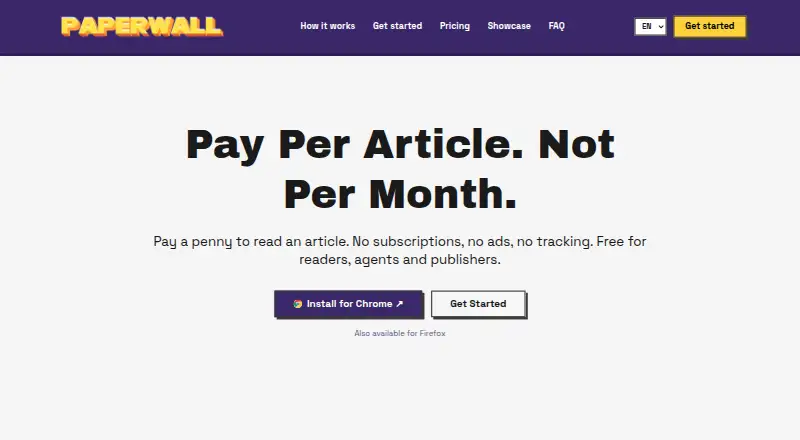
What Paperwall is
Paperwall is an open protocol for paying small amounts to read individual web articles. Publishers set prices, and most articles are said to cost between $0.01 and $0.10; adding one script tag enables payments on a publisher’s site. Readers pay per article from an encrypted wallet stored on their device and accessed with their password. Paperwall says publishers receive payments instantly and keep all content payments, although facilitators may charge processing fees. The protocol is licensed under GPL-3.0 and can be forked, audited, or self-hosted. Its developer tools—an SDK, browser extension, CLI, and A2A server—are free to use or self-host. Publishers can choose SKALE Mainnet or Base Mainnet and client mode, recommended for most publishers, or server mode, which requires a backend. An MCP server supports named AI clients including Claude Code, Cursor, Windsurf, Claude Desktop, Codex, OpenCode, Gemini CLI, and Antigravity. The protocol plan is free; the listed subscription costs $10 a month. Users currently need to fund accounts manually, and publisher allowlists and denylists are still in development.
Who it suits
Paperwall may suit publishers adding per-article payments, readers who prefer paying for individual pieces, and developers building tools that pay for content. Server mode is an option for publishers who need full control and can provide a backend.
What it does well
- Publishers can enable payments with one script tag
- Encrypted reader wallet is stored on the device
- Developer tools are free to use or self-host
- GPL-3.0 licensing allows forking and self-hosting
What to know first
- Accounts currently require manual funding
- Publisher allowlists and denylists remain in development
- Firefox and Safari are on the roadmap, not supported currently
- Server mode requires a backend
Limits
The free protocol plan provides the SDK, extension, CLI, and A2A server at no cost to use or self-host. The listed $10/mo subscription says readers pay even if they read just one article; accounts currently require manual funding.
Plans
| Plan | Billed and limits | Price |
|---|---|---|
| Paperwall protocol | Free to use; SDK, extension, CLI, and A2A server cost nothing to use or self-host | Free |
| Subscription | Pay even if you read just 1 article | $10 a month |
As paperwall.app lists them, read 8 Oct 2026. The maker's own page has the final word.
Getting started
- Visit the Paperwall website and choose whether to use its protocol tools or subscription.
- For a publisher setup, choose SKALE Mainnet or Base Mainnet.
- Choose client mode, recommended for most publishers, or server mode, which requires a backend.
- Add the single Paperwall script tag to a publisher site to enable article payments.
- Readers use a supported Chrome or Chromium-based browser and fund their account manually.
- Use the SDK, browser extension, CLI, A2A server, or MCP server for development or AI assistant clients.
Paperwall is an open protocol for paying tiny amounts to read individual web articles. It is best for publishers wanting per-article sales and for developers or AI-agent builders who value self-hostable payment infrastructure. The trade-off is a young system: readers fund wallets manually, and publisher access controls are still being developed.
Overview
Paperwall replaces publication-wide subscriptions with a price attached to each article. Publishers choose the amount, with most articles said to cost between $0.01 and $0.10, so occasional readers can pay only for pieces they want. There is no metered paywall or registration wall, and one-time payments are supported.
That model is more suitable for independent articles and light readers than for households seeking unlimited access. Publishers can monetize individual work without forcing every visitor into a recurring plan, although success depends on readers maintaining a funded wallet.
Key features
A publisher adds one script tag to enable article payments. Client mode is recommended for most publishers and keeps implementation simpler; server mode requires a backend but gives the publisher full control. Production network choices are SKALE Mainnet and Base Mainnet.
Funds are held in an encrypted wallet on the reader's device and unlocked with the user's password. This offers local control, but it also makes manual account funding part of the experience. The maker says publishers receive payouts instantly and retain 100% of content payments; facilitators may still impose processing fees.
Paperwall is GPL-3.0 licensed, so teams can fork, audit, or self-host it. Its SDK, browser extension, CLI, and A2A server are free to use or self-host. An MCP server connects payment-capable AI workflows with Claude Code, Cursor, Windsurf, Claude Desktop, Codex, OpenCode, Gemini CLI, and Antigravity. Chrome and Chromium-based browsers, including Edge, Brave, and Arc, are supported now; Firefox and Safari are planned.
The main maturity caveats are operational. Users currently have to fund accounts manually, while publisher allowlists and denylists remain under development. Publishers needing polished audience controls should treat those gaps as material.
Pricing
| Plan | Price | What it includes |
|---|---|---|
| Paperwall protocol | free | Free use; SDK, extension, CLI, and A2A server can be used or self-hosted at no charge. |
| Subscription | $10 a month | A subscription option; payment applies even if you read just one article. |
The free protocol plan is the clear choice for self-hosting developers, publishers evaluating the integration, and readers using per-article payments. The $10 a month subscription is harder to justify for very light readers because the stated terms charge the full month after a single article; readers should compare that recurring cost with their likely article spending.
Platforms
Paperwall is offered as a browser extension, web service, and self-hosted software. Current browser support covers Chrome and Chromium derivatives such as Edge, Brave, and Arc. Firefox and Safari are on the roadmap rather than current options.
Who it's for
Choose Paperwall if you publish articles and want direct, one-time payments, or if you build applications and agents that need to pay for content. Its open license and free developer components particularly suit teams able to manage their own infrastructure. Readers who prefer paying for occasional articles may also benefit, provided they accept manual wallet funding and device-based access.
Pros and cons
Pros
- Per-article prices of roughly $0.01 to $0.10 let occasional readers avoid publication-wide subscriptions.
- A single script tag lowers the integration burden for publishers.
- GPL-3.0 licensing, self-hosting, and free SDK, extension, CLI, and A2A server support give developers control without software charges.
- Instant payouts and 100% retention of content payments are attractive to publishers, subject to facilitator processing fees.
- MCP support covers a broad set of named AI clients.
Cons
- Manual account funding adds friction before a reader can pay.
- The wallet is device-based, so access depends on the encrypted wallet and its password on that device.
- Allowlists and denylists are still being developed, limiting publisher governance today.
- Browser coverage excludes Firefox and Safari for now.
- The $10.00 USD monthly subscription can cost more than occasional article purchases for light readers.
Alternatives
Paywall Software is the broader directory choice when you want to compare paywall products rather than commit to Paperwall's micropayment model.
Pelcro is a better fit for publishers needing a conventional customer-management platform with Android, iOS, web, and API coverage, a free tier for 100 customers, and an Advanced plan for up to 2,000 customers.
Cleeng suits larger subscription operations that need global payment processing, automatic local-tax calculation, and fraud and chargeback management in its free Merchant Basic offering.
codoc is worth considering for Japanese-language selling workflows, with a free plan, a 15% sales fee, and a 9,800 JPY monthly Pro plan.
Content Credits SDK is an alternative free publisher SDK built around content credits and percentage-based monetization.
Milkie is a free, MIT-licensed open-source option for publishers who prefer that licensing model.
Pay-To-View Lite fits WordPress publishers wanting a fixed rental price and duration, with a free limited Lite plan and a one-time Pro purchase.
Pigeon is aimed at WordPress publishers who want a paid publishing plan rather than a micropayment protocol; its free tier is a transaction-disabled demo.
PostGate is a free web option with no monthly subscription, charging a 5% platform fee on successful transactions plus Stripe fees.
Verdict
Paperwall is a strong choice for publishers and developers who want open, self-hostable infrastructure for inexpensive one-off article payments, especially when AI-agent access matters. Look elsewhere if you need mature publisher allowlists, broad browser support, or a hands-off wallet and funding experience.
Verdict
Paperwall offers per-article payments alongside tools for publishers, readers, and developers. Manual funding and the unfinished publisher controls are relevant limitations to consider.
Questions
Is Paperwall free to use?
The Paperwall protocol plan is free to use. Its SDK, browser extension, CLI, and A2A server cost nothing to use or self-host. A separate subscription is listed at $10/mo.
How do publishers accept payments?
Publishers add a single script tag to their site, set article prices, and choose a production network: SKALE Mainnet or Base Mainnet.
Which browsers are supported?
Paperwall currently supports Chrome and Chromium-based browsers, including Edge, Brave, and Arc. Firefox and Safari are on the roadmap.
Is Paperwall open source?
Yes. It is licensed under GPL-3.0 and can be forked, audited, or self-hosted.
How are reader payments handled?
Readers pay per article from an encrypted wallet on their device, accessed with their password. Paperwall says publishers receive payments instantly and keep 100% of content payments, though facilitators may charge processing fees.
Which AI assistant clients are supported?
Paperwall names Claude Code, Cursor, Windsurf, Claude Desktop, Codex, OpenCode, Gemini CLI, and Antigravity as clients for its MCP server.
Facts from Paperwall's own pages
- AI integrations
- Paperwall offers an MCP server for AI assistants and names Claude Code, Cursor, Windsurf, Claude Desktop, Codex, OpenCode, Gemini CLI, and Antigravity as supported clients. · github.com, 8 Oct 2026
- Developer tools
- The product offers an SDK, browser extension, CLI, and A2A server, which the maker says cost nothing to use or self-host. · paperwall.app, 8 Oct 2026
- Early-stage limitation
- The maker says users currently need to fund their account manually and is still developing publisher allowlists and denylists. · paperwall.app, 8 Oct 2026
- Open source
- Paperwall is licensed under GPL-3.0 and can be forked, audited, or self-hosted. · paperwall.app, 8 Oct 2026
- Payment modes
- Client mode is recommended for most publishers, while server mode requires a backend and offers full control. · paperwall.app, 8 Oct 2026
- Payment networks
- The publisher setup lists SKALE Mainnet and Base Mainnet as production network options. · paperwall.app, 8 Oct 2026
- Publisher payouts
- The site says publishers receive payments instantly and keep 100% of content payments, while facilitators may charge processing fees. · paperwall.app, 8 Oct 2026
- Publisher setup
- Publishers add a single script tag to their site to enable article payments. · paperwall.app, 8 Oct 2026
- Reader payments
- Readers pay per article, with publishers setting prices and most articles said to cost between $0.01 and $0.10. · paperwall.app, 8 Oct 2026
- Reader wallet
- Reader funds are stored in an encrypted wallet on the device and are accessible with the user's password. · paperwall.app, 8 Oct 2026
- Supported browsers
- The FAQ lists Chrome and Chromium-based browsers including Edge, Brave, and Arc as currently supported, with Firefox and Safari on the roadmap. · paperwall.app, 8 Oct 2026
- Supported users
- The maker describes Paperwall for publishers, readers, AI agent users, and developers building apps or agents that pay for content. · paperwall.app, 8 Oct 2026
- What it does
- Paperwall is an open protocol for micropayments that lets readers pay tiny amounts per web article. · paperwall.app, 8 Oct 2026
Where Paperwall stands on Freedom251
- Paywall Software#5 of 30