
codoc
What codoc is
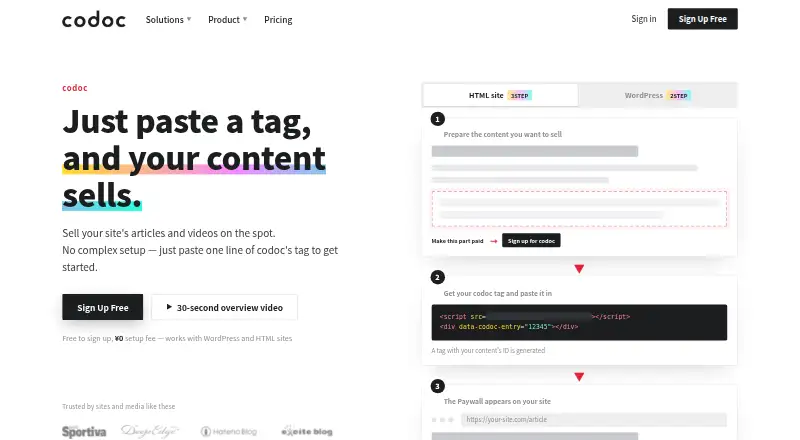
codoc lets publishers, bloggers, and web service operators sell content directly to readers through a website. Add it to WordPress or an HTML site with an embedded tag, use its WordPress plugin, or connect through a supported service such as Hatena Blog. Creators can sell articles, videos, and audio as individual purchases, offer monthly or annual subscriptions, and accept tips. For paid subscriptions, creators can set a buyer trial period; billing starts automatically afterward unless the subscriber cancels during the trial.
Buyers can pay by credit card, debit card, prepaid credit card, Apple Pay, Google Pay, or convenience store payment. codoc serves paid content after payment or login authentication, and card details are sent directly to Stripe or CREDIX rather than stored on codoc's servers. The free codoc plan costs nothing and charges a 15% sales fee plus a 300円 transfer fee per payout. codoc pro costs ¥9,800 a month, retains the 15% sales fee, and adds REST API access, buyer email access, buyer interface design changes, and private accounts. Managing article and subscription plan information through the API requires a pro contract. The maker is based in Shinagawa, Tokyo, Japan.
Who it suits
codoc suits publishers, bloggers, and web service operators who want readers to pay for individual content, subscriptions, or tips on their websites. It supports WordPress, Hatena Blog, and custom HTML or CMS sites, with pro API access for deeper CMS integration.
What it does well
- Supports individual sales, subscriptions, and tips.
- Works with WordPress, Hatena Blog, and custom sites.
- Accepts several card, digital wallet, and convenience store payment methods.
- Creators can configure free trials for paid subscriptions.
- Pro includes API access and buyer email access.
What to know first
- The free plan charges a 15% sales fee.
- Each payout on the free plan has a 300円 transfer fee.
- API access for article and subscription management requires pro.
- Free-plan content gifts and buyer messages have quantity limits.
Limits
The free plan charges a 15% sales fee and a 300円 transfer fee per payout; content gifts and buyer messages have quantity limits. Standard account limits include a 50,000円 maximum for single-item and subscription prices, 10,000円 tips, and 100 messages per send.
Plans
| Plan | Billed and limits | Price |
|---|---|---|
| codoc pro trial | 14-day free trial · All pro features during trial | Free |
| codoc | No setup, monthly, annual or registration fee; 15% of sales · Individual and subscription sales · tips · standard limits | Free |
| codoc pro | ¥9,800/month; 15% sales fee · API · purchaser emails · private accounts · test environment · higher limits · dedicated support | ¥9,800 a month |
| enterprise | Contact codoc · Negotiated sales-fee reduction and enterprise features | On request |
As codoc.jp lists them, read 14 Oct 2026. The maker's own page has the final word.
Getting started
- Visit https://codoc.jp/.
- Choose the free codoc plan or codoc pro at ¥9,800 a month.
- Add codoc to a WordPress or HTML site with an embedded tag, or use the WordPress plugin.
- For deeper CMS integration or API management, use a pro contract.
- Configure individual purchases, subscriptions, or tips for readers.
codoc adds reader payments to an existing publishing site, giving creators a way to sell individual content, ongoing subscriptions, or tips without moving their publishing operation elsewhere. It is aimed at publishers, bloggers, and web service operators with an audience they want to monetize directly. Its strongest fit is a site that needs straightforward paid access; publishers needing API management or buyer email access will have to budget for Pro.
Overview
codoc can be added to WordPress and HTML sites with an embedded tag, and it also offers a WordPress plugin. Hatena Blog and custom HTML or CMS sites are supported. That makes it a practical option for publishers who want payments layered onto their current site, though deeper integration with a publisher’s own CMS depends on the Pro API.
Its sales model covers one-time content purchases, subscriptions, and tips. Readers can pay by credit or debit card, prepaid credit card, Apple Pay, Google Pay, or convenience store payment. Card details go directly to Stripe or CREDIX and are not stored on codoc’s servers.
Key features
Creators can sell articles, videos, and audio one item at a time, or set subscriptions to renew monthly or annually. A free trial can be attached to a paid subscription; billing starts automatically when the trial ends unless the subscriber cancels. This gives publishers a way to let readers sample ongoing access, but the automatic billing transition should be clear at sign-up.
Paid content is stored and delivered by codoc, then shown through JavaScript after payment or login authentication. This provides a payment-gated delivery path for existing sites. REST API access for managing article and subscription plan information requires Pro, so the free plan is a weaker fit for publishers who need to connect codoc closely to a custom CMS.
Pro also includes a dedicated email support desk. The maker offers paid WordPress setup and design customization, which may help publishers who want assistance with implementation, though those services are separate from the stated monthly plan price.
Pricing
The free codoc plan costs nothing. It includes general sales functions, but content gifts and buyer messages have quantity limits. Sales incur a 15% fee, and each payout has a 300円 transfer fee. This is the lower-commitment way to start selling, but the transaction and payout charges matter for creators expecting frequent withdrawals or meaningful sales volume.
codoc pro costs ¥9,800 a month, billed at 9,800円/月. It adds API access, the ability to obtain buyer email addresses, buyer interface design changes, and private accounts. The sales fee remains 15%, so Pro makes most sense when its management and account controls are useful to the publishing workflow; it does not reduce the stated fee on sales.
Standard account limits include a 50,000円 maximum for single-item and subscription prices, 10,000円 for tips, and 100 messages per send. The pricing note also includes a 14-day trial. These caps are relevant for publishers setting premium prices, soliciting larger tips, or sending frequent buyer messages.
Platforms
codoc is available on the web and through an extension, with API access available on Pro. Its site integrations cover WordPress, Hatena Blog, and custom HTML or CMS sites. API and extension support make it relevant to publishers with a more tailored setup, while the free plan is centered on the general sales functions.
Who it's for
codoc suits independent publishers, bloggers, and web service operators who already have a website and want to charge readers for specific content or continuing access. It is especially appropriate when a WordPress plugin or a simple embedded tag covers the integration need. It is less compelling for publishers whose economics depend on minimizing transaction fees, or whose CMS workflow requires API management but cannot absorb the Pro subscription.
Pros and cons
- Pros: Supports one-time sales, recurring subscriptions, and tips in one service, giving publishers several ways to monetize an audience.
- Pros: Works with WordPress and HTML sites, with a plugin and paid API option for publishers who need closer CMS integration.
- Pros: Offers multiple payment methods, including Apple Pay, Google Pay, and convenience store payment.
- Cons: The 15% sales fee applies on both plans, and the free plan adds a 300円 fee per payout.
- Cons: API management, buyer email access, interface customization, and private accounts require the 9,800円/月 Pro plan.
- Cons: Standard account caps limit item and subscription prices, tip amounts, and messages per send.
Alternatives
For a broader set of options, browse Paywall Software. Pelcro is another freemium choice, with a free plan capped at 100 customers and an Advanced plan priced at $450 a month for up to 2,000 customers; consider it when those customer tiers better match your scale. Cleeng offers a free Merchant Basic plan for up to 10k subscribers, with global payment processing, local tax calculation, and fraud and chargeback management, making it worth considering for publishers prioritizing those capabilities.
Content Credits SDK is a free option for readers considering a micropayment-oriented approach. Milkie is free and open source under the MIT license. Paperwall is free and GPL-3.0 licensed, with self-hosting as an option. Pay-To-View Lite offers a free WordPress plan with fixed rental price and duration, plus a 29.00 USD one-time Pro plan. Pigeon has a free WordPress demo with no transactions and a Publishers plan at $99 a month. PostGate is free with a 5% platform fee on successful transactions, with Stripe processing fees charged separately.
Verdict
Choose codoc if you want to add direct content sales, subscriptions, or tips to a supported website. The free plan covers general sales, while pro is needed for API management and adds buyer email access and interface customization. Compare the 15% sales fee and, on the free plan, the per-payout transfer fee with your expected sales volume.
Verdict
Choose codoc if you want to add direct content sales, subscriptions, or tips to a supported website. The free plan covers general sales, while pro is needed for API management and adds buyer email access and interface customization. Compare the 15% sales fee and, on the free plan, the per-payout transfer fee with your expected sales volume.
Questions
Is there a free plan?
Yes. The codoc plan costs nothing and includes general sales functions. It charges a 15% sales fee and a 300円 transfer fee per payout.
What does codoc pro cost?
codoc pro costs ¥9,800 a month and has a 15% sales fee. It adds API use, buyer email access, buyer interface design changes, and private accounts.
What can creators sell?
Creators can sell articles, videos, and audio as individual items, offer one-time purchases and monthly or annual subscriptions, and accept tips.
Which websites does codoc support?
It supports WordPress, Hatena Blog, and custom HTML or CMS sites. WordPress and HTML sites can use an embedded tag; a WordPress plugin is also available.
Which payment methods can buyers use?
The listed methods are credit cards, debit cards, prepaid credit cards, Apple Pay, Google Pay, and convenience store payment.
Does API access require pro?
Yes. Managing article and subscription plan information through the REST API requires a codoc pro contract.
Facts from codoc's own pages
- Affiliate feature
- Creators can issue referral links and set the commission rate paid when referred content sells. · codoc.jp, 14 Oct 2026
- API
- Account linking and API integration can embed content sales into another web service; API access requires codoc pro. · codoc.jp, 14 Oct 2026
- API documentation
- codoc says API documentation is provided after signup or a codoc pro contract. · codoc.jp, 14 Oct 2026
- API limitation
- REST API access for managing article and subscription plan information requires a codoc pro contract. · codoc.jp, 7 Oct 2026
- Cloud hosting
- codoc states that its server architecture uses AWS and is designed to scale out. · codoc.jp, 14 Oct 2026
- Company headquarters
- The operator lists 7A R-Gotanda, 8-2-12 Nishigotanda, Shinagawa-ku, Tokyo 141-0031, Japan. · codoc.jp, 14 Oct 2026
- Company legal name
- The operator is codoc株式会社 (codoc Inc.), represented by CEO Naoto Ishikawa. · codoc.jp, 14 Oct 2026
- Company size indicator
- Compalyze reports one social-insurance-covered employee in September 2026 and ¥5 million capital. · compalyze.co.jp, 14 Oct 2026
- Content protection
- The pro page says paid content is stored and delivered by codoc and is shown through JavaScript only after payment or login authentication. · codoc.jp, 7 Oct 2026
- Creator eligibility
- The WordPress listing says creators must live in Japan, the United States or the European Union and hold a bank account in the relevant country. · wordpress.org, 14 Oct 2026
- Documentation and support
- The site provides creator and purchaser FAQs; codoc pro adds a dedicated email support channel and setup assistance. · codoc.jp, 14 Oct 2026
- External content
- HTML pages or selected areas can be protected by codoc authentication, including full-page coverage and redirects. · codoc.jp, 14 Oct 2026
- Founded
- Compalyze lists codoc株式会社 as established in April 2019. · compalyze.co.jp, 14 Oct 2026
- Free trials
- Creators can configure a free trial for paid subscription plans. · codoc.jp, 14 Oct 2026
- Free trials for buyers
- Creators can configure a free trial for a paid subscription, after which billing starts automatically unless the subscriber cancels during the trial. · codoc.jp, 7 Oct 2026
- Headquarters
- Shinagawa, Tokyo, Japan · codoc.jp, 28 Sept 2026
- Independent business description
- Compalyze describes codoc as a content-sales and billing platform for publishers, web media, blog services, UGC platforms and individual creators. · compalyze.co.jp, 14 Oct 2026
- Individual sales
- Creators can price and sell individual articles, videos or audio items. · codoc.jp, 14 Oct 2026
- Infrastructure
- The codoc pro page says its server infrastructure uses AWS and is designed to scale out. · codoc.jp, 7 Oct 2026
- Integrations
- Official integrations include WordPress plus examples involving Hatena Blog, Excite Blog and Kotobank. · codoc.jp, 14 Oct 2026
- Intended users
- The maker presents codoc for publishers, bloggers, and web service operators who want to monetize content through direct reader payments. · codoc.jp, 7 Oct 2026
- Limited-quantity sales
- Creators can cap the number of sales for an offering. · codoc.jp, 14 Oct 2026
- Limit: paywall styling
- The FAQ says direct paywall display-format customization is not supported, although themes and CSS options are described elsewhere. · codoc.jp, 14 Oct 2026
- Limit: refund policy
- The creator FAQ says refunds are not supported. · codoc.jp, 14 Oct 2026
Where codoc stands on Freedom251
- Paywall Software#2 of 30