Freedom251 › Container Build Tools
Paketo Buildpacks
What Paketo Buildpacks is
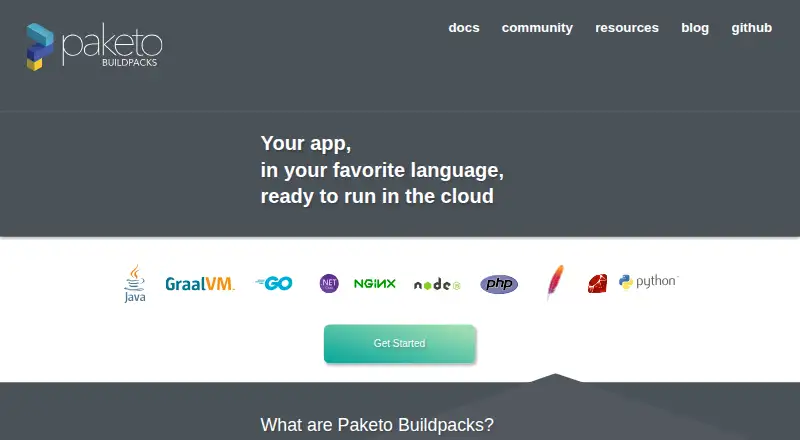
Paketo Buildpacks turns application source code into container images by detecting the language, collecting the dependencies it needs, and assembling a build. Guides cover Java, Node.js, .NET Core, Go, Python, PHP, and Ruby. Built-in caching can speed up rebuilds without requiring advanced build-tool customization. Buildpacks are modular: teams can combine them for an application or use project tooling to create new ones. Configuration can use environment variables, buildpack.yml, bindings, and Procfiles.
For supply-chain visibility, Paketo generates bills of materials in Syft JSON, SPDX JSON, CycloneDX JSON, and a Paketo-specific format. Buildpacks running in CI can patch an image’s OS layer without rebuilding application source code. Paketo stacks run as a dedicated non-root user while building and running applications. Stacks are rebuilt weekly and when packages receive CVE patches; the project aims to release fixes for High and Critical CVEs within 48 hours of a patch release.
The project is community-driven and vendor-neutral. It is free, open-source software for Linux and self-hosted use, with listed integrations including Docker, Kubernetes, CircleCI, GitLab, Tekton, and Spring Boot.
Who it suits
Paketo Buildpacks suits developers and operators who need to build container images from application source, particularly for the languages covered by its guides. Its modular buildpacks, caching, SBOM formats, and CI OS-layer patching also fit teams seeking configurable builds and supply-chain visibility.
What it does well
- Builds container images from source by detecting languages and dependencies.
- Guides cover seven languages, including Java, Go, and Python.
- Caching supports faster rebuilds without advanced build-tool customization.
- Creates SBOMs in four supported formats.
- CI can patch image OS layers without rebuilding application source.
- Stacks use a dedicated non-root user.
What to know first
- Available platforms are Linux and self-hosted.
- No free trial is offered.
Plans
| Plan | Billed and limits | Price |
|---|---|---|
| Paketo Buildpacks | Open source buildpacks for building container images | Free |
As paketo.io lists them, read 4 Oct 2026. The maker's own page has the final word.
Getting started
- Visit https://paketo.io/.
- Use the project’s buildpacks for a supported application language.
- Configure builds with environment variables, buildpack.yml, bindings, or Procfiles.
- Use local build caching and generate an SBOM in a supported format.
Verdict
Choose Paketo Buildpacks if you want free, open-source tools for creating container images from supported application source code. Its modular buildpacks, SBOM output, and OS-layer patching are useful for configurable, security-conscious build workflows. Look elsewhere if you need a platform beyond Linux or self-hosted use.
Questions
How much does Paketo Buildpacks cost?
The listed plan is free. The pricing model is free.
Is Paketo Buildpacks open source?
Yes. The listed plan describes it as open-source buildpacks for building container images.
Which languages are covered?
The documentation provides buildpack guides for Java, Node.js, .NET Core, Go, Python, PHP, and Ruby.
Which platforms and tools does it integrate with?
Listed integrations include Docker, Kubernetes, CircleCI, GitLab, Tekton, HashiCorp Waypoint, the Pack CLI, Spring Boot, Tilt, and VMware Tanzu Build Service.
What SBOM formats are supported?
Paketo supports Syft JSON, SPDX JSON, CycloneDX JSON, and a Paketo-specific format.
Facts from Paketo Buildpacks's own pages
- Build process
- Buildpacks detect an application’s language, gather its required dependencies, and build an image. · paketo.io, 4 Oct 2026
- Caching
- Built-in caching enables faster rebuilds without advanced customization of build tooling. · paketo.io, 4 Oct 2026
- Configuration
- Buildpacks can be configured with environment variables, buildpack.yml, bindings, and Procfiles. · paketo.io, 4 Oct 2026
- Customization
- Buildpacks are modular and can be composed for an application’s needs, and the project provides tooling to create buildpacks. · paketo.io, 4 Oct 2026
- Integrations
- The site lists Docker and Kubernetes, CircleCI, GitLab, Tekton, HashiCorp Waypoint, the Pack CLI, Spring Boot, Tilt, and VMware Tanzu Build Service among compatible platforms and tools. · paketo.io, 4 Oct 2026
- Intended users
- The project describes itself as community-driven, vendor-neutral, and used by tens of thousands of developers and operators daily. · paketo.io, 4 Oct 2026
- OS patching
- Buildpacks in CI can patch the OS layer of application images without rebuilding application source code. · paketo.io, 4 Oct 2026
- Purpose
- Paketo Buildpacks transform application source code into container images and provide production-ready buildpacks for popular languages and frameworks. · paketo.io, 4 Oct 2026
- SBOM formats
- Paketo buildpacks support Syft JSON, SPDX JSON, CycloneDX JSON, and a Paketo-specific SBOM format. · paketo.io, 4 Oct 2026
- Security
- Paketo stacks run as a dedicated non-root user when building and running applications. · paketo.io, 4 Oct 2026
- Software supply chain
- Buildpacks provide a bill of materials that gives visibility into software supply chains. · paketo.io, 4 Oct 2026
- Stack updates
- Stacks are rebuilt weekly and when packages are patched for CVEs; the project aims to release fixes for High and Critical CVEs within 48 hours of a patch release. · paketo.io, 4 Oct 2026
- Support
- The community page invites users to reach the project on Slack, join working group meetings, and use the mailing list for project news and security disclosures. · paketo.io, 4 Oct 2026
- Supported languages
- The documentation provides buildpack guides for Java, Node.js, .NET Core, Go, Python, PHP, and Ruby. · paketo.io, 4 Oct 2026
Where Paketo Buildpacks stands on Freedom251
- Container Build Tools#23 of 34