Freedom251 › Container Build Tools

Skaffold
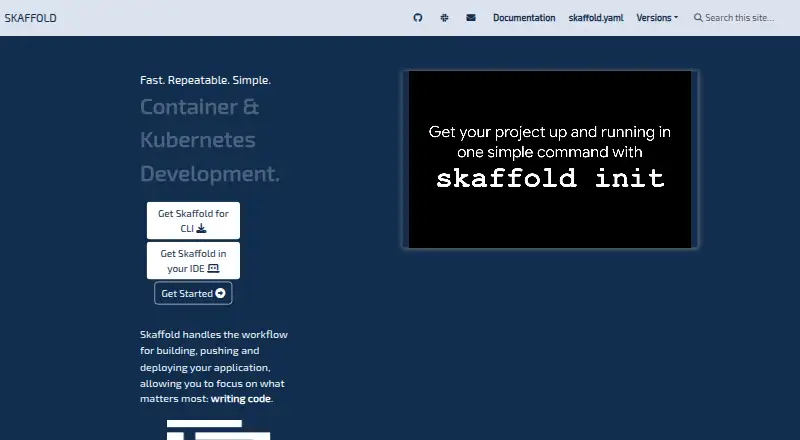
What Skaffold is
Skaffold is an open-source project from Google for building, pushing, and deploying applications. It runs on the developer’s computer, with no component running in the cluster. In dev mode, it watches source files and can rebuild images, sync files, test images, and redeploy when it detects changes. Its command-line interface includes actions for building and testing, rendering and applying configuration, deploying, and cleaning up application artifacts. Listed features include policy-based image tagging, resource port-forwarding, logging, and file syncing.
Skaffold offers builder options including Docker, Jib, Bazel, custom builders, Buildpacks, and ko. Deployment options include kubectl, kpt, Helm, Docker, Google Cloud Run, Kustomize, and Render. Cloud Code adds Skaffold support through extensions for Visual Studio Code and JetBrains IDEs. It supports Linux, macOS, and Windows, as well as local Kubernetes and Compose workflows. Skaffold is free, with a standalone CLI and IDE integrations. It checks Google servers for updates by default, and users can disable that check. Its installation page says anonymized usage data is collected to help prioritize features, with an opt-out available.
Who it suits
Skaffold suits developers who want a local development loop for building and deploying applications, including workflows involving local Kubernetes or Compose. It may also fit teams using its supported builders, deployment options, or Visual Studio Code and JetBrains extensions.
What it does well
- Free and open source, with a standalone CLI and IDE integrations.
- Watches source files and can rebuild, sync, test, and redeploy.
- Offers builder choices including Docker, Jib, Bazel, and Buildpacks.
- Supports deployment options including Helm, Cloud Run, Kustomize, and Render.
- Runs on Linux, macOS, and Windows.
What to know first
- The Skaffold gRPC server is not compatible with HTTPS.
- Update checks contact Google servers by default.
- Anonymized usage data collection requires opting out to disable.
Plans
| Plan | Billed and limits | Price |
|---|---|---|
| Skaffold | Open-source project · standalone CLI and IDE integrations | Free |
As skaffold.dev lists them, read 9 Oct 2026. The maker's own page has the final word.
Getting started
- Visit the Skaffold website.
- Choose the standalone CLI or an IDE integration.
- Use Cloud Code extensions for Visual Studio Code or JetBrains IDEs, if desired.
- Use Skaffold on Linux, macOS, or Windows.
- Choose a documented builder and deployment option for your workflow.
Verdict
Choose Skaffold if you want an open-source CLI for a development loop that can build and deploy applications, with multiple builder and deployment options. Developers whose workflow depends on HTTPS compatibility for the Skaffold gRPC server should look elsewhere for that capability.
Questions
How much does Skaffold cost?
Skaffold is free and open source.
Which operating systems does it support?
It supports Linux, macOS, and Windows.
Does Skaffold run inside a cluster?
It runs client-side and has no on-cluster component.
Which builders and deployment tools does it support?
Documented builders include Docker, Jib, Bazel, custom builders, Buildpacks, and ko. Deployment options include kubectl, kpt, Helm, Docker, Google Cloud Run, Kustomize, and Render.
Does Skaffold collect usage data?
Its installation page says it collects anonymized usage data to help prioritize features, and users can opt out.
Where can users get support?
The documentation directs users encountering issues to file an issue in the GoogleContainerTools/skaffold repository.
Facts from Skaffold's own pages
- Build and delivery
- Its CLI includes commands to build, test, render, apply, deploy, and clean up application artifacts. · skaffold.dev, 9 Oct 2026
- Build integrations
- Documented builder options include Docker, Jib, Bazel, custom builders, Buildpacks, and ko. · skaffold.dev, 9 Oct 2026
- Client-side
- Skaffold runs client-side and has no on-cluster component. · skaffold.dev, 9 Oct 2026
- Compatibility limit
- The Skaffold gRPC server is not compatible with HTTPS, according to its API documentation. · skaffold.dev, 9 Oct 2026
- Deployment integrations
- The documentation lists kubectl, kpt, Helm, Docker, Google Cloud Run, Kustomize, and Render deployment options. · skaffold.dev, 9 Oct 2026
- Development loop
- In dev mode, Skaffold watches source files and can rebuild images, sync files, test images, and redeploy when changes are detected. · skaffold.dev, 9 Oct 2026
- Features
- The homepage lists policy-based image tagging, resource port-forwarding and logging, and file syncing among its features. · skaffold.dev, 9 Oct 2026
- IDE support
- Cloud Code provides Skaffold support through extensions for Visual Studio Code and JetBrains IDEs. · skaffold.dev, 9 Oct 2026
- Platforms
- Standalone binaries are documented for Linux, macOS, and Windows. · skaffold.dev, 9 Oct 2026
- Privacy
- Skaffold checks Google servers for updates by default, and the documentation says the check can be disabled. · skaffold.dev, 9 Oct 2026
- Project
- Skaffold describes itself as an open-source project from Google. · skaffold.dev, 9 Oct 2026
- Purpose
- Skaffold handles building, pushing, and deploying applications so developers can focus on writing code. · skaffold.dev, 9 Oct 2026
- Support route
- The documentation directs users encountering issues to file an issue in the GoogleContainerTools/skaffold repository. · skaffold.dev, 9 Oct 2026
- Usage data
- The installation page says anonymized usage data is collected to help prioritize features, and users can opt out. · skaffold.dev, 9 Oct 2026
Where Skaffold stands on Freedom251
- Container Build Tools#19 of 34
- Kubernetes Deployment Tools#16 of 28
- Container Development Environments#23 of 40