Freedom251 › Retail Store Operations Software
OrderGrid Store Operations OS
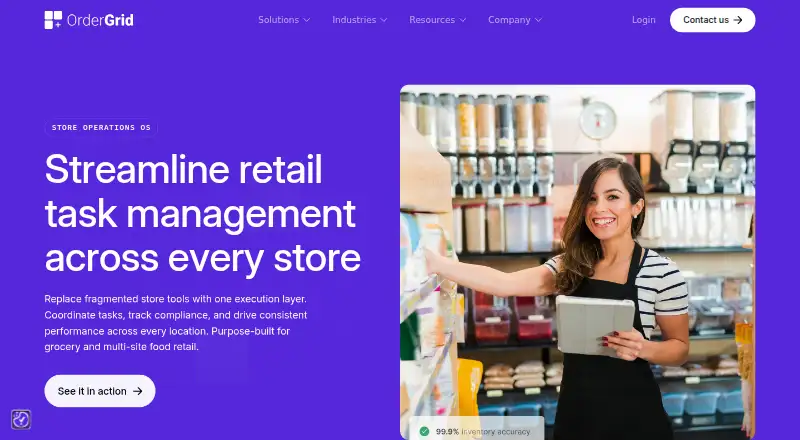
What OrderGrid Store Operations OS is
OrderGrid Store Operations OS coordinates tasks, compliance tracking, and performance across grocery and multi-site food retail locations. Its inventory tools track stock at shelf level with audit trails, lot and expiry information, and synchronization across locations. Store teams can carry out tasks on mobile, follow layout-based routes, use barcode-guided picking and putaway, and receive smart reordering prompts. Fulfillment capabilities include multi-order picking, temperature-aware staging, exception alerts, and live dashboards for pickers and orders. AI-powered insights let users ask operational questions in natural language. Role-based access controls can enable or restrict features by user type, location, or responsibility. OrderGrid says it connects with POS, ERP, and order sources through open APIs; its integrations page names NetSuite, SAP, Clover, Deliveroo, and Shopify as coming soon. The product is available on Android, iOS, and web. OrderGrid describes setup as connecting systems, training the store team, and launching with synchronized omnichannel inventory. The product page directs questions to [email protected]. Pricing is available on request.
Who it suits
It suits grocery and multi-site food retail operators coordinating store tasks, inventory, and fulfillment across locations. Teams seeking mobile execution, audit trails, and operational dashboards may find its listed capabilities relevant.
What it does well
- Tracks inventory by shelf, lot, and expiry
- Supports barcode-guided picking and putaway
- Offers temperature-aware staging and exception alerts
- Role-based controls vary by user and location
- Available on Android, iOS, and web
What to know first
- Named systems including SAP and Shopify are coming soon
- Pricing is available on request
Getting started
- Visit the OrderGrid Store Operations OS website.
- Contact [email protected] with questions and request pricing.
- Connect the store's systems.
- Train the store team.
- Go live with synchronized omnichannel inventory.
OrderGrid Store Operations OS is an operations platform for grocery chains and other multi-site food retailers that need store work, stock control, and fulfillment managed together. It is strongest for organizations coordinating in-store and online execution across locations; its integration readiness should be a deciding checkpoint.
Overview
OrderGrid combines task execution, compliance, inventory, and fulfillment in a shared operating layer for multiple stores. Layout-based routing, mobile workflows, and synchronized stock records are designed to keep local teams aligned with central operations rather than running separate processes at each site.
Setup involves connecting existing systems, training store teams, and launching with real-time inventory synchronized across shelves, picking, and online availability. That approach can support omnichannel control, but retailers should confirm that the connections they require are ready: the integrations directory identifies NetSuite, SAP, Clover, Deliveroo, Shopify, and other systems as coming soon.
Key features
Inventory and compliance
Shelf-level tracking with audit trails, lot and expiry records, exception-based spot checks, and validated returns and adjustments give managers accountable stock processes. Cross-location synchronization supports a shared availability picture, while audit checklists and proof of completion help document whether work was actually finished. These controls suit food retailers where traceability and disciplined adjustments matter more than a basic stock list.
Task execution
Mobile-first workflows let staff execute tasks on the shop floor. Layout-based routing can direct work through a store, barcode guidance supports picking and putaway, and smart reordering prompts turn operational signals into replenishment actions. The combination is useful for repeatable, location-specific routines, though its value depends on successful system connections and staff adoption during rollout.
Fulfillment and visibility
Multi-order picking, temperature-aware staging, exception alerts, and live picker and order dashboards address the practical complexity of grocery fulfillment. A control-tower view surfaces fulfillment health, out-of-stock issues, pick rates, and store metrics. Team-specific dashboards, shared alerts and thresholds, centralized KPIs, and filters by site let different roles focus on relevant performance without losing the overall picture.
Insights, permissions, and security
Natural-language queries provide an AI-powered way to ask operational questions instead of relying only on preset reports. Role-based controls can enable or restrict functions by user type, location, or responsibility. OrderGrid's API terms require TLS 1.2 or higher for data in transit and describe technical and organizational safeguards; its privacy notice is designed around GDPR and CCPA/CPRA compliance.
Pricing
OrderGrid uses custom pricing, with quotes provided on request. There are no published seat counts, usage quotas, trial terms, renewal conditions, or free plan to compare. This model is more appropriate for retailers prepared for a managed buying process than for small operators needing an immediate self-serve price.
Platforms
OrderGrid supports Android, iOS, web, and API access. The mobile apps fit store-floor execution, web access suits management and centralized dashboards, and the API is intended for connections with POS, ERP, and order sources through open interfaces.
Who it's for
This is purpose-built for grocery and multi-site food retail, particularly chains coordinating store tasks, perishables controls, and omnichannel fulfillment across locations. It is less compelling for a single small shop or a business seeking a lightweight checklist tool without inventory and fulfillment operations.
Pros and cons
Pros
- Broad food-retail coverage: Inventory, task workflows, compliance evidence, and fulfillment operate in one model.
- Strong operational controls: Lot and expiry tracking, audit trails, validated adjustments, and temperature-aware staging address retail-specific risk.
- Multi-site management: Central KPIs, site filters, role-based access, and shared alerts support differentiated oversight.
- Actionable visibility: Live picker dashboards, exception alerts, and natural-language queries connect execution with performance.
Cons
- Integration uncertainty: Named NetSuite, SAP, Clover, Deliveroo, and Shopify connections are marked coming soon, which may delay deployment or require verification.
- Custom buying process: Without public prices or plan limits, smaller retailers cannot quickly estimate cost or compare tiers.
- Implementation effort: Connecting systems, training teams, and synchronizing omnichannel inventory requires a coordinated rollout.
Alternatives
For a broad category comparison, see Retail Store Operations Software.
- ZebraDesigner is a better fit when the priority is free basic barcode label and tag design and printing, with Android, iOS, web, and Windows support.
- Amply suits teams wanting a freemium store-operations tool with a free tier for up to two stores, task scheduling, SOP building, and offline mobile use.
- Rytual is worth choosing when a low-cost, trial-based option for one user and one store is sufficient.
- AssignRight is preferable for straightforward web task management, with a free tier for up to three users and one team.
- Movista is another paid option for Android, iOS, web, and API deployments.
- VisitBasis fits merchandising-focused programs with product forms and planogram support.
- Hubler offers a custom enterprise proposal after a demo.
- OPSCENTER provides all-inclusive pricing without extra charges for content creators, dashboards, or reporting.
Verdict
Choose OrderGrid if you run grocery or multi-site food retail and need one system for accountable store work, synchronized inventory, and fulfillment oversight. Its main advantage is the depth of operational coordination across locations. Look elsewhere if a required POS, ERP, or order-source integration must be available now, or if you need transparent self-serve pricing before engaging sales.
Verdict
OrderGrid brings inventory, task execution, and fulfillment workflows into one store operations platform for grocery and multi-site food retail. Pricing is provided on request.
Questions
How much does OrderGrid Store Operations OS cost?
Pricing is available on request.
Which platforms does OrderGrid support?
It is available on Android, iOS, and the web.
What systems does it integrate with?
OrderGrid says it connects with POS, ERP, and order sources through open APIs. NetSuite, SAP, Clover, Deliveroo, and Shopify are listed as coming soon.
Who is the product for?
OrderGrid describes it as purpose-built for grocery and multi-site food retail.
How is the product set up?
OrderGrid describes setup as connecting systems, training the store team, and then going live with synchronized omnichannel inventory.
How can I contact OrderGrid?
The product page directs questions to [email protected].
Facts from OrderGrid Store Operations OS's own pages
- Access controls
- Role-based access controls can restrict or enable features by user type, location, or responsibility. · ordergrid.com, 4 Oct 2026
- AI insights
- The product offers operational insights through natural-language queries and a control tower dashboard for fulfillment health, out-of-stock issues, pick rates, and store metrics. · ordergrid.com, 9 Oct 2026
- API terms
- OrderGrid publishes API terms that cover its application, Partner, REST, and Public APIs. · ordergrid.com, 9 Oct 2026
- Dashboards and access
- It offers role-based access by store and function, team-specific dashboard views, shared alerts and thresholds, and centralized KPIs with site filters. · ordergrid.com, 9 Oct 2026
- Deployment and setup
- The page describes connecting existing systems, training store teams, and launching with real-time omnichannel inventory synced across shelves, picking, and online availability. · ordergrid.com, 9 Oct 2026
- Fulfillment
- The product supports multi-order picking, staging by order type and temperature, exception alerts, and live picker and order dashboards. · ordergrid.com, 9 Oct 2026
- Insights
- AI-powered insights let users query operational information in natural language. · ordergrid.com, 4 Oct 2026
- Integrations
- OrderGrid says it integrates with POS, ERP, and order sources, and that its open APIs can connect with any platform; named integration listings include Deliveroo, SAP, Clover, Shopify, and others marked “Coming soon.” · ordergrid.com, 9 Oct 2026
- Intended users
- OrderGrid describes Store Operations OS as purpose-built for grocery and multi-site food retail. · ordergrid.com, 4 Oct 2026
- Inventory
- Inventory features include shelf-level tracking with audit trails, lot and expiry tracking, and synchronized inventory across locations. · ordergrid.com, 4 Oct 2026
- Inventory controls
- Features include shelf-level tracking with audit trails, exception-based spot checks, validated returns and adjustments, and lot and expiry tracking. · ordergrid.com, 9 Oct 2026
- Notable limit
- The maker’s integrations directory marks its listed integrations as “Coming soon.” · ordergrid.com, 9 Oct 2026
- Privacy
- OrderGrid’s privacy notice says it is designed to comply with laws including the EU and UK GDPR and the US CCPA and CPRA. · ordergrid.com, 9 Oct 2026
- Purpose
- Store Operations OS coordinates tasks, compliance, and performance across grocery and multi-site food retail locations. · ordergrid.com, 9 Oct 2026
- Security
- OrderGrid’s homepage displays a SOC 2 Type 2 certification badge. · ordergrid.com, 9 Oct 2026
- Setup
- The product page describes setup as connecting systems, training the store team, and going live with synchronized omnichannel inventory. · ordergrid.com, 4 Oct 2026
- Support
- The Store Operations OS page lists [email protected] for questions. · ordergrid.com, 9 Oct 2026
- Task workflows
- Store teams can use mobile-first task execution, layout-based routing, smart reordering prompts, and barcode-guided picking and putaway. · ordergrid.com, 9 Oct 2026
- Who it serves
- The Store Operations OS page says the product is purpose-built for grocery and multi-site food retail. · ordergrid.com, 9 Oct 2026
Where OrderGrid Store Operations OS stands on Freedom251
- Retail Store Operations Software#20 of 28