Freedom251 › IT Automation Software

OpenVox
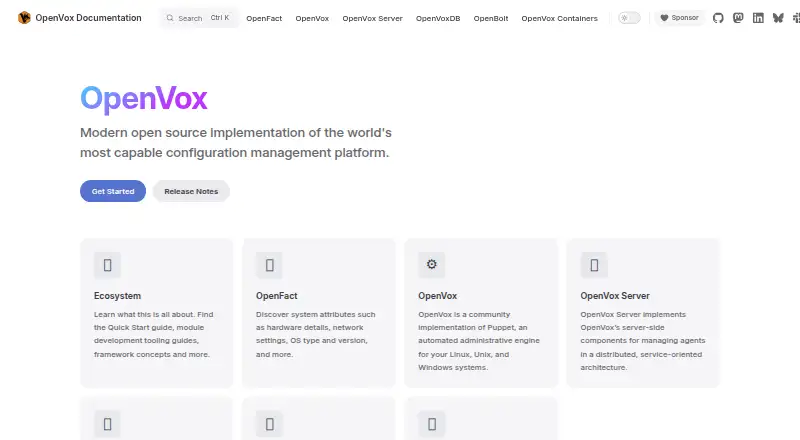
What OpenVox is
OpenVox is a free, community-maintained configuration management system and implementation of Puppet. It uses a declarative language to manage system state and can run with agents managed by a server or in standalone mode, where `puppet apply` compiles and applies a catalog locally. OpenVox is downstream-compatible with Puppet Open Source, so existing manifests, modules, Hiera data, and tooling work unchanged. Its documented packages include an agent, server, database components, and OpenBolt. In agent/server deployments, communication uses HTTPS with mutual TLS; agents need a certificate signed by a local Puppet certificate authority or an external CA before they retrieve catalogs. The server exposes HTTP APIs for catalogs, certificates, status, and metrics. OpenVoxDB stores reports, inventory, and exported resources, while OpenBolt automates infrastructure over SSH and WinRM without agents. The software is self-hosted and lists support for Enterprise Linux, Amazon Linux, Fedora, SLES, Debian, Ubuntu, macOS, and Windows. Documentation directs users to community help and commercial support partners.
Who it suits
OpenVox suits teams managing system configuration across its listed operating systems, especially those with existing Puppet Open Source manifests and tooling. It offers both agent/server and standalone operating modes.
What it does well
- Existing Puppet Open Source tooling works unchanged.
- Supports agent/server and standalone operation.
- Agent/server communication uses HTTPS with mutual TLS.
- OpenBolt automates over SSH and WinRM without agents.
- Lists drift detection and compliance reporting.
What to know first
- Requires self-hosted deployment.
- Agents need a signed certificate before retrieving catalogs.
- Support is directed to community help and commercial partners.
Plans
| Plan | Billed and limits | Price |
|---|---|---|
| OpenVox | Community-maintained software · agent/server or standalone use | Free |
As docs.openvoxproject.org lists them, read 2 Oct 2026. The maker's own page has the final word.
Getting started
- Visit the OpenVox documentation site.
- Choose a supported operating system: Enterprise Linux, Amazon Linux, Fedora, SLES, Debian, Ubuntu, macOS, or Windows.
- Install the package or packages needed for the chosen deployment, such as `openvox-agent` or `openvox-server`.
- Choose agent/server operation or standalone use with `puppet apply`.
- For agent/server use, configure HTTPS with mutual TLS and sign agent certificates through a local Puppet CA or an external CA.
- Use the documentation’s community help or commercial support partner list if support is needed.
Verdict
OpenVox offers a self-hosted route to Puppet-compatible configuration management, with server-managed agents or local catalog application. Teams should account for certificate setup in agent/server deployments.
Questions
How much does OpenVox cost?
The listed plan is free.
Is OpenVox open source?
Yes. It is community-maintained software.
Which operating systems does OpenVox support?
Supported platforms include Enterprise Linux, Amazon Linux, Fedora, SLES, Debian, Ubuntu, macOS, and Windows.
Can OpenVox run without a server?
Yes. Standalone mode uses `puppet apply` to compile and apply a catalog locally.
Will existing Puppet data and tools work with OpenVox?
Yes. Existing Puppet Open Source manifests, modules, Hiera data, and tooling work unchanged.
What support options are described?
The documentation points to community help and a list of commercial support partners.
Facts from OpenVox's own pages
- Certificate authority
- Before agents retrieve configuration catalogs, they need a signed certificate from the local Puppet certificate authority or an external CA. · docs.openvoxproject.org, 2 Oct 2026
- Compatibility
- OpenVox is downstream-compatible with Puppet Open Source, and existing manifests, modules, Hiera data, and tooling work unchanged. · docs.openvoxproject.org, 2 Oct 2026
- Data store
- OpenVoxDB is described as OpenVox’s data warehouse for reports, inventory, and exported resources. · docs.openvoxproject.org, 2 Oct 2026
- Integrations
- OpenVox Server exposes HTTP APIs, including catalog, certificate authority, status, and metrics endpoints. · docs.openvoxproject.org, 2 Oct 2026
- Operating modes
- OpenVox can run as agents managed by a server or in standalone mode, where `puppet apply` compiles and applies a catalog locally. · docs.openvoxproject.org, 2 Oct 2026
- Orchestration
- OpenBolt is a community implementation of Puppet Bolt that automates infrastructure management over SSH and WinRM without requiring agents. · docs.openvoxproject.org, 2 Oct 2026
- Packages
- The documented package set includes `openvox-agent`, `openvox-server`, `openvoxdb`, `openvoxdb-termini`, and `openbolt`. · docs.openvoxproject.org, 2 Oct 2026
- Platforms
- The documentation provides installation instructions for Linux, Windows, and macOS. · docs.openvoxproject.org, 2 Oct 2026
- Project stewardship
- The documentation says OpenVox was adopted under Vox Pupuli stewardship and that a Puppet Standards Steering Committee guides language and feature evolution. · docs.openvoxproject.org, 2 Oct 2026
- Purpose
- OpenVox is a community-maintained implementation of Puppet, a configuration management system that manages system state through a declarative language. · docs.openvoxproject.org, 2 Oct 2026
- Security
- In agent/server mode, agents and servers communicate over HTTPS with mutual TLS. · docs.openvoxproject.org, 2 Oct 2026
- Support
- The documentation directs users to community help and a list of commercial support partners. · docs.openvoxproject.org, 2 Oct 2026
Where OpenVox stands on Freedom251
- IT Automation Software#21 of 77
- Configuration Management Tools#11 of 26
- Orchestration / Provisioning Software#13 of 27