Freedom251 › Generative Design Software
OpenMDAO
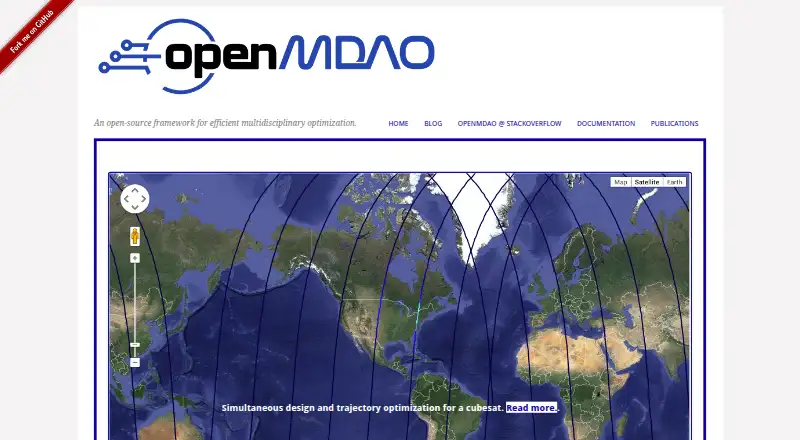
What OpenMDAO is
OpenMDAO is a free, open-source Python framework for systems analysis and multidisciplinary optimization. Its main focus is gradient-based optimization using analytic derivatives, including design problems with hundreds or thousands of variables. Models are assembled from components and groups, with drivers for optimization algorithms or design of experiments. Nonlinear and linear solvers can be positioned at different levels of a model hierarchy. Derivative capabilities include analytic partial derivatives, finite-difference and complex-step approximations, derivative checks, and forward or reverse total derivative calculations. MPI features support parallel subsystems and distributed variables; parallel computing can also support gradient-free optimization, mixed-integer nonlinear programming, and design-space exploration. Documented features include model visualizations, optimization progress plots, and recording and reading model or solver cases. The project identifies Dymos for transient modeling and optimal control and pyCycle for turbine engine cycle analysis as related libraries. OpenMDAO is available for Linux and self-hosted use under the Apache 2.0 license. The supported 3.x line requires Python 3.10 or later.
Who it suits
OpenMDAO may suit engineers and researchers building systems models for multidisciplinary optimization, including applications such as cubesat design, wind turbines, or unconventional aircraft concepts. It is aimed at users working in Python and able to meet its version requirements.
What it does well
- Free under the Apache 2.0 license
- Supports analytic and approximate derivative methods
- MPI features support parallel subsystems
- Includes model and optimization visualizations
What to know first
- Supported 3.x line requires Python 3.10 or later
- Parallel derivative approximation requires MPI
- API may change periodically during active development
Limits
The supported OpenMDAO 3.x line requires Python 3.10 or later. Parallel finite-difference and complex-step derivative approximation requires MPI and may not run on Colab or Binder.
Plans
| Plan | Billed and limits | Price |
|---|---|---|
| OpenMDAO | open-source framework · Apache 2.0 license | Free |
As openmdao.org lists them, read 4 Oct 2026. The maker's own page has the final word.
Getting started
- Open the OpenMDAO website.
- Use Linux or a self-hosted environment.
- Install the supported OpenMDAO 3.x line with Python 3.10 or later.
- Install from PyPI or clone the GitHub repository.
- Add optional dependency sets for testing, documentation, or visualization if needed.
OpenMDAO is a free, open-source Python framework for systems analysis and multidisciplinary optimization. It suits engineers and researchers assembling complex, simulation-driven models, especially when gradient information and parallel execution matter. The trade-off is a developer-oriented workflow tied to a current Python version and an actively changing API.
Overview
OpenMDAO represents a model as components and groups, then uses drivers to run optimization algorithms or design-of-experiments studies. This hierarchy is useful when a project combines many interacting disciplines and needs explicit control over how the model is assembled. It is not a turnkey engineering package: you write and connect the model in Python, so it rewards teams with software and numerical-modeling skills rather than users seeking a graphical, no-code tool.
The central method is gradient-based optimization with analytic derivatives for design spaces containing hundreds or thousands of variables. Its parallel-computing capabilities also accommodate gradient-free optimization, mixed-integer nonlinear programming and broader design-space exploration. That range makes it adaptable, although users must still select and configure the algorithms and model structure themselves.
Key features
Solvers and derivatives
Nonlinear and linear solvers can be placed at different levels of the model hierarchy, giving engineers control over nested solution processes. OpenMDAO accepts analytic partial derivatives, or approximations through finite-difference and complex-step methods. Derivative checking helps identify implementation errors, while forward and reverse total-derivative calculations support different scaling patterns. This is a strong toolkit for optimization work where derivative quality affects convergence; it is more machinery than a small, single-equation study needs.
Parallel models and records
MPI can execute parallel subsystems and distribute variables across processes, which is valuable for expensive multidisciplinary simulations. Parallel finite-difference and complex-step approximations require MPI, and the documentation cautions that this mode may not run on Colab or Binder. Model visualizations, optimization-progress plots, and recording or reading model and solver cases make it possible to inspect runs and compare results rather than treating an optimization as a black box.
Related libraries and integration
Simulation integration is supported, and the project identifies Dymos for transient modeling and optimal control and pyCycle for turbine-engine cycle analysis as libraries built on OpenMDAO. Those extensions are a practical reason to choose the framework when a project aligns with those domains.
Pricing
OpenMDAO costs nothing. It is an open-source framework under the Apache 2.0 license, which permits integration into proprietary software without requiring that software to become open source. There are no seat charges, usage quotas or trial period to manage. You do, however, take responsibility for installing and maintaining the framework and its dependencies.
Platforms
OpenMDAO is available for Linux and self-hosted deployment. Installation is documented through PyPI or a cloned GitHub repository, with optional dependency sets for testing, documentation and visualization. The supported OpenMDAO 3.x line requires Python 3.10 or later, and its API may change periodically while development remains active. Teams standardizing on older Python versions should plan compatibility work before adopting it.
Who it's for
OpenMDAO is aimed at engineering and research teams modeling systems such as cubesats and mission plans, wind turbines, or unconventional aircraft. It is a particularly good fit when a simulation has many design variables, benefits from analytic or checked derivatives, and can exploit MPI parallelism. It is less suitable for casual users, teams wanting a ready-made application, or environments that cannot provide Python 3.10-plus and MPI where parallel approximations are needed.
Pros and cons
- Pros: Free Apache 2.0 licensing allows proprietary integration without an open-source obligation.
- Pros: Analytic, finite-difference and complex-step derivative workflows, with checking and forward/reverse totals, address demanding optimization problems.
- Pros: Hierarchical solvers, distributed variables and MPI parallel subsystems support large multidisciplinary models.
- Pros: Visualization, progress plots and case recording improve run inspection and reproducibility.
- Cons: Python 3.10 or later excludes older runtime environments.
- Cons: MPI is required for parallel derivative approximations and those workflows may fail on Colab or Binder.
- Cons: Active-development API changes can create maintenance work for long-lived projects.
- Cons: Building the model in code demands numerical and software expertise instead of providing a turnkey interface.
Alternatives
Generative Design Software is the broader directory category to browse when you want options beyond a Python framework.
TopOpt is free across Android, iOS, Linux, macOS, web and Windows, and focuses on free MATLAB code for minimum-compliance and buckling optimization; choose it when that narrower topology-optimization scope and wider platform coverage fit better.
Dakota is free, open source under the GNU LGPL, and runs on Linux, macOS and Windows; pick it when a cross-platform LGPL tool is preferable.
OpenLSTO is free on Linux, macOS and Windows, with a first-light version supporting 2D compliance minimization under a volume constraint; choose it for that focused topology-optimization problem.
Plato offers a free Linux open-source version with a limited set of objectives and constraints, while its licensed version targets U.S. government agencies and contractors; select it when that audience and scope match.
nTop has a free non-commercial education edition for students, educators and academic researchers on Linux and Windows, with commercial licensing priced separately; choose it for an education-focused nTop workflow.
ICEM Surf is a Windows paid product with a personal learning edition at no charge and no support; choose it when surface-design tooling matters and the learning-only terms are acceptable.
Z88Arion is Windows-only freeware in German, with a separate license required for commercial use; pick it when those constraints suit a lightweight structural-analysis option.
Avocado is free on Android, Linux, macOS and Windows, but remains in early development, requires a PlayStation BIOS and has variable game compatibility; choose it for that specific emulation use case, not engineering optimization.
Verdict
Choose OpenMDAO if you need a programmable, extensible framework for large multidisciplinary optimization with serious derivative, solver and parallel-computing control. Look elsewhere if you need a polished turnkey interface, broad desktop support, or a stable API that avoids Python and MPI constraints.
Verdict
OpenMDAO offers a broad set of modeling, solver, derivative, and optimization capabilities in a free Python framework. Check the Python requirement and MPI dependency if your workflow uses parallel derivative approximations.
Questions
Does OpenMDAO cost anything?
The OpenMDAO plan costs nothing. It is an open-source framework released under the Apache 2.0 license.
Which platforms are listed?
OpenMDAO lists Linux and self-hosted use.
What Python version does it require?
The repository says the current supported OpenMDAO 3.x line requires Python 3.10 or later.
How can I install OpenMDAO?
Installation is documented through PyPI or a cloned GitHub repository. Optional dependency sets are available for testing, documentation, and visualization.
Can proprietary software use OpenMDAO?
The project says its Apache 2.0 license permits proprietary software to be integrated without making that software open source.
What is the MPI limitation?
Parallel finite-difference and complex-step derivative approximation requires MPI. The documentation says it may not run on Colab or Binder.
Facts from OpenMDAO's own pages
- Derivative tools
- It supports analytic partial derivatives, finite-difference and complex-step approximations, derivative checking, and forward or reverse total derivative calculations. · openmdao.org, 4 Oct 2026
- Founded
- 2007 · openmdao.org, 28 Sept 2026
- Installation
- The project documents installation from PyPI or a cloned GitHub repository, with optional dependency sets for testing, documentation, and visualization. · github.com, 4 Oct 2026
- Intended users
- The project describes applications including cubesat design and mission planning, wind turbine design, and unconventional aircraft concepts. · openmdao.org, 4 Oct 2026
- License
- OpenMDAO is released under the Apache 2.0 license, which the project says permits proprietary software to be integrated without making it open source. · openmdao.org, 4 Oct 2026
- Model structure
- Models are built from components and groups, with drivers that can run optimization algorithms or design of experiments. · openmdao.org, 4 Oct 2026
- Other optimization
- Its parallel computing features can also support gradient-free optimization, mixed-integer nonlinear programming, and design space exploration. · openmdao.org, 4 Oct 2026
- Parallel computing
- MPI features can run parallel subsystems and distributed variables across multiple processes. · openmdao.org, 4 Oct 2026
- Parallel dependency limit
- The documentation says parallel finite-difference and complex-step derivative approximation requires MPI and may not run on Colab or Binder. · openmdao.org, 4 Oct 2026
- Primary method
- The project focuses on gradient-based optimization with analytic derivatives for design spaces with hundreds or thousands of design variables. · openmdao.org, 4 Oct 2026
- Purpose
- OpenMDAO is an open-source Python framework for systems analysis and multidisciplinary optimization. · openmdao.org, 4 Oct 2026
- Related libraries
- The project identifies Dymos for transient modeling and optimal control and pyCycle for turbine engine cycle analysis as libraries built on OpenMDAO. · openmdao.org, 4 Oct 2026
- Solver features
- OpenMDAO provides nonlinear and linear solvers that can be placed at different levels of a model hierarchy. · openmdao.org, 4 Oct 2026
- Version requirements
- The repository says the current supported OpenMDAO 3.x line requires Python 3.10 or later and that its API may change periodically while in active development. · github.com, 4 Oct 2026
- Visualization and recording
- Documented features include model visualizations, optimization progress plots, and recording and reading model or solver cases. · openmdao.org, 4 Oct 2026
Where OpenMDAO stands on Freedom251
- Generative Design Software#8 of 20