Freedom251 › Generative Design Software
Dakota
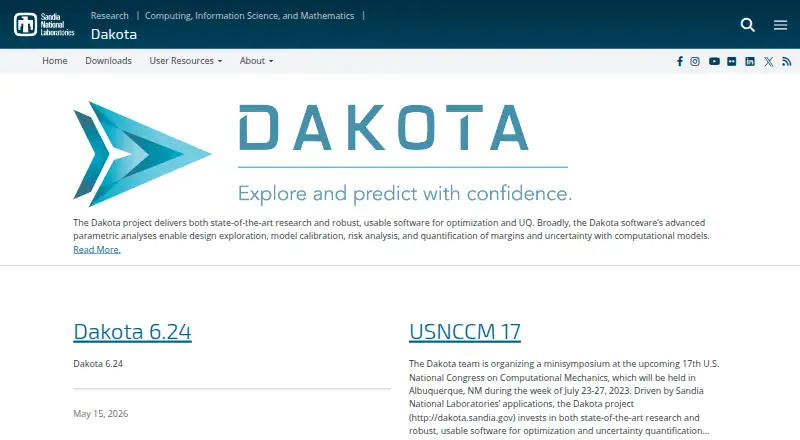
What Dakota is
Dakota is software for optimization and uncertainty quantification using computational models. It provides methods for optimization, parameter estimation, sensitivity or variance analysis, and uncertainty assessment. Engineering analysts can use it to explore designs and assess confidence in computational predictions. The C++ toolkit links simulation codes with iterative systems-analysis methods, and its capabilities can be combined into strategies such as hybrid optimization, surrogate-based optimization, and optimization under uncertainty. Dakota lists MPI for parallel distributed-memory communication, and its installation instructions include an optional PYTHONPATH setup for the dakota.interfacing Python module. Prebuilt binaries are available for macOS, Windows, and Red Hat Enterprise Linux 7 and 8; other platforms require building from source. Versions 5.0 and newer are available under the GNU Lesser General Public License. Some optional numerical libraries, including DOT, NLPQLP, and NPSOL/NLSSOL, require separate commercial licenses. Documentation for releases 6.17 and later is on Dakota’s documentation site, with older manuals available to download. The project began in 1994 and directs support questions to GitHub Discussions.
Who it suits
Dakota suits engineering analysts exploring design options or evaluating confidence in computational predictions. It is also relevant to users who need optimization and uncertainty methods connected to simulation codes.
What it does well
- Free software under the GNU LGPL
- Combines simulation codes with analysis methods
- Includes optimization and uncertainty methods
- MPI is listed for distributed-memory communication
- Introductory and analysis screencasts are available
What to know first
- Some platforms require building from source
- Some optional numerical libraries need commercial licenses
Plans
| Plan | Billed and limits | Price |
|---|---|---|
| Dakota | Open-source software under GNU LGPL | Free |
As dakota.sandia.gov lists them, read 3 Oct 2026. The maker's own page has the final word.
Getting started
- Visit the Dakota website.
- Choose the package for Linux, macOS, or Windows, or build from source for another platform.
- Install Dakota and follow the installation instructions.
- Optionally configure PYTHONPATH to use the dakota.interfacing Python module.
- Consult the documentation or introductory screencasts to get started.
Overview
Dakota is a computational-model toolkit for analysts who need to optimize designs and understand uncertainty in simulation results. It is most compelling for engineering work built around existing simulation codes; its breadth comes with a technical, integration-focused approach rather than a self-contained design application.
Key features
Dakota brings optimization, uncertainty quantification, parameter estimation, and sensitivity or variance analysis together. That combination is useful when choosing a design requires both comparing candidates and assessing confidence in predictions. Multi-objective optimization and strategies such as hybrid optimization, surrogate-based optimization, and optimization under uncertainty give analysts ways to combine methods around more complex problems.
Its extensible C++ interface connects simulation codes to iterative systems-analysis methods. That is a practical advantage for teams with established computational workflows, but a drawback for readers seeking a ready-made graphical design environment. An optional Python module, dakota.interfacing, can be used by configuring PYTHONPATH. MPI is offered as a utility for parallel distributed-memory communication.
Documentation for releases 6.17 and later is provided through Dakota’s documentation site, with older manuals available for download. GitHub Discussions is the user-support channel, and screencasts cover introductory use, input files, sensitivity analysis, and sampling. These resources address common parts of adoption, though the workflow still assumes users are comfortable working with a technical toolkit.
Pricing
Dakota is free: its plan costs nothing and versions 5.0 and newer are available under the GNU Lesser General Public License. There is no free trial because the software itself is free. This makes it accessible for engineering analysts and teams evaluating model-based methods without a subscription charge.
The free software does not include every optional numerical library on the same terms. DOT, NLPQLP, and NPSOL/NLSSOL require separate commercial licenses, so projects that depend on those libraries should account for additional licensing. Dakota is therefore a stronger fit when its open-source capabilities meet the need, and less straightforward when a workflow depends on one of those separately licensed options.
Platforms
Dakota supports Linux, macOS, and Windows. Prebuilt binaries are available for macOS, Windows, and Red Hat Enterprise Linux 7 and 8; other platforms require building from source. That gives users on the named systems a more direct installation route, while other Linux distributions or environments may require additional technical effort.
Who it's for
Dakota is aimed at engineering analysts exploring designs and assessing confidence in computational predictions. It suits users who can connect simulation codes to iterative analysis methods and benefit from several optimization and uncertainty approaches in one toolkit. Readers who need a standalone design interface, or whose work does not center on computational models, are better served by a more focused application.
Pros and cons
- Pros: Optimization, uncertainty quantification, parameter estimation, and sensitivity analysis sit within one toolkit, supporting analysis beyond simply finding a candidate design.
- Pros: Multi-objective and combined strategies such as surrogate-based optimization extend the options for model-centered engineering problems.
- Pros: Free GNU LGPL software and support for Linux, macOS, and Windows make it accessible across common engineering environments.
- Cons: Its C++ integration model is technical and assumes simulation-code workflows; it is not a self-contained graphical design tool.
- Cons: Users on platforms without prebuilt binaries must build from source, and certain optional numerical libraries require separate commercial licenses.
Alternatives
For topology-optimization work, TopOpt is a free option with MATLAB code for minimum-compliance and buckling optimization, including free MATLAB and COM options; choose it when that narrower focus fits better than Dakota’s broader analysis toolkit. OpenLSTO is also free and open source, with a first light version supporting 2D compliance minimization under a volume constraint, making it a fit when that specific problem is enough.
OpenMDAO is a free, open-source framework under Apache 2.0 for Linux and self-hosted use; consider it when those platform and framework terms suit the project. nTop offers a free non-commercial version for students, educators, and academic researchers, so it is an alternative for those eligible users. Plato has a free open-source version with a limited set of objectives and constraints, which may suit work that fits within those limits.
ARL Topologies is another alternative. Z88Arion is freeware for Windows, with a separate license required for commercial use. Avocado is free but remains in early development, requires a PlayStation BIOS, and has variable game compatibility, so it serves a different use case from Dakota. See Generative Design Software for a broader category list.
Verdict
Choose Dakota if you are an engineering analyst working with computational models and want a free toolkit that combines optimization with uncertainty and sensitivity analysis. Its range of methods and extensible simulation interface are the central reasons to choose it. Look elsewhere if you need a self-contained design application, cannot build from source on your platform, or rely on optional numerical libraries whose commercial licensing does not suit your project.
Verdict
Dakota offers a broad set of model-based optimization and uncertainty methods through an extensible C++ toolkit. Check platform requirements and separate licenses for optional numerical libraries when planning an implementation.
Questions
How much does Dakota cost?
The listed Dakota plan is free: free.
Is Dakota open source?
Dakota versions 5.0 and newer are available under the GNU Lesser General Public License.
Which operating systems are supported?
Prebuilt binaries are available for macOS, Windows, and Red Hat Enterprise Linux 7 and 8. Other platforms require building from source.
Can Dakota connect with simulation software?
Yes. Its C++ toolkit provides an interface between simulation codes and iterative systems analysis methods.
Are all numerical libraries included without separate licensing?
Some optional libraries, including DOT, NLPQLP, and NPSOL/NLSSOL, require separate commercial licenses.
Where can users get support?
The project directs users to GitHub Discussions and offers screencasts on introductory use, input files, sensitivity analysis, and sampling.
Facts from Dakota's own pages
- Advanced strategies
- Dakota capabilities can be combined in strategies such as hybrid optimization, surrogate-based optimization, and optimization under uncertainty. · dakota.sandia.gov, 3 Oct 2026
- Analysis methods
- Its methods include optimization, uncertainty quantification, parameter estimation, and sensitivity or variance analysis. · dakota.sandia.gov, 3 Oct 2026
- Commercial extensions
- Some optional numerical libraries, including DOT, NLPQLP, and NPSOL/NLSSOL, require separate commercial licenses. · dakota.sandia.gov, 3 Oct 2026
- Documentation
- Documentation for releases 6.17 and later is provided through Dakota’s documentation site, while older manuals are available for download. · dakota.sandia.gov, 3 Oct 2026
- Intended users
- The project describes its use for engineering analysts exploring designs and assessing confidence in computational predictions. · dakota.sandia.gov, 3 Oct 2026
- License
- Dakota versions 5.0 and newer are available under the GNU Lesser General Public License. · dakota.sandia.gov, 3 Oct 2026
- Operating systems
- Prebuilt binaries are available for macOS, Windows, and Red Hat Enterprise Linux 7 and 8; other platforms require building from source. · dakota.sandia.gov, 3 Oct 2026
- Parallel computing
- Dakota lists MPI as a utility for parallel distributed-memory communication. · dakota.sandia.gov, 3 Oct 2026
- Project history
- The Dakota project was initiated in 1994. · dakota.sandia.gov, 3 Oct 2026
- Purpose
- Dakota provides software for optimization and uncertainty quantification using computational models. · dakota.sandia.gov, 3 Oct 2026
- Python support
- The installation instructions provide an optional PYTHONPATH setup for using the dakota.interfacing Python module. · dakota.sandia.gov, 3 Oct 2026
- Software interface
- The C++ toolkit provides an extensible interface between simulation codes and iterative systems analysis methods. · dakota.sandia.gov, 3 Oct 2026
- Support
- The project directs users to GitHub Discussions for user support. · dakota.sandia.gov, 3 Oct 2026
- Training resources
- The project offers screencasts covering introductory use, input files, sensitivity analysis, and sampling. · dakota.sandia.gov, 3 Oct 2026
Where Dakota stands on Freedom251
- Generative Design Software#3 of 20