Freedom251 › Music Transcription Software
Omnizart
What Omnizart is
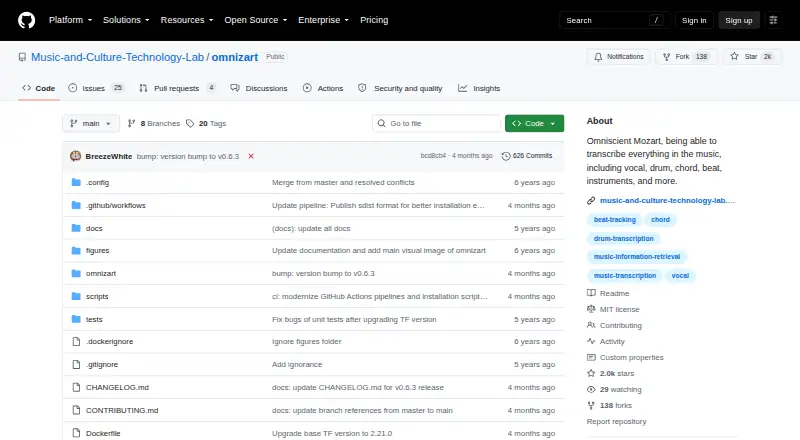
Omnizart is a free Python library for transcribing polyphonic music into pitched instruments, vocal melody, chords, drum events, and beats. Pre-trained checkpoints are available for transcription without first training a model. The project documents a broader process that includes downloading datasets, preprocessing features, training models, transcribing audio, and sonification. It provides applications for music, drums, vocals, vocal contours, chords, and beats, with MIDI, CSV, and text listed as output formats. Omnizart can be installed with pip, Docker, or Conda and includes a command-line interface; documentation also links to a Colab notebook and a Replicate web demo. The package requires Python 3.8 or later but below 3.15. The README says it is incompatible with ARM-based macOS because of underlying dependencies. Provided drum checkpoints can still be used for transcription, though the repository reports an unresolved problem with training the drum model from scratch. Omnizart is distributed under the MIT License, which provides the software as-is without warranty. GitHub Issues is the support channel for installation, compatibility, and usage problems.
Who it suits
Omnizart may suit developers and science or research users who need a Python-based music transcription library. Its checkpoints support transcription, while its documented training workflow may appeal to users working with datasets and models.
What it does well
- Transcribes instruments, vocals, chords, drums, and beats.
- Pre-trained checkpoints are provided.
- Supports pip, Docker, and Conda installation.
- Outputs include MIDI, CSV, and text.
- GitHub Issues covers installation and usage problems.
What to know first
- Incompatible with ARM-based macOS.
- Drum model training has a reported unresolved issue.
- Requires Python below version 3.15.
- MIT license provides no warranty.
Limits
Omnizart is incompatible with ARM-based macOS, and its package requires Python version 3.8 or later and below 3.15. The drum model has a reported issue that prevents loss convergence when training from scratch, although provided drum checkpoints remain usable for transcription.
Plans
| Plan | Billed and limits | Price |
|---|---|---|
| Omnizart | MIT License · pip, Docker, or Conda installation | Free |
As github.com lists them, read 1 Oct 2026. The maker's own page has the final word.
Getting started
- Open the Omnizart GitHub project.
- Check that your system is Linux, Windows, macOS, or self-hosted; ARM-based macOS is incompatible.
- Use Python 3.8 or later and below 3.15.
- Install through pip, use Docker, or install from source with Conda.
- Use a provided pretrained checkpoint for transcription, or follow the documented dataset, preprocessing, and training workflow.
- Consult the Colab notebook or Replicate web UI demo for demonstrations.
Omnizart is a Python library for transcribing polyphonic music, aimed chiefly at developers and research users. Its pretrained checkpoints and documented training workflow make it a flexible free option, but its ARM-based Mac incompatibility and a known drum-training bug narrow its appeal.
Overview
The project covers transcription of pitched instruments, vocal melody, chords, drum events, and beats. It also documents a broader workflow—from obtaining datasets and preprocessing features through training, transcription, and sonification—so it can serve both people who need a transcription tool and those building research workflows around music data.
Pretrained checkpoints allow users to start transcribing without training a model. Output formats include MIDI, CSV, and text, with MIDI export, chord detection, and stem separation among its stated capabilities. The trade-off is a developer-oriented Python library rather than a narrowly packaged consumer app.
Key features
Transcription and outputs
Omnizart supports music, drum, vocal, vocal-contour, chord, and beat applications. That breadth is useful when a project needs more than note transcription alone; the multiple output formats also give downstream workflows options beyond MIDI. Its pretrained checkpoints are particularly valuable for users who want to transcribe without first preparing data or training a model.
Installation and workflow
Users can install through pip, use Docker, or install from source with Conda, and the project includes a command-line interface. This gives technical users several ways to fit the library into an existing environment, though the range of routes does not make it a turnkey desktop workflow. Official documentation also links to a Colab notebook and a Replicate web demo for trying the project through those interfaces.
Training caveat
The documented training workflow is a strength for research users, but it comes with a concrete exception: the drum model has unknown bugs that prevent loss convergence when trained from scratch. Provided drum checkpoints remain usable for transcription, so this limitation matters most to users seeking to train their own drum model.
Pricing
Omnizart is free: its Omnizart plan costs nothing under the MIT License and supports pip, Docker, or Conda installation. There is no paid tier to unlock in the stated plan. The license permits use under MIT terms, while also providing the software as is without warranty.
Platforms
Omnizart supports Linux, macOS, Windows, and self-hosted use. Package metadata requires Python version >=3.8 and <3.15, so compatibility depends on both the operating system and the Python environment. Despite macOS support in general, the README says the software is incompatible with ARM-based Macs because of underlying dependencies; users on those machines should look elsewhere or use another supported environment.
Who it's for
Omnizart is best suited to developers, science and research users, and technically comfortable musicians who need transcription outputs or a documented path for model work. It is a strong fit when free access, multiple transcription targets, and control over installation matter more than a consumer-focused interface. It is a poor fit for ARM-based Mac users and for anyone whose main goal is training the drum model from scratch.
Pros and cons
Pros
- Broad transcription scope: pitched instruments, voice, chords, drums, and beats cover several common analysis needs in one project.
- Ready-to-use checkpoints: users can begin transcription without first training models, including drum transcription despite the training caveat.
- Flexible technical setup: pip, Docker, Conda source installation, CLI use, and documented Colab and Replicate demos offer different ways to work with the project.
- Free and open under MIT: the plan costs nothing, with no stated paid upgrade.
Cons
- No ARM-based Mac compatibility: the dependency limitation excludes a substantial class of Mac users from a local setup.
- Drum training is unreliable: unknown bugs prevent loss convergence from scratch, limiting experimentation with that model.
- Technical orientation: the Python package, command line, and source-install options suit developers and researchers better than users seeking a conventional desktop app.
- As-is warranty: the MIT license disclaims warranty, so users should account for that when relying on the software.
Alternatives
Choose AnthemScore if a freemium desktop or web option with a trial better fits your workflow; its web free plan gives a 14-day full-song trial, then unlimited 30-second clips. Klangio Transcription Studio is a better match for users who want a mobile or web service and can work within its free demo limit of 20 seconds per transcription.
Melody Scanner may suit users who want mobile or web access, YouTube import, and a free plan that allows recording up to one minute, with sheet output limited to 40 bars. MuScriptor is another free, MIT-licensed code option with a hosted demo, though its model weights are CC BY-NC 4.0 non-commercial.
Pick Piano2Notes if a piano-focused mobile or web demo and PDF, MIDI, and MusicXML preview better meet the need; its free transcriptions cover the first 20 seconds. ScoreCloud is a better fit for users seeking a web, desktop, or iOS notation service, including notating from singing, with a free plan capped at 10 online songs and watermarked printing.
Spotify Basic Pitch is a free open-source alternative with an online demo for users seeking a more direct option. Violin2Notes is an alternative for violin-focused transcription, with mobile and web access and a free demo limited to the first 20 seconds.
Browse more options in Music Transcription Software.
Verdict
Choose Omnizart if you are a developer or research user who wants a free, flexible transcription library, pretrained models, and a documented route from data preparation to output. Its breadth and installation choices are compelling, but ARM-based Mac incompatibility and the drum-training bug are meaningful constraints. Users who need a conventional consumer app, ARM Mac support, or reliable from-scratch drum training should choose another tool.
Verdict
Omnizart offers transcription checkpoints and a documented training workflow, with several installation routes and output formats. ARM-based Mac users and anyone training the drum model should note the stated limitations.
Questions
Is Omnizart free?
Yes. The Omnizart plan is free and is distributed under the MIT License.
What can it transcribe?
It transcribes pitched instruments, vocal melody, chords, drum events, and beats from polyphonic music.
Which operating systems and installation routes are supported?
The listed platforms are Linux, macOS, Windows, and self-hosted. Installation options include pip, Docker, and Conda source installation.
What Python versions does it require?
The package requires Python version 3.8 or later and below 3.15.
Can it run on ARM-based Macs?
No. The README says Omnizart is incompatible with ARM-based macOS because of underlying dependencies.
What license and support channel does it have?
Omnizart uses the MIT License. GitHub Issues is the project’s channel for installation, compatibility, and usage problems.
Facts from Omnizart's own pages
- Demonstrations
- Official documentation links to a Colab notebook and a Replicate web UI demo. · music-and-culture-technology-lab.github.io, 1 Oct 2026
- Drum limitation
- The repository says the drum model has unknown bugs that prevent loss convergence when training from scratch, while provided checkpoints remain usable for drum transcription. · github.com, 1 Oct 2026
- Founded
- 2017 · github.com, 28 Sept 2026
- Intended users
- Package metadata classifies the intended audience as developers and science or research users. · github.com, 1 Oct 2026
- Interfaces
- The project provides pip installation, Docker usage, Conda source installation, and a command-line interface. · github.com, 1 Oct 2026
- Latest release
- Release 0.6.3 dated 2026-05-31 added an in-code sherpa-onnx source-separation backend and CLI startup optimization. · github.com, 1 Oct 2026
- License
- Omnizart is distributed under the MIT License, and the license states that the software is provided as is without warranty. · github.com, 1 Oct 2026
- Lifecycle
- The documentation covers dataset downloading, feature preprocessing, model training, transcription, and sonification. · music-and-culture-technology-lab.github.io, 1 Oct 2026
- Mac limitation
- The README states that Omnizart is incompatible with ARM-based macOS because of underlying dependencies. · github.com, 1 Oct 2026
- Pretrained models
- Pre-trained checkpoints are provided for immediate transcription use. · music-and-culture-technology-lab.github.io, 1 Oct 2026
- Purpose
- Omnizart is a Python library and streamlined solution for automatic music transcription. · music-and-culture-technology-lab.github.io, 1 Oct 2026
- Python versions
- The package metadata requires Python version >=3.8 and <3.15. · github.com, 1 Oct 2026
- Support channel
- The project provides GitHub Issues for installation, compatibility, and usage problems. · github.com, 1 Oct 2026
- Supported applications
- The repository lists music, drum, vocal, vocal-contour, chord, and beat applications. · github.com, 1 Oct 2026
- Transcription targets
- It transcribes pitched instruments, vocal melody, chords, drum events, and beat from polyphonic music. · github.com, 1 Oct 2026
Where Omnizart stands on Freedom251
- Music Transcription Software#10 of 31