Freedom251 › Network Simulation Software
OMNeT++
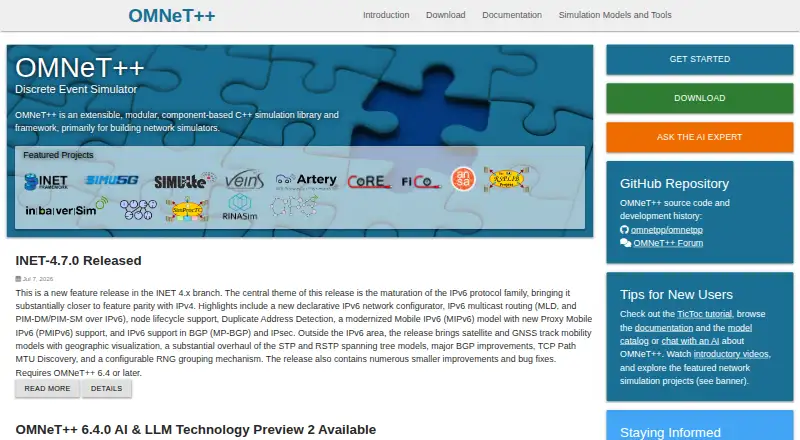
What OMNeT++ is
OMNeT++ is a discrete-event simulation framework for building network simulators from communicating C++ modules. Their structure is defined in NED, and simulations can run in Qtenv, a graphical environment, or Cmdenv, a command-line interface. The IDE Analysis Tool uses Pandas and Matplotlib to analyze and plot results; R and Matlab can also process them. Extensions cover real-time simulation, network emulation, database integration, and SystemC integration. Its INET model library includes Internet stack models and other protocols and components. OMNeT++ is available for Linux, Windows, and macOS, with a core archive and container images also offered. The project recommends opp_env for installation and uses WSL in its recommended Windows route. The Academic Public License permits noncommercial use, including teaching and research; commercial work requires a separate license, with pricing on request. The free plan costs nothing. The maker says there is no telemetry or account system, and models and results remain on the user’s computer.
Who it suits
OMNeT++ suits researchers, teachers, and scientific or industrial teams building and analyzing simulations. Commercial projects need a separate license.
What it does well
- Graphical Qtenv and command-line Cmdenv interfaces
- Analysis Tool uses Pandas and Matplotlib
- INET includes Internet stack models and protocols
- Supports real-time simulation and network emulation
- Maker says models and results stay on the computer
What to know first
- Commercial work requires a separate license
- Windows installation route uses WSL
- Commercial license pricing is provided on request
Limits
The Academic Public License covers noncommercial use, including teaching and research. For-profit work, including commercial research projects, requires a separate commercial license; pricing is on request.
Plans
| Plan | Billed and limits | Price |
|---|---|---|
| OMNeT++ Academic Public License | Free for noncommercial use, including teaching and research; commercial use requires a separate license; redistribution of copies and modifications is subject to the license terms | Free |
| Commercial license | Commercial licensing is offered through OMNEST; pricing is provided on request | On request |
As omnetpp.org lists them, read 30 Sept 2026. The maker's own page has the final word.
Getting started
- Visit the OMNeT++ website and choose a Linux, Windows, or macOS package, core archive, or container image.
- Use opp_env, the project’s recommended installer, to set up OMNeT++ and other models or frameworks.
- On Windows, follow the recommended route using WSL.
- Choose the Academic Public License for noncommercial teaching or research, or contact OMNEST about a commercial license.
- Build a model from communicating C++ modules and describe its structure in NED.
- Run it in Qtenv or Cmdenv, then inspect results with the IDE Analysis Tool.
Overview
OMNeT++ is a discrete-event simulation framework for building network models from C++ components. It is best suited to researchers, educators and engineering teams who need to create or extend simulations, rather than users looking for a ready-made network lab. Its modeling and analysis tools are substantial, but for-profit work requires a separate commercial license.
Key features
Models combine communicating C++ modules, with their structure defined in NED. This gives developers a component-based way to build simulations, but makes the framework a better match for people comfortable with C++ than for users who want to configure a lab without coding. INET, the standard protocol model library, provides Internet stack models and other protocols and components as a starting point.
Qtenv offers a graphical runtime environment, while Cmdenv runs simulations from the command line. That pairing suits both interactive exploration and command-line workflows. The IDE Analysis Tool uses Pandas and Matplotlib to analyze and plot results; results can also be processed with R or Matlab.
Extensions cover real-time simulation, network emulation, database integration and SystemC integration. Support for real-time emulation and hardware-in-the-loop makes OMNeT++ relevant when a simulation needs to connect with real systems, not just run as a standalone model. Its AI technology preview adds a Qtenv chat interface and an MCP server for querying and manipulating active simulations; it is available for Linux x86_64 and macOS aarch64.
Pricing
OMNeT++ Academic Public License: free. It permits noncommercial use, including teaching and research, making it the appropriate plan for academic work that stays within those limits. Redistribution of copies and modifications is subject to the license terms. For-profit work, including commercial research projects, requires a separate license.
Commercial license: custom pricing through OMNEST. This is the route for commercial projects; teams should account for that separate licensing decision before adopting OMNeT++ for paid work. OMNeT++ can also be used for limited-length evaluations, with evaluation downloads available by request.
Platforms
Packages are offered for Linux, Windows and macOS, alongside a core archive and container images. The project recommends opp_env for installing OMNeT++ and other models and frameworks; on Windows, its recommended installation route uses WSL. Desktop deployment and self-hosting suit teams running simulations in their own environment. The maker says the software sends no data, uses no telemetry or account system, and keeps models and results on the user's computer.
For help, users can turn to Discussions, the bug tracker and Stack Overflow; OMNEST characterizes community support as informal via the mailing list.
Who it's for
OMNeT++ fits scientific and industrial users who need a programmable simulation foundation, particularly for research, teaching, network modeling or work involving real-time emulation and hardware-in-the-loop. It is a weaker choice for anyone seeking a turnkey topology lab, or for a commercial team that wants to proceed without a separate licensing arrangement.
Pros and cons
- Pros: Modular C++ models and NED structure give developers a flexible basis for custom simulations.
- Pros: Qtenv, Cmdenv and the analysis tool support graphical runs, command-line runs and result plotting across familiar data tools.
- Pros: INET and extensions for emulation, real-time simulation, databases and SystemC broaden the work the framework can support.
- Cons: Building around C++ modules makes it less suitable for users who want a finished graphical lab rather than a modeling framework.
- Cons: The free license is limited to noncommercial use; commercial projects need a separate license with custom pricing.
- Cons: Recommended Windows installation goes through WSL, an additional setup step for Windows users.
Alternatives
For a network-simulation-specific shortlist, browse Network Simulation Software.
- Cisco Modeling Labs is worth considering if a free tier capped at 5 running nodes or paid tiers for 20 or 40 Cisco nodes better fit the lab you need.
- Containerlab is a free alternative if you want a container-based lab and can meet its Linux server or VM, Docker and, for some operations, sudo requirements.
- EVE-NG is another freemium option, with a free tier limited to 7 nodes per instance, 63 per lab and the Admin role.
- GNS3 is a free, open-source alternative.
- IMUNES is a free, open-source alternative.
- Mininet is free under a permissive BSD open-source license, but requires the Linux kernel and is limited by one server's CPU and bandwidth.
- PNETLab offers a free platform with full features in its offline version, which is limited to 10 accounts.
- Cisco Packet Tracer is free to use, with enrollment in a course required to download the latest version.
Verdict
Choose OMNeT++ if you need a programmable, extensible foundation for network simulation and can work within its noncommercial license or obtain commercial licensing. Its modular models, multiple simulation interfaces and analysis options are the draw; look elsewhere if you need a ready-to-use lab or cannot accommodate separate commercial licensing.
Verdict
OMNeT++ combines modular C++ modeling with graphical and command-line simulation, analysis, and extension options. Its free license is for noncommercial use; commercial projects require separate licensing.
Questions
Is OMNeT++ free?
The Academic Public License is free for noncommercial use, including teaching and research. Commercial use requires a separate license.
How much does the commercial license cost?
OMNEST provides commercial licensing, with pricing on request.
Which operating systems are supported?
The download page offers packages for Linux, Windows, and macOS, along with a core archive and container images. The recommended Windows installation route uses WSL.
Does OMNeT++ have a free trial?
A free trial is listed. OMNEST says OMNeT++ can be used for limited-length evaluations, and its evaluation page offers a request-based download.
What does OMNeT++ simulate?
It is primarily used to build network simulators. Its models use discrete events and communicating C++ modules structured with NED.
Does OMNeT++ collect telemetry or require an account?
The maker’s privacy policy says OMNeT++ has no telemetry or account system. It says simulation models and results stay on the user’s computer.
Facts from OMNeT++'s own pages
- AI preview
- The AI technology preview adds a Qtenv chat interface and an MCP server for querying and manipulating active simulations, and is listed for Linux x86_64 and macOS aarch64. · omnetpp.org, 30 Sept 2026
- Analysis
- Its IDE Analysis Tool uses Pandas and Matplotlib to analyze and plot simulation results, which can also be processed with R or Matlab. · omnetpp.org, 30 Sept 2026
- Download platforms
- The current download page offers packages for Linux, Windows, and macOS, plus a core archive and container images. · omnetpp.org, 30 Sept 2026
- Evaluation
- OMNEST says OMNeT++ can be used for limited-length evaluations, while its evaluation page offers a request-based download. · omnest.com, 30 Sept 2026
- Extensions
- The site describes extensions for real-time simulation, network emulation, database integration, and SystemC integration. · omnetpp.org, 30 Sept 2026
- Founded
- 1997 · omnetpp.org, 28 Sept 2026
- Headquarters
- Budapest, Hungary · omnetpp.org, 28 Sept 2026
- Installation
- The project recommends opp_env to install OMNeT++ and other models and frameworks; on Windows its recommended route uses WSL. · omnetpp.org, 30 Sept 2026
- Intended users
- The maker describes OMNeT++ as popular in scientific and industrial settings and lists research and teaching as noncommercial use cases. · omnetpp.org, 30 Sept 2026
- Interfaces
- OMNeT++ includes a graphical runtime environment called Qtenv and a command-line simulation interface called Cmdenv. · omnetpp.org, 30 Sept 2026
- License limits
- The Academic Public License allows noncommercial use; for-profit work, including commercial research projects, requires a commercial license. · omnetpp.org, 30 Sept 2026
- Modeling
- Models are built from communicating C++ modules, with their structure defined in the NED language. · omnetpp.org, 30 Sept 2026
- Model library
- INET is presented as OMNeT++’s standard protocol model library and includes Internet stack models and other protocols and components. · omnetpp.org, 30 Sept 2026
- Privacy
- The maker’s privacy policy says OMNeT++ sends no data, has no telemetry or account system, and keeps simulation models and results on the user’s computer. · omnetpp.org, 30 Sept 2026
- Purpose
- OMNeT++ is an extensible, modular C++ simulation library and framework primarily used to build network simulators. · omnetpp.org, 30 Sept 2026
- Support
- The project points users to Discussions, a bug tracker, and Stack Overflow; the commercial OMNEST comparison describes OMNeT++ support as informal via the mailing list. · omnetpp.org, 30 Sept 2026
Where OMNeT++ stands on Freedom251
- Network Simulation Software#15 of 31