Freedom251 › Network Simulation Software
QuNetSim
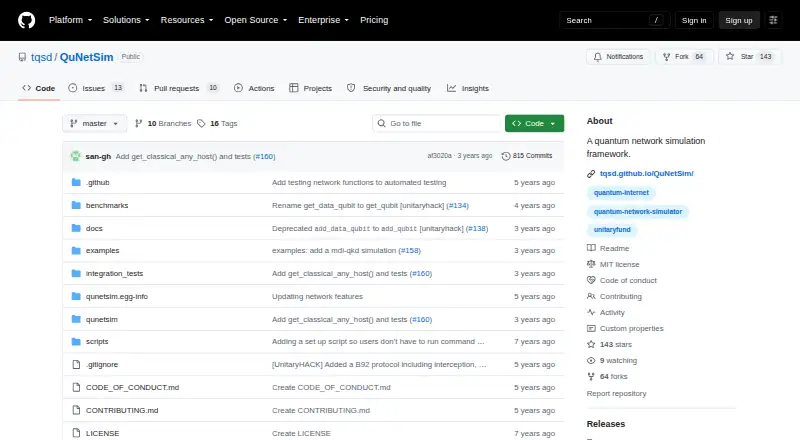
What QuNetSim is
QuNetSim is a free Python framework for developing and testing quantum networking applications and protocols. Its built-in tasks include qubit teleportation, entanglement distribution, superdense coding, and quantum key distribution. It supports multi-hop networks, using entanglement swapping to create entanglement between distant hosts. Users can define routing functions based on classical and quantum network states, while NetworkX graphs represent network structures. The event-driven framework uses packets with sequence numbers that can wait for acknowledgements. Its Host, Protocols, and Network components map to application, transport, and network layers. Documentation lists SimulaQron, ProjectQ, and EQSN as backends, with SimulaQron as the default; users can also implement and import their own network and qubit backends. Installation instructions cover pip and provide a template script that generates an example. The project documents setup for Linux, Mac OS X, and Windows and requires Python 3.5 or greater for those platform-specific instructions. QuNetSim is intended for students and instructors, particularly those new to quantum networks. The project describes it as educational, not as an accurate quantum-physics simulation or full quantum network simulator. It is MIT-licensed.
Who it suits
QuNetSim is suited to students and instructors learning about quantum networks, and to developers experimenting with network protocols. It is not intended as an accurate quantum-physics or full quantum-network simulator.
What it does well
- Includes four built-in quantum networking tasks.
- Supports multi-hop networks and entanglement swapping.
- Users can implement custom routing functions.
- Supports SimulaQron, ProjectQ, and EQSN backends.
- Free and MIT-licensed.
What to know first
- Not designed for accurate quantum-physics simulation.
- Not a full quantum network simulator.
- Platform-specific setup instructions require Python 3.5 or greater.
- Repository has no published security advisories or SECURITY.md policy.
Limits
QuNetSim is described as an educational tool and is not designed to accurately simulate quantum physics or serve as a full quantum network simulator.
Plans
| Plan | Billed and limits | Price |
|---|---|---|
| QuNetSim | MIT-licensed software · installable via pip | Free |
As github.com lists them, read 4 Oct 2026. The maker's own page has the final word.
Getting started
- Open the QuNetSim project website on GitHub.
- Use the installation instructions for Linux, macOS, or Windows.
- Install the framework with pip.
- Use the provided template script to generate an example.
- Select a supported backend; SimulaQron is the default.
Verdict
QuNetSim offers students and developers a free framework for exploring quantum networking tasks, routing, and backends. Its stated educational scope is an important limit for anyone seeking a physically accurate or complete network simulator.
Questions
How much does QuNetSim cost?
The listed plan is free. The project is open source.
Is QuNetSim open source?
Yes. The repository includes an MIT License.
Which platforms does QuNetSim support?
The listed platforms are Linux, macOS, self-hosted, and Windows. Installation instructions cover Linux, Mac OS X, and Windows.
Which backends can it use?
The documentation lists SimulaQron, ProjectQ, and EQSN, with SimulaQron as the default. Users can also implement and import their own network and qubit backends.
Who is QuNetSim intended for?
The documentation describes students and instructors, particularly people relatively new to quantum networks, as its intended users.
What are QuNetSim's simulation limits?
The project describes it as an educational tool, not an accurate quantum-physics simulator or a full quantum network simulator.
Facts from QuNetSim's own pages
- Architecture
- Its Host, Protocols, and Network components represent application, transport, and network layers, respectively. · tqsd.github.io, 4 Oct 2026
- Backends
- The documentation lists SimulaQron, ProjectQ, and EQSN as supported backends, with SimulaQron as the default. · tqsd.github.io, 4 Oct 2026
- Custom routing
- Users can write routing functions based on classical and quantum network states; network structures use NetworkX graphs. · tqsd.github.io, 4 Oct 2026
- Event-driven behavior
- QuNetSim is event-driven, and packets include sequence numbers and can wait for acknowledgements. · tqsd.github.io, 4 Oct 2026
- Extensible backends
- The backend is modular and users can implement and import their own network and qubit backends. · tqsd.github.io, 4 Oct 2026
- Installation
- The project documents installation with pip and provides a template script that generates an example. · tqsd.github.io, 4 Oct 2026
- Intended users
- The documentation describes students and instructors, especially people relatively new to quantum networks, as its intended users. · tqsd.github.io, 4 Oct 2026
- License
- The repository includes an MIT License granting permission to use, copy, modify, distribute, sublicense, and sell copies, subject to its stated conditions. · github.com, 4 Oct 2026
- Maintainer
- The GitHub organization identifies itself as the Theoretical Quantum Systems Design Group and lists Munich. · github.com, 4 Oct 2026
- Multi-hop networks
- The framework supports multi-hop quantum networks and uses entanglement swapping to generate entanglement between distant hosts. · tqsd.github.io, 4 Oct 2026
- Operating systems
- The installation guide provides instructions for Linux, Mac OS X, and Windows and requires Python 3.5 or greater for its platform-specific setup instructions. · tqsd.github.io, 4 Oct 2026
- Purpose
- QuNetSim is a Python framework for developing and testing quantum networking applications and protocols. · tqsd.github.io, 4 Oct 2026
- Quantum tasks
- Built-in tasks include qubit teleportation, entanglement distribution, superdense coding, and quantum key distribution. · tqsd.github.io, 4 Oct 2026
- Security
- GitHub reports that the repository has no SECURITY.md policy and no published security advisories. · github.com, 4 Oct 2026
- Simulation limitation
- The project says it is an educational tool and is not designed to accurately simulate quantum physics or serve as a full quantum network simulator. · tqsd.github.io, 4 Oct 2026
Where QuNetSim stands on Freedom251
- Network Simulation Software#17 of 31