Freedom251 › Network Simulation Software
EMANE
What EMANE is
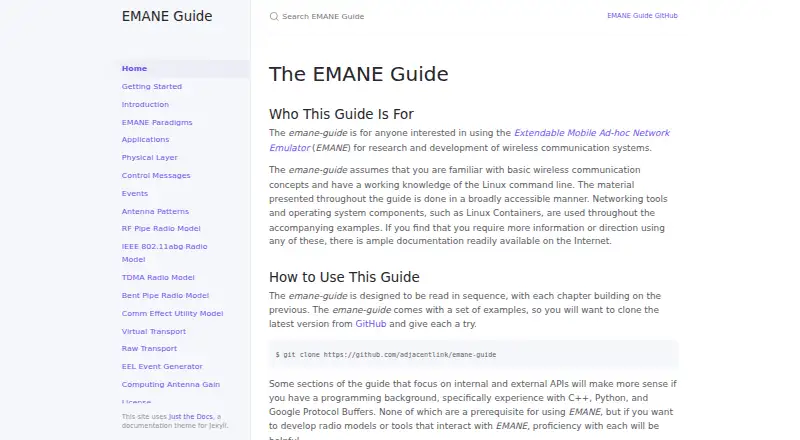
EMANE is an open-source framework for emulating wireless network architectures. It runs as a Linux user-space application and is used in wireless communications research and development to design, develop, and test simple or complex network setups. Its physical-layer model represents signal propagation, antenna profile effects, and interference. Radio-model plugins emulate a waveform’s lowest layer, with RF Pipe, IEEE 802.11abg, TDMA, and Bent Pipe models included alongside the Comm Effect utility model.
The distribution provides Raw Transport and Virtual Transport boundaries for IP and non-IP wireless-system emulation. XML files configure platforms, NEMs, radio models, boundaries, and radio error-rate or packet-completion curves. Scenario events cover antenna profiles, locations, pathloss, and fading selection; custom event-generating applications can be built with the Python emane.events module. Radio-model plugins can also be paired with existing software-defined-radio components for shared-code experimentation. EMANE supports real-time emulation and includes an automation API. Its guide advises using one NEM per emulator instance for performance. C++, Python, and Google Protocol Buffers experience can help with development, but is not required to use the framework.
Who it suits
EMANE suits people working on wireless communications research and development who need to model network behavior at the physical layer. Users should be familiar with basic wireless concepts and the Linux command line; programming experience is useful for developing models or tools but is not required to use EMANE.
What it does well
- Free, open-source distribution for Linux.
- Models signal propagation, antenna effects, and interference.
- Includes four radio models and a utility model.
- Supports IP and non-IP wireless-system emulation.
- Can combine radio plugins with software-defined-radio components.
- Provides real-time emulation and an automation API.
What to know first
- Runs as a Linux user-space application.
- The guide assumes basic wireless and Linux command-line familiarity.
- Performance guidance recommends one NEM per emulator instance.
Limits
The distribution is free. Its performance guidance advises using one NEM per emulator instance.
Plans
| Plan | Billed and limits | Price |
|---|---|---|
| EMANE | Open-source distributed wireless network emulation framework | Free |
As emane.io lists them, read 3 Oct 2026. The maker's own page has the final word.
Getting started
- Visit the EMANE website.
- Use a Linux environment; the application runs in Linux user space.
- Configure the platform, NEM, radio model, boundary, and curves with XML files.
- Select radio and transport models for the emulation.
- Add scenario events, or create custom event-generating applications with Python emane.events.
Verdict
Choose EMANE for wireless research and development that needs configurable, real-time network emulation, including physical-layer effects and multiple radio models. It is best suited to users comfortable with Linux and basic wireless concepts; the guide recommends one NEM per instance for performance.
Questions
How much does EMANE cost?
The EMANE plan is free.
Is EMANE open source?
Yes. The distribution is open source. The accompanying source code is released under the BSD 3-clause license.
Which platforms does EMANE support?
EMANE runs as a Linux user-space application and is self-hosted.
Who makes EMANE?
Adjacent Link describes itself as a privately owned engineering company focused on developing and testing mission-critical mobile wireless systems.
Does EMANE support real-time emulation and automation?
Yes. EMANE supports real-time emulation and has an automation API.
Where can users ask questions or report bugs?
Adjacent Link’s GitHub organization provides project Issues and Pull Requests for application-specific questions or bugs.
Facts from EMANE's own pages
- Configuration
- The emulator processes XML configuration files for platform, NEM, radio model, boundary, and radio error-rate or packet-completion curves. · emane.io, 3 Oct 2026
- Emulation
- Its physical-layer model accounts for signal propagation, antenna profile effects, and interference sources. · emane.io, 3 Oct 2026
- Headquarters
- Bridgewater, New Jersey, United States · emane.io, 28 Sept 2026
- Help and support
- Adjacent Link's GitHub organization provides project Issues and Pull Requests for reporting application-specific bugs or questions. · emane.io, 3 Oct 2026
- Intended users
- The guide is for people using EMANE in wireless-communication-systems research and development and assumes familiarity with basic wireless concepts and the Linux command line. · emane.io, 3 Oct 2026
- License
- The guide says accompanying source code is released under the BSD 3-clause license; the guide itself is under Creative Commons Attribution 4.0 unless otherwise noted. · emane.io, 3 Oct 2026
- Linux application
- EMANE runs as a Linux user-space application and uses radio-model plugins with a physical-layer model to emulate a waveform's lowest layer. · emane.io, 3 Oct 2026
- Maker
- Adjacent Link describes itself as a privately owned engineering company focused on developing and testing mission-critical mobile wireless systems. · adjacentlink.com, 3 Oct 2026
- Network boundaries
- The distribution includes Raw Transport and Virtual Transport boundaries, and supports IP and non-IP wireless-system emulation. · emane.io, 3 Oct 2026
- Programming
- C++, Python, and Google Protocol Buffers experience can help with developing radio models or tools, but the guide says they are not prerequisites for using EMANE. · emane.io, 3 Oct 2026
- Purpose
- EMANE is an open-source distributed emulation framework for designing, developing, and testing simple and complex network architectures. · emane.io, 3 Oct 2026
- Radio models
- The open-source distribution includes RF Pipe, IEEE 802.11abg, TDMA, and Bent Pipe radio models, plus the Comm Effect utility model. · emane.io, 3 Oct 2026
- Scaling guidance
- The guide advises using one NEM per emulator instance for performance reasons. · emane.io, 3 Oct 2026
- Scenario events
- Its physical layer uses antenna profile, location, pathloss, and fading-selection events, and users can create custom event-generating applications with the Python emane.events module. · emane.io, 3 Oct 2026
- SDR integration
- EMANE radio-model plugins can be combined with existing software-defined-radio components for shared-code experimentation. · emane.io, 3 Oct 2026
Where EMANE stands on Freedom251
- Network Simulation Software#11 of 31