Freedom251 › Code Obfuscation Software
Obfuscar
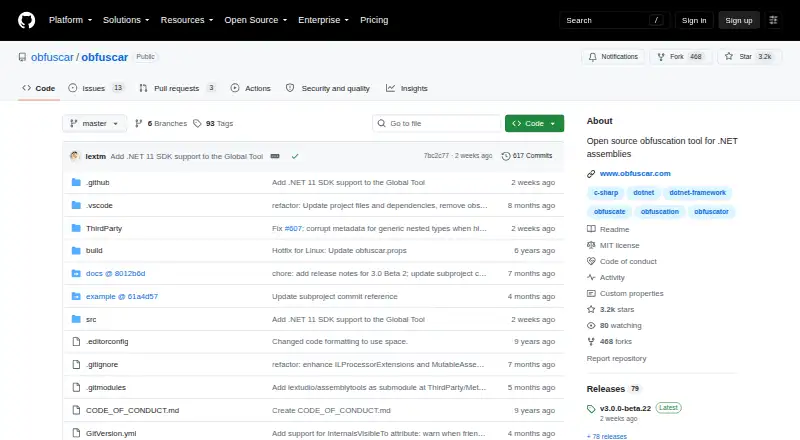
What Obfuscar is
Obfuscar is a free desktop tool for obfuscating .NET assemblies on Linux, macOS, and Windows. It renames metadata such as methods, properties, events, fields, types, and namespaces to short names, making decompiled code harder to follow. Those shorter names can also reduce the size of the resulting executable. Obfuscar can hide string constants by replacing string loads with calls that retrieve strings from a buffer; this adds a small performance cost. String hiding is reversible, so confidential information should not be stored as strings in an assembly.
You configure Obfuscar with an XML file that identifies the assemblies to process, dependency paths, and output location. It is available as a NuGet package and a .NET Global Tool, and it can be used from the command line. Obfuscar's 3.0 beta requires absolute paths in its configuration and rejects relative paths and variable placeholders. The project cautions that obfuscation makes reverse engineering harder but cannot stop a determined effort. It also advises processing only trusted assemblies, since malformed or malicious inputs can cause crashes, hangs, or other unexpected behavior.
Who it suits
Obfuscar suits .NET developers who want to make assembly metadata harder to read and can configure a command-line tool with XML. It also fits projects that want shorter metadata names or reversible string hiding, provided they understand the security limits.
What it does well
- Free under the MIT license.
- Runs on Linux, macOS, and Windows.
- Renames multiple kinds of .NET assembly metadata.
- Shorter generated names can reduce executable size.
- Available as a NuGet package and .NET Global Tool.
- Offers optional string hiding.
What to know first
- Obfuscation does not stop determined reverse engineering.
- String hiding is reversible and adds a small performance cost.
- Version 3.0 beta rejects relative paths and variable placeholders.
- Malformed or malicious assemblies can cause crashes or hangs.
Limits
The free plan is basic .NET assembly obfuscation. Obfuscation makes reverse engineering harder but does not prevent a determined person from reversing an assembly; string hiding is reversible and carries a small performance cost.
Plans
| Plan | Billed and limits | Price |
|---|---|---|
| Obfuscar | open source · MIT license · basic .NET assembly obfuscation | Free |
As github.com lists them, read 8 Oct 2026. The maker's own page has the final word.
Getting started
- Install Obfuscar as a NuGet package or .NET Global Tool.
- Create an XML configuration file for the assemblies to obfuscate.
- Set dependency paths and an output location in the configuration.
- For the 3.0 beta, use absolute paths and avoid variable placeholders.
- Run Obfuscar from the command line.
Obfuscar is a free tool for obfuscating .NET assemblies by renaming their metadata, making decompiled code harder to follow. It suits developers who want a command-line step in a .NET build and can work with XML configuration. Its compact names can also reduce output size, but obfuscation is a deterrent, not a barrier to determined reverse engineering.
Overview
Obfuscar targets .NET assemblies and changes names across methods, properties, events, fields, types and namespaces. The goal is to make the structure of decompiled code less readable; it does not make an assembly impossible to reverse engineer.
It is distributed as a NuGet package and a .NET Global Tool, with a CLI deployment model. An XML file specifies which assemblies to process, dependency paths and the output location. That keeps configuration explicit, but places setup in the hands of developers rather than offering a graphical workflow.
Key features
Metadata renaming and smaller output
Obfuscar replaces identifiers with short names. Besides making code harder to follow, those shorter names can dramatically shrink executable size, a useful side effect for projects where assembly size matters.
String hiding
String hiding replaces string loads with calls that retrieve values from a buffer, at a small performance cost. The protection is reversible, so it is not suitable for confidential credentials or other secrets embedded in an assembly.
Configuration and integrations
XML configuration covers assemblies, dependencies and output paths. Community projects documented by Obfuscar can parse its mapping files or generate XML configuration for Unity, but those projects are unaffiliated; teams should treat them as separate tools rather than built-in support.
Pricing
| Plan | Price | Includes |
|---|---|---|
| Obfuscar | free | Open source under the MIT license; basic .NET assembly obfuscation. |
The free plan covers the core obfuscation use case without a paid tier to step up to. It is a strong fit for individual developers and teams comfortable maintaining a command-line configuration. Community help is available through Stack Overflow and GitHub issues; commercial support is provided by LeXtudio Support Services.
Platforms
Obfuscar supports Linux, macOS and Windows, and its configuration guide provides path examples for all three. Version 3.0 beta requires absolute paths in configuration and rejects relative paths and variable placeholders, which can make existing or portable configurations harder to use.
Who it's for
Obfuscar fits .NET developers seeking a free way to make assembly metadata less legible as part of a CLI workflow. It is also worth considering when shorter identifiers could reduce executable size. It is not the right choice for anyone who needs obfuscation to stop a determined reverse engineer or wants to protect confidential strings inside an assembly.
Input handling needs care: malformed or malicious assemblies can cause unexpected behavior, including crashes or hangs. Process only trusted inputs.
Pros and cons
Pros
- Free, open-source core: the MIT-licensed plan provides basic .NET assembly obfuscation at no cost.
- Useful across desktop operating systems: Linux, macOS and Windows are supported, with platform-specific path examples.
- Potential size savings: shortened generated names can dramatically shrink executables as well as obscure metadata.
Cons
- Not a strong security boundary: obfuscation raises the difficulty of reverse engineering but cannot stop a determined effort.
- String hiding is reversible: it carries a small performance cost and should not be used to safeguard confidential values.
- Configuration constraints in 3.0 beta: absolute paths are required, while relative paths and variable placeholders are rejected.
- Untrusted inputs can be hazardous: malformed or malicious assemblies may crash or hang the tool.
Alternatives
Browse code obfuscation software for more options. For a different target or platform set, consider these alternatives:
- ByteHide Shield has a free tier for core obfuscation aimed at individual developers and small projects, plus paid plans for advanced techniques. Consider it if that tier structure or its broader listed platform support better matches your project.
- JS-Confuser is free and open source for JavaScript-focused needs; choose it instead when your target is JavaScript rather than .NET assemblies.
- ProGuard is a free, open-source shrinker for Java and Kotlin; choose it for those ecosystems instead of .NET.
- Tigress is another option to compare if its paid offering and trial suit your needs.
- yEd Graph Editor is a graph editor, not an assembly obfuscator.
- Garble is a free Go code obfuscator requiring Go 1.27 or later; choose it for Go projects.
- JavaScript Obfuscator offers a free plan with unlimited standard obfuscation, a 25 MB lifetime VM quota and a 4 MB VM file-size limit; choose it for JavaScript workflows that fit those limits.
- Obfuscator-LLVM is a Linux-only open-source LLVM fork; consider it for an LLVM-based workflow rather than .NET assemblies.
Verdict
Choose Obfuscar if you need a free, cross-platform CLI tool to make .NET assembly metadata harder to follow, with possible executable-size savings as a bonus. Look elsewhere if you need protection against determined reverse engineering, must keep strings confidential, or cannot work within its XML configuration and absolute-path requirements in the 3.0 beta.
Verdict
Pick Obfuscar if you need a free, command-line way to make .NET assembly metadata harder to follow across Linux, macOS, or Windows. Look elsewhere if you need obfuscation to prevent determined reverse engineering or must store confidential strings in assemblies.
Questions
How much does Obfuscar cost?
The Obfuscar plan is free, and the software is open source under the MIT license.
Which platforms does it support?
Obfuscar supports Linux, macOS, and Windows.
What does Obfuscar obfuscate?
It renames metadata in .NET assemblies, including methods, properties, events, fields, types, and namespaces. It can also hide string constants.
How do I configure it?
Use an XML configuration file to specify assemblies, dependency paths, and an output location. Obfuscar is available as a NuGet package and a .NET Global Tool for command-line use.
Does Obfuscar prevent reverse engineering?
No. It makes reverse engineering more difficult, but does not stop someone determined to reverse the assembly.
Does Obfuscar integrate with other projects?
Community projects listed in the documentation parse Obfuscar mapping files and generate Obfuscar XML configuration for Unity. Those projects are unaffiliated.
Facts from Obfuscar's own pages
- Confidential strings
- The documentation says string hiding is reversible and advises against storing confidential information as strings in assemblies. · docs.lextudio.com, 8 Oct 2026
- Configuration
- Obfuscar uses an XML configuration file to specify assemblies to obfuscate, dependency paths and output location. · docs.lextudio.com, 8 Oct 2026
- Current beta constraint
- Obfuscar 3.0 requires absolute paths in configuration and rejects relative paths and variable placeholders. · docs.lextudio.com, 8 Oct 2026
- Distribution
- Obfuscar is available as a NuGet package and as a .NET Global Tool. · docs.lextudio.com, 8 Oct 2026
- Executable size
- The shorter generated names can dramatically shrink executable size. · docs.lextudio.com, 8 Oct 2026
- Integrations
- The project documentation lists community projects for parsing Obfuscar mapping files and generating Obfuscar XML configuration for Unity, and says they are unaffiliated. · docs.lextudio.com, 8 Oct 2026
- Metadata renaming
- It renames methods, properties, events, fields, types and namespaces to a minimal set of names. · docs.lextudio.com, 8 Oct 2026
- Platform compatibility
- The configuration guide gives examples for macOS, Linux and Windows paths. · docs.lextudio.com, 8 Oct 2026
- Protection limitation
- The documentation says obfuscation makes reverse engineering difficult but does not stop someone determined to reverse engineer the assembly. · docs.lextudio.com, 8 Oct 2026
- Purpose
- Obfuscar obfuscates .NET assemblies by renaming metadata to make decompiled code harder to follow. · docs.lextudio.com, 8 Oct 2026
- Security limitation
- The project warns that malformed or malicious assemblies can cause unexpected behavior, including crashes or hangs, and says to process only trusted inputs. · github.com, 8 Oct 2026
- String hiding
- Obfuscar can hide string constants by replacing string loads with calls that retrieve strings from a buffer, with a small performance cost. · docs.lextudio.com, 8 Oct 2026
- Support
- Community help is available through Stack Overflow and GitHub issues, and commercial support is provided by LeXtudio Support Services. · docs.lextudio.com, 8 Oct 2026
Where Obfuscar stands on Freedom251
- Code Obfuscation Software#6 of 34