Freedom251 › Code Obfuscation Software
Garble
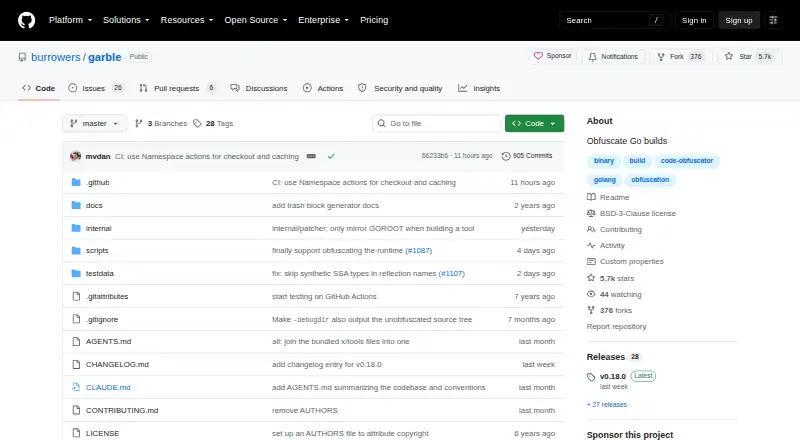
What Garble is
Garble is a free command-line tool that wraps the Go toolchain to obfuscate Go builds while aiming to preserve program behavior. Its commands include garble build, garble test, and garble run, along with options to reverse obfuscated text and file bug reports. It replaces identifiers and package paths with short base64 hashes and strips build, module, and debug information. The optional -literals flag transforms eligible literal expressions into more complex expressions with the same runtime value.
The optional -tiny flag removes additional binary information and can make binaries about 15% smaller, but removes panic output and may make crashes harder to diagnose. Builds are deterministic for the same inputs, and the reverse command can de-obfuscate stack traces when the required inputs are available. A garble build should take about twice as long as go build because it creates an original build and an obfuscated one. Garble obfuscates supported packages, including the standard runtime, but excludes runtime/cgo and crypto/internal/fips140. It runs on Linux and requires Go 1.27 or later.
Who it suits
Garble suits Go developers who distribute binaries but want to make reverse engineering more difficult. It is a Linux command-line option for users able to work within its package and runtime limitations.
What it does well
- Free plan with no trial required.
- Supports build, test, and run commands.
- Deterministic builds for the same inputs.
- Optional literal transformation and smaller binary mode.
What to know first
- Requires Go 1.27 or later.
- Go plugins are not supported.
- Exported methods are not obfuscated.
- Builds should take about twice as long as go build.
Limits
Garble is free and requires Go 1.27 or later. The optional `-tiny` flag removes panic output, and obfuscated binaries cannot use APIs such as `runtime.GOROOT` and `runtime/debug.ReadBuildInfo`.
Plans
| Plan | Billed and limits | Price |
|---|---|---|
| Garble | Free Go code obfuscator; requires Go 1.27 or later | Free |
As github.com lists them, read 8 Oct 2026. The maker's own page has the final word.
Getting started
- Visit the Garble project on GitHub.
- Use a Linux environment with Go 1.27 or later.
- Run Garble's build, test, or run command as part of your Go workflow.
- Consider the optional `-literals` or `-tiny` flags where their tradeoffs fit.
Garble is a free, self-hosted command-line layer around the Go toolchain that obscures compiled programs while retaining their behavior. It is aimed at developers shipping Go binaries whose source is proprietary or sold separately. The trade-off is substantial compatibility and build-time overhead, so it suits release protection better than every development build.
Overview
Garble renames identifiers and package paths to short base64-derived hashes, then strips build, module, and debugging metadata from the resulting binary. It can process supported packages in the build, including Go's standard runtime, giving broader coverage than an application-only pass. This raises the cost of inspecting a distributed executable, but it should be treated as a deterrent rather than an absolute barrier to reverse engineering.
The command-line interface stays close to ordinary Go work: garble build, garble test, and garble run are provided, along with commands for reversing obfuscated text and submitting bug reports. A build generally takes about twice as long as go build, since Garble first completes a normal build and then an obfuscated one. That is manageable for release pipelines, but it can be frustrating for rapid edit-build cycles.
Key features
Multiple obfuscation layers
The optional -literals flag turns eligible literal expressions into more complicated expressions that evaluate to the same runtime values. It is useful when recognizable constants would reveal implementation clues. Control-flow obfuscation and string encryption are also part of the offering, giving users more than simple symbol renaming.
Tiny binaries and their cost
-tiny removes additional binary information and can reduce size by roughly 15 percent. The saving comes with a serious operational penalty: panic output is removed, making failures harder to diagnose. Use it for constrained deployments where size matters more than post-crash visibility, not as a default for binaries that need straightforward support.
Repeatable output and recovery
Matching inputs produce deterministic builds, which helps teams reproduce artifacts and investigate release differences. When the required inputs are retained, Garble's reverse command can de-obfuscate stack traces. That recovery path is valuable, but it depends on preserving those inputs; teams that discard build material will lose much of the debugging benefit.
Compatibility boundaries
Exported methods are currently left unobfuscated because interfaces may need their names. Go plugins are unsupported. Runtime calls such as runtime.GOROOT and runtime/debug.ReadBuildInfo do not work in obfuscated binaries, and runtime/cgo plus crypto/internal/fips140 are excluded from obfuscation. These constraints can rule Garble out for plugin-based systems or software that reports build metadata at runtime.
Pricing
| Plan | Price | What it includes |
|---|---|---|
| Garble | free | Free Go code obfuscator; requires Go 1.27 or later |
There is no paid tier, trial period, seat allowance, or recurring charge to weigh. The cost advantage is strongest for individual developers and teams comfortable operating a self-hosted CLI. The requirement for Go 1.27 or later is the practical entry condition.
Platforms
Garble runs on Linux and targets Go projects. Its self-hosted, CLI-based deployment fits build servers and developer machines rather than a hosted dashboard or cross-language workflow.
Who it's for
Choose Garble when you distribute Go executables while keeping source private, and when deterministic artifacts, optional stronger transformations, and familiar Go commands justify longer builds. It is particularly appropriate for release or licensing workflows where discouraging casual inspection matters. Look elsewhere if you depend on Go plugins, runtime build-information APIs, cgo packages that must be obfuscated, or highly visible panic diagnostics.
Pros and cons
- Pros: free to use; obfuscates identifiers, paths, metadata, literals, control flow, and strings; can cover the standard runtime; deterministic output supports reproducible releases; stack-trace reversal is possible when inputs are preserved.
- Cons: builds take about twice as long; tiny mode removes panic output; exported methods remain readable; plugins are unsupported; several runtime APIs and selected packages are excluded.
Alternatives
For a broader multi-platform product with a free core and paid advanced techniques, consider ByteHide Shield. JS-Confuser is the better fit for free, open-source JavaScript obfuscation. For Java or Kotlin shrinking, use ProGuard. Tigress is an alternative with paid options and a free trial. Obfuscar targets basic .NET assembly obfuscation under the MIT license. yEd Graph Editor is unrelated to Go obfuscation and is instead a free graph editor. JavaScript Obfuscator offers web/API JavaScript plans with a capped free VM quota. Obfuscator-LLVM is a Linux-only open-source LLVM fork.
Browse more tools in Code Obfuscation Software.
Verdict
Garble is a strong choice for Go developers who need a no-cost, reproducible way to make shipped binaries harder to inspect without abandoning standard Go commands. Its main reason to choose something else is compatibility: plugins, runtime metadata APIs, excluded packages, and the debugging cost of tiny mode can outweigh the protection.
Verdict
Garble provides several obfuscation options and build commands for Go projects, with deterministic output for matching inputs. Its exclusions and longer build time are worth considering, especially if debugging or runtime APIs matter.
Questions
How much does Garble cost?
Garble is free.
What language does Garble support?
It obfuscates Go builds.
Which operating system is listed?
Linux is listed as its platform.
What does Garble change in a build?
It replaces identifiers and package paths with short base64 hashes and removes build, module, and debug information. An optional flag can also rewrite eligible literal expressions.
Can Garble make a binary smaller?
Its optional `-tiny` flag removes more binary information and can make binaries about 15% smaller, but also removes panic output.
Facts from Garble's own pages
- Build commands
- It supports garble build, garble test, and garble run, plus commands to reverse obfuscated text and file bug reports. · github.com, 8 Oct 2026
- Build time
- A garble build should take about twice as long as go build because it completes an original build and an obfuscated build. · github.com, 8 Oct 2026
- Identifier obfuscation
- It replaces identifiers and package paths with short base64 hashes. · github.com, 8 Oct 2026
- Limit: exported methods
- Exported methods are not currently obfuscated because they may be required by interfaces. · github.com, 8 Oct 2026
- Limit: plugins
- Go plugins are not currently supported. · github.com, 8 Oct 2026
- Limit: runtime APIs
- APIs such as runtime.GOROOT and runtime/debug.ReadBuildInfo will not work in obfuscated binaries. · github.com, 8 Oct 2026
- Literal obfuscation
- The optional -literals flag replaces eligible literal expressions with more complex expressions that resolve to the same runtime value. · github.com, 8 Oct 2026
- Metadata removal
- It removes build, module, and debug information from obfuscated builds. · github.com, 8 Oct 2026
- Purpose
- Garble wraps the Go toolchain to obfuscate Go builds while aiming to preserve their behavior. · github.com, 8 Oct 2026
- Release signing
- The v0.18.0 release page says its tag was signed with the committer’s verified signature. · github.com, 8 Oct 2026
- Reproducible builds
- Garble builds are deterministic given the same inputs, and its reverse command can de-obfuscate stack traces when the needed inputs are available. · github.com, 8 Oct 2026
- Supported packages
- Garble obfuscates supported packages being built, including the standard runtime, while runtime/cgo and crypto/internal/fips140 are excluded. · github.com, 8 Oct 2026
- Tiny mode
- The optional -tiny flag removes more binary information and can make binaries about 15% smaller, but removes panic output and can make crashes harder to debug. · github.com, 8 Oct 2026
- Use case
- The project describes obfuscation as useful when sharing Go binaries whose source is private or requires purchase, to help discourage reverse engineering. · github.com, 8 Oct 2026
Where Garble stands on Freedom251
- Code Obfuscation Software#8 of 34