Freedom251 › Code Obfuscation Software
JS-Confuser
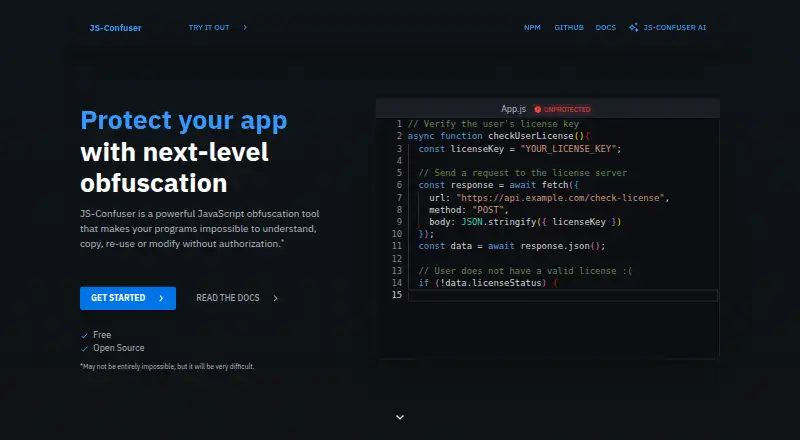
What JS-Confuser is
JS-Confuser is a free, open-source JavaScript obfuscator that makes code harder to read, copy, reuse, or modify while seeking to preserve its functionality. Its browser playground lets users paste JavaScript, adjust settings, run obfuscation, and download the result; processing remains in the browser even offline, and the maker says code and actions are not sent to a remote server. Users can choose Low, Medium, or High presets or create configurations. Options include variable renaming, string concealing, control-flow flattening, dead-code insertion, domain and date locks, and tamper protection. The API provides JSConfuser.obfuscate for source code and JSConfuser.obfuscateAST for Babel ASTs. The editor targets Browser or Node.js output and includes Prettier and editable JSON settings. Obfuscation may increase file size and performance overhead or break a program. It does not prevent determined reverse engineers from recovering code or sensitive information. Tamper protection requires eval and non-strict mode, may break code, and must be enabled manually.
Who it suits
It suits developers who want to make JavaScript harder to inspect or reuse, either through the browser playground or the programming API. Users needing tamper protection should account for its runtime requirements and possible code breakage.
What it does well
- Free and open source.
- Playground runs offline in the browser.
- Offers Low, Medium, and High presets.
- API supports source code and Babel ASTs.
What to know first
- Obfuscation can increase file size and performance overhead.
- Obfuscation may break a program.
- Determined reverse engineers may recover code or sensitive information.
- Tamper protection requires eval and non-strict mode.
Plans
| Plan | Billed and limits | Price |
|---|---|---|
| Free | browser playground · npm package/API · low, medium and high presets | Free |
As js-confuser.com lists them, read 15 Oct 2026. The maker's own page has the final word.
Getting started
- Open the JS-Confuser website.
- Paste JavaScript into the browser playground, or use the programming API.
- Choose a Low, Medium, or High preset, or configure options.
- Select Browser or Node.js as the output target.
- Obfuscate the code and download the result.
JS-Confuser is a free, open-source JavaScript obfuscator for developers who want to make client-side or Node.js code harder to inspect and reuse. It suits people who want configurable browser or API workflows without adding a paid plan. Its flexibility is useful, but the transformations can impose runtime and compatibility costs and cannot guarantee secrecy.
Overview
JS-Confuser transforms JavaScript to make copying, modification, and analysis more difficult while aiming to preserve behavior. The browser playground handles pasted code locally, including offline, and says it does not send input or actions to a remote server. That is a practical choice for code a developer does not want to upload, though the API offers a programmatic route for projects that need automation.
Obfuscation is a speed bump, not a security boundary. The maker cautions that determined reverse engineers may still recover code or sensitive information. Do not use it as a substitute for keeping secrets out of distributed JavaScript.
Key features
Low, Medium, and High presets give users starting levels, and custom configurations allow finer control. Available options include variable renaming, string concealing, control-flow flattening, dead-code insertion, domain and date locks, and tamper protection. This range suits developers who need more than renamed identifiers, but stronger transformations can increase file size and performance overhead or break programs.
The playground accepts pasted JavaScript, allows option changes, and downloads the obfuscated result. Browser and Node.js are the available output targets. Prettier is included, and JSConfuser.ts can be edited as a JSON representation of the settings, including custom implementations. These conveniences make experimentation and configuration more approachable, but they do not remove the need to check transformed code in its intended environment.
For integration, the API exposes JSConfuser.obfuscate for source and JSConfuser.obfuscateAST for Babel ASTs. The maker links an NPM package and GitHub repository; Webpack and build plugins are planned rather than current integrations. Teams seeking a ready-made build plugin should not assume one is available.
Tamper protection has especially important constraints: it requires eval and non-strict mode, may break code, and must be enabled manually because it can execute arbitrary code. It is a poor fit when those requirements conflict with a project’s runtime or security practices.
Pricing
The Free plan costs nothing and is open source. It includes JavaScript, Node.js, and browser targets, anti-tamper controls, control-flow obfuscation, and string encryption. There is no paid tier or seat, quota, trial, or renewal term stated for JS-Confuser. Its free price makes it accessible for individual developers and projects that can accept the tradeoffs; the main cost is operational rather than financial, in the form of added size, overhead, and compatibility risk.
Platforms
JS-Confuser supports API, Linux, macOS, web, and Windows. The browser playground can run offline, while the programming API supports source-code and Babel AST input. The stated deployment model is hybrid and build integration is via API, so developers can choose between browser-based work and programmatic use rather than relying only on a graphical editor.
Who it's for
JS-Confuser is a sensible fit for developers who want a free way to make distributed JavaScript less immediately readable, especially when they value local browser processing or need an API. Its presets suit quick trials; custom configurations and AST support are better suited to developers integrating obfuscation into a code workflow.
Look elsewhere if the requirement is to prevent determined reverse engineering, protect secrets embedded in client code, or use transformations without testing their effect on behavior and performance. Projects dependent on strict mode or avoiding eval should also avoid tamper protection.
Pros and cons
- Pro: The playground processes code in the browser, including offline, so it can be used without sending input to a remote server.
- Pro: Presets, custom settings, multiple transformation options, and source or Babel AST API methods accommodate both manual and programmatic workflows.
- Pro: The open-source Free plan includes browser, Node.js, and JavaScript targets with control-flow, string-encryption, and anti-tamper capabilities.
- Con: Obfuscation can enlarge files, add runtime overhead, or break a program, so transformed output carries a compatibility and performance burden.
- Con: It cannot guarantee that code or sensitive information will resist a determined reverse engineer.
- Con: Tamper protection requires eval and non-strict mode and may break code, limiting where it is appropriate.
Alternatives
Code Obfuscation Software is a useful place to compare options across the category. Choose ByteHide Shield instead if its free core obfuscation or paid advanced techniques better match a project; it covers a wider stated platform set, including mobile and self-hosted use. Tigress is another option for readers considering a paid obfuscator with a free plan and trial, though its platform coverage differs.
JavaScript Obfuscator is worth comparing for its unlimited standard obfuscation, but its free plan has a 25 MB lifetime VM quota and a 4 MB VM file limit. Obfuscator.io offers the same stated free quota and file limit, with a Pro plan at $19 a month for readers who want a paid option. Allatori may suit developers looking at a freemium option with desktop platform support and annual support updates. Skater .NET Obfuscator is aimed at a different platform, Windows, and a different target, .NET assemblies. yEd Graph Editor and Obfuscar are other free options to compare.
Verdict
Choose JS-Confuser if you want a free, open-source JavaScript obfuscator with local browser processing, configurable transformations, and an API for source or Babel AST workflows. Its strongest case is flexible access without a subscription; its main limitation is that obfuscation adds risk and effort without delivering foolproof protection. If your priority is guaranteed confidentiality or frictionless compatibility, look elsewhere.
Verdict
JS-Confuser offers browser-based and API workflows with configurable obfuscation options. Treat obfuscation as a barrier rather than foolproof protection, and weigh the possible size, performance, and compatibility costs.
Questions
Is JS-Confuser free?
Yes. Its Free plan costs nothing, and the maker describes it as free and open source.
Can I use JS-Confuser offline?
The browser playground runs entirely in the browser, including offline. It says code and actions are never sent to a remote server.
What output targets does it support?
The editor offers Browser and Node.js output targets.
Does it have an API?
Yes. JSConfuser.obfuscate handles source code, and JSConfuser.obfuscateAST handles Babel ASTs.
What are the tradeoffs of obfuscation?
It can increase performance overhead and file size, and may break a program. Determined reverse engineers may still deobfuscate code or extract sensitive information.
What does tamper protection require?
It requires eval and non-strict mode, may break code, and must be enabled manually.
Facts from JS-Confuser's own pages
- Browser playground
- The playground lets users paste code, configure options, obfuscate it and download the result. · js-confuser.com, 15 Oct 2026
- Control-flow obfuscation
- Control-flow obfuscation is a listed feature that makes program logic harder to follow. · github.com, 15 Oct 2026
- Custom extensibility
- Custom string encodings accept decoder templates and user-supplied encode and optional decode functions. · js-confuser.com, 15 Oct 2026
- Documentation depth
- Documentation covers getting started, installation, usage, FAQ, options and presets, with individual pages for transformations. · js-confuser.com, 15 Oct 2026
- Formatting and configuration
- The playground includes Prettier and lets users edit JSConfuser.ts as a JSON representation of obfuscator settings that can also include custom implementations. · js-confuser.com, 30 Sept 2026
- Founded
- 2020 · js-confuser.com, 28 Sept 2026
- Function obfuscation
- Function obfuscation is included among the project's core features. · github.com, 15 Oct 2026
- GitHub activity
- The public repository shows 525 stars, 68 forks, 25 issues and 706 commits. · github.com, 15 Oct 2026
- Independent deobfuscation result
- Defuscator's September 2026 test recovered strings from a JS-Confuser 2.1.3 low-preset sample, while the high preset remained virtualized in a bytecode VM. · defuscator.com, 15 Oct 2026
- Installation
- The documented installation method is npm install js-confuser. · github.com, 15 Oct 2026
- Integrations
- The maker links to an NPM package and GitHub repository; its roadmap lists Webpack and build plugins as planned features. · js-confuser.com, 30 Sept 2026
- Integrity checking
- The tool includes an integrity option intended to detect source-code changes. · js-confuser.com, 15 Oct 2026
- Known tradeoffs
- The maker says obfuscation can increase performance overhead and file size, and may break a program in some cases. · js-confuser.com, 30 Sept 2026
- Licence
- The public repository identifies the project as MIT licensed. · github.com, 15 Oct 2026
- Limit: output size
- Reddit commenters report very large percentage increases in output size, including a cited 37,380% increase for a tiny input. · reddit.com, 15 Oct 2026
- Local processing
- The playground runs entirely in the browser, including offline, and says input code and actions are never sent to a remote server. · js-confuser.com, 30 Sept 2026
- Locks
- Domain locks and date-based locks can restrict where or when obfuscated code runs. · github.com, 15 Oct 2026
- Maker location
- The LinkedIn profile associated with Michael Brasington lists Raleigh, North Carolina, United States. · linkedin.com, 15 Oct 2026
- Maker project date
- Michael Brasington's LinkedIn project entry dates JS-Confuser to May 2021 and describes it as a TypeScript tool published on NPM. · linkedin.com, 15 Oct 2026
- Minification
- Its minifier performs dead-code removal, constant folding, variable grouping and other shortening transformations. · js-confuser.com, 15 Oct 2026
- NPM licence and package status
- NPM describes the package as a JavaScript obfuscation tool under the MIT License and provides TypeScript declarations. · npmjs.com, 15 Oct 2026
- NPM release
- NPM lists version 2.1.3 as the current package version and reports 12,911 weekly downloads on the page opened. · npmjs.com, 15 Oct 2026
- Obfuscation options
- Options include variable renaming, string concealing, control-flow flattening, dead-code insertion, domain locks, date locks, and tamper protection. · js-confuser.com, 30 Sept 2026
- Official limitation
- The FAQ warns that obfuscation can add runtime overhead, enlarge files and sometimes break programs. · js-confuser.com, 15 Oct 2026
Where JS-Confuser stands on Freedom251
- Code Obfuscation Software#1 of 34