Freedom251 › Code Obfuscation Software

Allatori
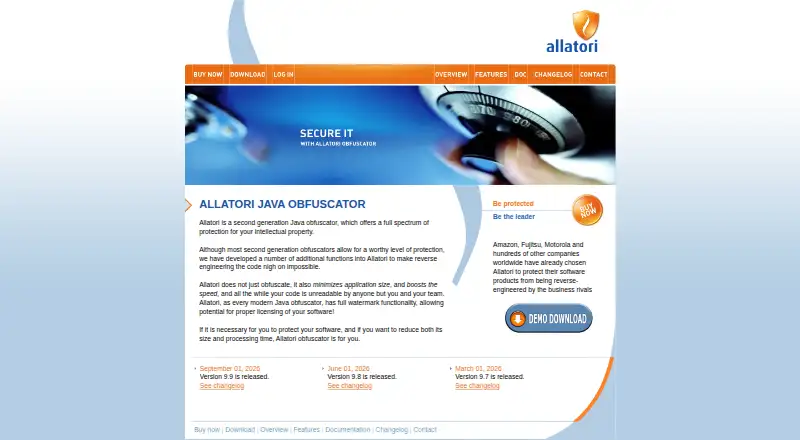
What Allatori is
Allatori is a Java obfuscator that works on compiled class files to help protect intellectual property and make reverse engineering more difficult. It does not require original source code. Its features include renaming obfuscation, control-flow and debug-information changes, string encryption, watermarking, incremental obfuscation, and a module designed to disrupt decompilers. It supports J2EE, J2SE, J2ME, and Android targets. Build options include command-line scripts, Apache Ant, Maven, Android Studio, and an Eclipse plugin. Allatori is written in Java and can run on systems with a Java 1.4-or-newer virtual machine; the maker says it has been tested on Windows, Mac OS X, and UNIX. The maker reports typical application size reductions of about 10–40%, sometimes reaching 60% with many third-party libraries. String encryption typically adds 1–2% to bytecode size, while flow obfuscation can slightly increase size and rarely reduce performance. A single-developer license is listed at $290, paid once; a free plan is also listed.
Who it suits
Allatori suits Java developers who want to obfuscate compiled applications and integrate the process into build workflows. It is also relevant to Android projects using Android Studio or Ant.
What it does well
- Works on compiled class files without original source.
- Supports J2EE, J2SE, J2ME, and Android.
- Integrates with Ant, Maven, command-line scripts, and Eclipse.
- Paid licenses include 12 months of email support and updates.
What to know first
- Native methods and their classes are not renamed automatically.
- String encryption typically increases bytecode size by 1–2%.
- Flow obfuscation can slightly increase application size.
Limits
The free plan's limits are not described. String encryption typically increases bytecode size by 1–2%; flow obfuscation can slightly increase size and rarely reduce performance.
Plans
| Plan | Billed and limits | Price |
|---|---|---|
| Single Developer License — 11+ licenses | includes free email support, updates and upgrades for 12 months · 11+ licenses · 25% volume discount | $200, paid once |
| Single Developer License — 6-10 licenses | includes free email support, updates and upgrades for 12 months · 6-10 licenses · 20% volume discount | $230, paid once |
| Single Developer License — 2-5 licenses | includes free email support, updates and upgrades for 12 months · 2-5 licenses · 10% volume discount | $260, paid once |
| Single Developer License — 1 license | includes free email support, updates and upgrades for 12 months · 1 developer · cannot be shared or used concurrently | $290, paid once |
| Site License | includes free email support, updates and upgrades for 12 months · any number of developers · one company office/location · location normally within 30 miles | $3,750, paid once |
| Business License | includes free email support, updates and upgrades for 12 months · any number of developers · all company offices worldwide · no geographical restrictions within juridical company borders | $4,850, paid once |
| Site License Update | annual support update · email support · updates · upgrades for 12 months | $500 a year |
| Single Developer License Update | annual support update · email support · updates · upgrades for 12 months | $75 a year |
The first 8 of 9 plans, as allatori.com lists them, read 1 Oct 2026. The maker's own page has the final word. Every plan
Getting started
- Visit https://allatori.com/ to access Allatori.
- Choose the free plan or a paid license; single developer license updates start at $75 a year.
- Use the command-line interface with an automated build script, or connect through Ant or Maven.
- For Android projects, integrate obfuscation with Android Studio or Ant; Eclipse users can add the Allatori Builder plugin.
- Provide compiled Java class files for obfuscation; original Java source code is not required.
Overview
Allatori is a Java class-file obfuscator for developers who need to make compiled applications harder to reverse engineer without retaining or supplying source code. Its breadth of obfuscation and build integrations is useful for Java and Android release workflows; the trade-offs are licensing complexity and care required around native methods.
Key features
Allatori combines name, control-flow and debug-information obfuscation with string encryption, watermarking and incremental obfuscation. That mix offers more than identifier renaming for teams seeking to obscure both code structure and embedded text. A dedicated decompiler-protection module is designed to trigger fatal errors in decompilers attempting to process transformed code, though it does not change the need to manage compatibility in the application itself.
String literals are encrypted in class constant pools and decrypted at runtime. The maker says this typically adds 1–2% to bytecode size with insignificant performance impact. Flow obfuscation can also slightly increase size and rarely reduce performance, so applications with tight size or performance constraints should weigh those costs against the added obscurity.
The product also includes a stack-trace utility, J2ME and Android obfuscation, and incremental obfuscation. It works on compiled class files, not source. That makes it suitable where source is unavailable at the obfuscation stage, but it is not a source-code transformation tool.
Allatori supports command-line use in automated build scripts, plus Apache Ant and Maven integration. Android obfuscation can be integrated with Android Studio and Ant projects; an Eclipse plugin adds a builder that runs obfuscation on clean rebuilds. These options suit teams automating release builds across different Java toolchains.
The maker reports typical application-size reductions of about 10–40%, sometimes up to 60% when applications contain many third-party libraries. Those reductions may appeal to teams seeking smaller outputs as well as obfuscation, but the result will depend on the application and should not be treated as a guaranteed saving.
One important constraint is native code: native methods and their containing classes are not renamed automatically, and members accessed by native code must be explicitly excluded. Projects relying on JNI need deliberate configuration to avoid breaking those references.
Pricing
Allatori has a free plan and paid licenses. The Single Developer License Update costs $75 a year for email support, updates and upgrades for 12 months. It fits an existing single-developer license holder maintaining support; it is not the one-time license purchase.
One-time Single Developer Licenses include email support, updates and upgrades for 12 months. A single license costs $290, paid once and is for one developer; it cannot be shared or used concurrently. Volume pricing lowers the per-license price: $260, paid once for 2–5 licenses, $230, paid once for 6–10, and $200, paid once for 11 or more. These tiers suit teams buying multiple developer licenses, while the single-license terms are restrictive for shared or simultaneous use.
For broader organizations, the Site License costs $3,750, paid once and covers any number of developers at one company office or location, normally within 30 miles. The Business License costs $4,850, paid once and covers any number of developers across all company offices worldwide, with no geographical restrictions within the juridical company's borders. Annual support-update licenses cost $500 a year for a Site License and $750 a year for a Business License; each includes email support, updates and upgrades for 12 months.
Paid-license prices should be read alongside the 12-month support and upgrade period: the one-time license price is not an annual term, while update plans are annual. The free plan may suit evaluation or limited needs, but its caps are not established here.
Platforms
Allatori supports J2EE, J2SE, J2ME, Android and Java class files. It is written in Java and can technically run on systems with a Java 1.4-or-later virtual machine; it has been tested on Windows, Mac OS X and UNIX. Listed platforms are Android, Linux, macOS and Windows, with desktop deployment.
Who it's for
Allatori is a strong fit for Java developers and organizations that want multiple obfuscation layers, class-file input and integration into established build pipelines. Android teams also have IDE and Ant integration options. It is less suitable for projects that cannot accommodate small potential size or performance costs, or for native-method codebases that cannot explicitly exclude native-accessed members.
Pros and cons
- Pros: Multiple obfuscation techniques, including string encryption and decompiler protection, give teams more ways to obscure compiled Java code than renaming alone.
- Pros: CLI, Ant, Maven, Android Studio and Eclipse integrations support automated or IDE-based build workflows.
- Pros: Class-file input means the original Java source is not required.
- Cons: Native methods and their containing classes are not renamed automatically, and native-accessed members require explicit exclusions.
- Cons: String and flow obfuscation can increase bytecode size, and flow obfuscation can rarely reduce performance.
- Cons: A single-developer license cannot be shared or used concurrently, so teams need the right volume or organization-wide tier.
Alternatives
For a broader platform range and a free individual or small-project option, compare ByteHide Shield; its paid plans cover advanced techniques at custom pricing. If a free, open-source JavaScript obfuscator is the priority rather than Java class-file support, JS-Confuser is a more relevant fit.
JavaScript Obfuscator is another free option for JavaScript, with a 25 MB lifetime VM quota and 4 MB VM file-size limit. Obfuscator.io offers a similar free JavaScript route with those same stated VM limits, alongside a Pro plan at $19 a month. These are alternatives for JavaScript projects, not substitutes for Allatori's stated Java support.
For .NET assembly obfuscation on Windows, Skater .NET Obfuscator is the more relevant choice; its Standard Edition costs $119.99, paid once and includes an assembly browser, string encryption, and public and private member-name obfuscation. yEd Graph Editor, Obfuscar and ProGuard are also listed alternatives; the last two are free options for readers comparing other obfuscators.
Browse the Code Obfuscation Software directory to compare more tools.
Verdict
Choose Allatori if you need layered obfuscation for compiled Java or Android applications and want to fit it into a build pipeline without requiring source files. Its strongest case is the combination of obfuscation methods and integrations; look elsewhere if native-method constraints, possible size and performance costs, or per-developer licensing do not fit your project.
Verdict
Allatori provides several obfuscation methods and build integrations for Java class files. Consider the reported size and native-method limitations when deciding how to configure it.
Questions
Is Allatori free?
A free plan is available. Paid licenses include a single developer license update at $75 a year.
What platforms and targets does Allatori support?
It supports J2EE, J2SE, J2ME, Android and Java class files. It is written in Java and technically runs on systems supporting a 1.4-or-later virtual machine.
Does Allatori require Java source code?
No. It works strictly on compiled class files.
Which build tools and IDEs does it integrate with?
It has a command-line interface for automated scripts, Apache Ant and Maven integration, Android Studio and Ant support for Android obfuscation, and an Eclipse plugin.
What is included with a paid license?
Paid licenses include free email support, updates and upgrades for 12 months.
What is the single developer license price?
The listed single developer license for one license costs 290.00 USD once. It is for one developer and cannot be shared or used concurrently.
Facts from Allatori's own pages
- Android integration
- Android obfuscation can be integrated with Android Studio and Ant build projects. · allatori.com, 1 Oct 2026
- Build integrations
- Its command-line interface integrates with automated build scripts, and the product provides Apache Ant and Maven integration. · allatori.com, 1 Oct 2026
- Decompiler protection
- A dedicated module transforms code to cause fatal errors in decompilers during attempted decompilation. · allatori.com, 1 Oct 2026
- Eclipse integration
- An Eclipse IDE plugin adds an Allatori Builder that runs obfuscation on clean rebuilds. · allatori.com, 1 Oct 2026
- Export licensing
- The FAQ says some customers may be required to use Allatori by the US Department of State and the National Security Agency to obtain export licenses. · allatori.com, 1 Oct 2026
- Founded
- 2006 · allatori.com, 28 Sept 2026
- Input scope
- Allatori works strictly on compiled class files and does not require the original Java source code. · allatori.com, 1 Oct 2026
- Java platforms
- Allatori supports J2EE, J2SE and J2ME Java platforms. · allatori.com, 1 Oct 2026
- Native-method limit
- Native methods and their containing classes are never renamed automatically; members accessed by native code must be explicitly excluded. · allatori.com, 1 Oct 2026
- Obfuscation features
- The feature set includes name obfuscation, flow obfuscation, debug-info obfuscation, string encryption, watermarking, incremental obfuscation, stack-trace utility, build-tool interface, J2ME obfuscation and Android obfuscation. · allatori.com, 1 Oct 2026
- Optimization
- Allatori says it minimizes application size and boosts speed while making code unreadable to others. · allatori.com, 1 Oct 2026
- Performance limit
- String encryption typically increases bytecode size by 1–2% and has an insignificant performance impact, while flow obfuscation can slightly increase size and rarely reduce performance. · allatori.com, 1 Oct 2026
- Product
- Allatori is a second-generation Java obfuscator designed to protect intellectual property and make reverse engineering difficult. · allatori.com, 1 Oct 2026
- Runtime platforms
- Allatori is written entirely in Java, technically runs on platforms supporting a 1.4+ virtual machine, and has been tested on Windows, Mac OS X and UNIX. · allatori.com, 1 Oct 2026
- Size reduction
- The company reports typical application size reductions of about 10–40%, sometimes reaching 60% with many third-party libraries. · allatori.com, 1 Oct 2026
- String encryption
- String literals are encrypted in class constant pools and decrypted at runtime. · allatori.com, 1 Oct 2026
- Support
- Paid licenses include free email support, updates and upgrades for 12 months. · allatori.com, 1 Oct 2026
Where Allatori stands on Freedom251
- Code Obfuscation Software#2 of 34