Freedom251 › Code Obfuscation Software
Obfuscator-LLVM
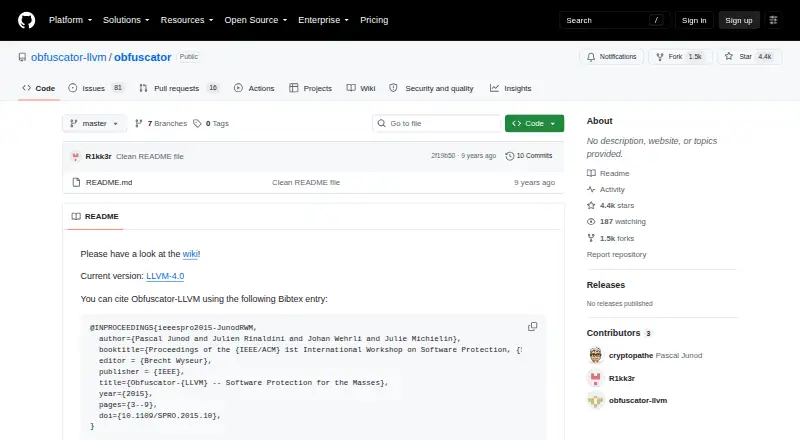
What Obfuscator-LLVM is
Obfuscator-LLVM is a free, open-source fork of LLVM that applies obfuscation during compilation to make software harder to reverse engineer or modify. Its listed passes include instruction substitution, bogus control flow, and control-flow flattening, as well as function annotations. The project says its intermediate-representation approach works with LLVM-supported languages such as C, C++, Objective-C, Ada, and Fortran. Listed targets include x86, ARM, PowerPC, MIPS, SPARC, SystemZ, and others. The project is self-hosted on Linux and built from source by cloning the repository and using CMake and make; the resulting binaries go in build/bin. The guide also describes use through Clang, an autotools build, and a custom Xcode plugin. Its latest official non-development branch is identified as llvm-4.0, based on LLVM 4.0.1. The FAQ cautions that obfuscated code can be slower and larger, that constants and buffers are not scrambled, and that the tool does not provide code tamper-proofing. It describes the project as an advanced prototype needing substantially more testing before production use.
Who it suits
It may suit developers working with LLVM-supported languages who want compile-time obfuscation and can build and assess the tool themselves. Its stated security limitations make it a poor fit for anyone expecting strong protection or tamper-proofing.
What it does well
- Free and open source.
- Includes three listed obfuscation passes.
- Works with LLVM-supported languages.
- Supports numerous listed compilation targets.
- Can be integrated through Clang.
What to know first
- Build requires CMake and make.
- Obfuscation can slow and enlarge code.
- Constants and buffers are not scrambled.
- No code tamper-proofing is implemented.
Plans
| Plan | Billed and limits | Price |
|---|---|---|
| Obfuscator-LLVM | Open-source LLVM fork · commercial version was available until end of 2016 | Free |
As github.com lists them, read 7 Oct 2026. The maker's own page has the final word.
Getting started
- Open the project repository on GitHub.
- Clone the source repository.
- Build it with CMake and make; the resulting binaries are placed in build/bin.
- Follow the guide's instructions for using the compiler through Clang, an autotools build, or a custom Xcode plugin.
Verdict
Obfuscator-LLVM offers several compile-time obfuscation passes across a range of LLVM languages and targets. Its maintainers describe it as an advanced prototype, with limited protection and a need for more testing before production use.
Questions
Does Obfuscator-LLVM cost anything?
The project is free and open source. Its listed plan is free.
Which operating system does it support?
The listed platform is Linux.
Which languages can it work with?
The project says its LLVM intermediate-representation approach is compatible with LLVM-supported languages, including C, C++, Objective-C, Ada, and Fortran.
What obfuscation does it provide?
Listed passes are instruction substitution, bogus control flow, and control-flow flattening. Function annotations are also included.
Is it tamper-proof or highly secure?
No. The FAQ says code tamper-proofing is not implemented and the project should not be considered very secure; it may only slow a typical reverse engineer.
What are the performance and production limits?
The FAQ says obfuscated code will be slower and larger, depending on the code and settings. It calls the project an advanced prototype that needs substantially more testing before production use.
Facts from Obfuscator-LLVM's own pages
- Build and download
- The installation guide instructs users to clone the source repository and build it with CMake and make; the resulting binaries are placed in build/bin. · github.com, 7 Oct 2026
- Founded
- 2010 · github.com, 28 Sept 2026
- Function annotations
- The feature list also includes function annotations. · github.com, 7 Oct 2026
- Integrations
- The guide describes using the compiler through Clang, with an autotools build, and through a custom Xcode plugin. · github.com, 7 Oct 2026
- License
- The obfuscation passes are distributed under the University of Illinois/NCSA Open Source License, which permits use, modification, and distribution subject to its conditions. · github.com, 7 Oct 2026
- Obfuscation passes
- The listed passes are instruction substitution, bogus control flow, and control-flow flattening. · github.com, 7 Oct 2026
- Performance
- The FAQ says obfuscated code will be slower and larger, with the impact depending on code and obfuscation settings. · github.com, 7 Oct 2026
- Production suitability
- The FAQ describes the project as an advanced prototype and says it needs substantially more testing before production use. · github.com, 7 Oct 2026
- Purpose
- Obfuscator-LLVM is an open-source LLVM fork intended to strengthen software against reverse engineering and modification at compile time. · github.com, 7 Oct 2026
- Security limits
- The FAQ says the project should not be considered very secure and may only slow a typical reverse engineer; it notes constants and buffers are not scrambled. · github.com, 7 Oct 2026
- Supported languages
- The project says its intermediate-representation approach makes it compatible with languages supported by LLVM, including C, C++, Objective-C, Ada, and Fortran. · github.com, 7 Oct 2026
- Supported targets
- The project lists LLVM targets including x86, x86-64, PowerPC, ARM, Thumb, SPARC, Alpha, CellSPU, MIPS, MSP430, SystemZ, and XCore. · github.com, 7 Oct 2026
- Tamper protection
- The FAQ says Obfuscator-LLVM does not currently implement code tamper-proofing. · github.com, 7 Oct 2026
- Testing
- The FAQ says the team tested with cryptographic libraries including OpenSSL, GMP, and libtomcrypt, and also MySQL and ImageMagick. · github.com, 7 Oct 2026
- Version limit
- The guide identifies llvm-4.0, based on LLVM 4.0.1, as the latest official non-development branch and also lists older branches. · github.com, 7 Oct 2026
Where Obfuscator-LLVM stands on Freedom251
- Code Obfuscation Software#11 of 34