Freedom251 › Code Clone Detection Tools
NiCad
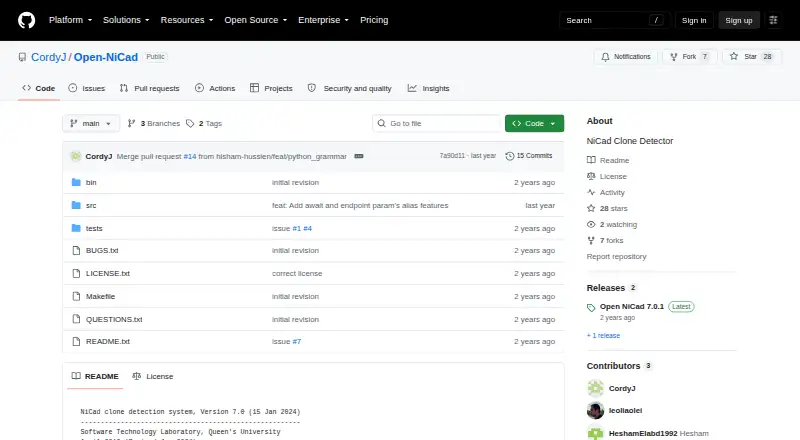
What NiCad is
NiCad is a free near-miss source code clone detector for examining code similarities within a repository. It can analyze source at file, function, or block granularity. Included language plugins cover C, C#, Java, Python, PHP, Ruby, WSDL, and ATL; support for other languages can be added when a TXL grammar is available. Configuration files let users adjust renaming, filtering, abstraction, and normalization before comparison. Results contain clone pairs and clone classes in XML-like formats, with optional browsable HTML reports. The default near-miss difference threshold is 0.30, while 0.00 represents exact clones. NiCadCross reports fragments in one system that appear as clones in a second. The software runs on Linux, macOS, and Windows, either from its directory for personal use or through a system-wide installation script. NiCad 7.0 requires OpenTxl 11 or later, and building its comparison tools requires Turing+ 6.2 or later. The project uses an MIT-style license with stated conditions for use, modification, distribution, sublicensing, and sale.
Who it suits
NiCad suits developers and teams looking for clone detection at repository, file, function, or block level. It is also relevant to users who need customizable comparisons or reports across multiple systems.
What it does well
- Analyzes source at file, function, or block level.
- Includes plugins for eight listed languages.
- Comparison settings can be customized in configuration files.
- Optional browsable HTML reports.
- Free, MIT-style licensed software.
What to know first
- Requires OpenTxl 11 or later.
- Building comparison tools requires Turing+ 6.2 or later.
- Other language plugins require an available TXL grammar.
- Issue creation is restricted, and no issues are open.
Limits
NiCad 7.0 requires OpenTxl 11 or later. Building its comparison tools additionally requires Turing+ 6.2 or later.
Plans
| Plan | Billed and limits | Price |
|---|---|---|
| Free and open source | MIT-licensed software · requires OpenTxl 11 or later | Free |
As github.com lists them, read 4 Oct 2026. The maker's own page has the final word.
Getting started
- Open the NiCad project repository.
- Install OpenTxl 11 or later for NiCad 7.0.
- Install Turing+ 6.2 or later if you need to build the comparison tools.
- Run NiCad from its directory for personal use, or use the installation script for a system-wide installation.
- Choose an analysis granularity and configure comparison settings as needed.
NiCad is a free, self-hosted near-miss source-code clone detector for developers, reviewers, and teams examining duplication across repositories. It suits technically equipped users who need configurable comparisons at several code scales; the main trade-off is managing its OpenTxl and Turing+ build requirements yourself.
Overview
NiCad uses a hybrid clone-detection method and scans repositories at file, function, or block granularity. That range lets a review move from duplicated components to repeated routines or smaller fragments instead of forcing one scope on every project. Its default near-miss difference threshold is 0.30, while 0.00 identifies exact clones only. The adjustable threshold is valuable when a team wants to tune how much variation still counts as duplication, but conclusions depend on choosing and documenting an appropriate value.
NiCad can run directly from its directory for personal use or be installed system-wide with its supplied installation script. It produces clone pairs and clone classes in XML-like formats, with optional browsable HTML reports. Structured output is suitable for downstream processing, while HTML provides a more convenient way to inspect findings. NiCadCross adds cross-system analysis by reporting fragments from one system that also appear as clones in a second system.
Key features
- Multiple analysis levels: File-, function-, and block-level scans let teams target the unit that matters to a quality review, from whole-file reuse to repeated code fragments.
- Language coverage and extension: Included plugins support C, C#, Java, Python, PHP, Ruby, WSDL, and ATL. Other languages can be added when a TXL grammar exists, which favors teams able to maintain language tooling over users seeking turnkey universal coverage.
- Configurable preprocessing: Configuration files can customize renaming, filtering, abstraction, and normalization before comparison. This helps reduce irrelevant syntactic differences, while requiring deliberate configuration to avoid hiding distinctions that matter.
- Threshold control: The 0.30 default surfaces near misses; 0.00 narrows the result to exact clones. Teams should treat the threshold as a review policy rather than an automatic measure of problematic duplication.
- Reports and cross-system checks: Clone pairs, clone classes, XML-like output, optional HTML, and NiCadCross support both automated pipelines and human investigation.
Pricing
Free and open source — free. The MIT-style license permits use, modification, distribution, sublicensing, and sale subject to its conditions. There is no free trial because the software is free, and no paid tier or seat quota is stated. The practical cost is operational: NiCad 7.0 requires OpenTxl 11 or later, and building its comparison tools requires Turing+ 6.2 or later. Choose this plan when you can supply and maintain those dependencies; it is less suitable when you need a hosted service or vendor-managed installation.
Platforms
NiCad supports Linux, macOS, and Windows, and is available as self-hosted software. That makes it workable for teams keeping source analysis inside their own environments, but platform support does not remove the OpenTxl and Turing+ prerequisites.
Who it's for
NiCad is a strong fit for developers, code-quality groups, and researchers comparing repositories or systems with a chosen level of granularity. It is particularly useful when configurable normalization, structured reports, or cross-system clone checks are important. Teams without TXL grammar resources, dependency-management capacity, or a preference for self-hosting should look at alternatives with simpler packaging.
Pros and cons
Pros
- Free MIT-style licensing permits broad use and modification without a subscription.
- Three analysis granularities and an adjustable threshold support tailored review policies.
- Plugins cover eight listed languages, with extension possible through TXL grammars.
- XML-like results, browsable HTML, and NiCadCross serve both automation and investigation.
- Linux, macOS, Windows, and self-hosted operation accommodate varied deployment environments.
Cons
- OpenTxl 11+ is required, and Turing+ 6.2+ is needed to build comparison tools, adding setup work.
- Language expansion depends on having a suitable TXL grammar.
- Threshold tuning can change what appears as a near miss, so results need a stated policy.
- The repository's Issues page shows no open issues and restricts issue creation, limiting that support channel.
Alternatives
Browse the Code Clone Detection Tools list for a wider comparison. Choose Duplo if you want free GNU GPL v2-or-later software with prebuilt binaries for Alpine Linux, macOS, and Windows. Pick PMD for a free BSD-style, downloadable static code analyzer across Linux, macOS, self-hosted, and Windows. CloneWorks is another free Linux, macOS, and Windows option, with acknowledgement and free-redistribution conditions. Choose dcd for free AGPL-3.0 software on Linux or macOS, with separately priced priority email support. jscpd offers free open-source analysis through API, Linux, macOS, self-hosted, and Windows environments. Simian Similarity Analyzer is a free open-source Apache 2.0 option for Linux, macOS, and Windows. CCFinderSW is a free MIT-licensed Windows tool requiring Java Runtime Environment 8 or later. Algo VPN is a free self-hosted VPN setup project, not a clone detector.
Verdict
Choose NiCad when you need free, self-hosted clone detection with file-, function-, and block-level control, configurable normalization, and machine-readable reports. Look elsewhere if managing OpenTxl and Turing+ or creating TXL language grammars is outside your team’s capabilities; its flexibility is most valuable to users prepared to own that technical setup.
Verdict
NiCad offers configurable clone detection across several languages and analysis granularities. Check its OpenTxl and Turing+ requirements against your setup before choosing it.
Questions
Is NiCad free?
Yes. NiCad is free and open source under an MIT-style license, with stated conditions for use, modification, distribution, sublicensing, and sale.
Which operating systems does NiCad support?
The listed platforms are Linux, macOS, and Windows. It also has a self-hosted option.
Which languages are included?
Included language plugins cover C, C#, Java, Python, PHP, Ruby, WSDL, and ATL. Other language plugins can be added when a TXL grammar is available.
What does NiCad detect?
It detects near-miss source code clones at file, function, or block granularity. The default difference threshold is 0.30, while 0.00 means exact clones.
What does NiCad require?
NiCad 7.0 requires OpenTxl 11 or later. Building its comparison tools requires Turing+ 6.2 or later.
How can I install or run NiCad?
You can run it from its directory for personal use or install it system-wide with the provided installation script.
Facts from NiCad's own pages
- Analysis granularity
- It analyzes source code at file, function, or block granularity. · github.com, 4 Oct 2026
- Cross-system detection
- NiCadCross reports fragments from one system that appear as clones in a second system. · github.com, 4 Oct 2026
- Customization
- Configuration files support customized renaming, filtering, abstraction, and normalization before comparison. · github.com, 4 Oct 2026
- Dependencies
- NiCad 7.0 requires OpenTxl 11 or later; building its comparison tools requires Turing+ 6.2 or later. · github.com, 4 Oct 2026
- Detection threshold
- The default near-miss difference threshold is 0.30, and 0.00 means exact clones. · github.com, 4 Oct 2026
- Extensibility
- Plugins for other languages can be added when a TXL grammar is available. · github.com, 4 Oct 2026
- Headquarters
- Kingston, Canada · github.com, 28 Sept 2026
- Install and use
- It can be run from its directory for personal use or installed system-wide with the provided installation script. · github.com, 4 Oct 2026
- Languages
- Included language plugins cover C, C#, Java, Python, PHP, Ruby, WSDL, and ATL. · github.com, 4 Oct 2026
- License
- The project uses an MIT-style license permitting use, modification, distribution, sublicensing, and sale subject to its stated conditions. · github.com, 4 Oct 2026
- Platforms
- The README says NiCad should compile and run on Linux and macOS, and in Cygwin or MSYS2 (MinGW) on Windows. · github.com, 4 Oct 2026
- Purpose
- NiCad is a near-miss source code clone detection system. · github.com, 4 Oct 2026
- Release
- The latest listed release is Open NiCad 7.0.1, described as the first open-source release of the clone detector. · github.com, 4 Oct 2026
- Reports
- Results include clone pairs and clone classes in XML-like formats, with optional browsable HTML reports. · github.com, 4 Oct 2026
- Support
- The repository's Issues page currently shows no open issues and says issue creation is restricted. · github.com, 4 Oct 2026
Where NiCad stands on Freedom251
- Code Clone Detection Tools#7 of 23
- Code Duplication Detection Tools#7 of 18