Freedom251 › Code Clone Detection Tools
CloneWorks
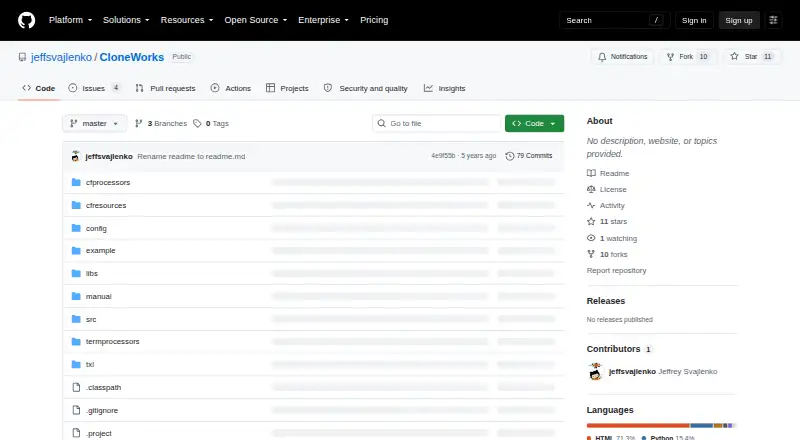
What CloneWorks is
CloneWorks prepares source code into fragments and detects code clones in those fragments. Its input builder supports Java, C, C++, C#, and Python, with extraction at block, function, or file granularity. The detector uses a token-based method and accepts a minimum similarity threshold from 0.0 to 1.0; the repository describes a test run using Type-3 clone detection. For an index larger than available memory, a partitioned partial-index mode is available, though its partition size must be determined experimentally. CloneWorks runs on Linux, macOS, and Windows and requires FreeTXL 10.6 or later, gcc, make, and Java 7 or later. The input builder is slower on Cygwin because process creation is slower on Windows. CloneWorks is free, but use requires acknowledgement and no charge may be made. Copies, modifications, and derivatives must remain under its license and be distributed without charge. The license provides the software as-is without warranty; the maintainer invites questions and bug reports by email.
Who it suits
CloneWorks suits developers or researchers who need to prepare code and find clones across supported languages and extraction granularities. Users should be prepared to meet its tool requirements and license terms.
What it does well
- Supports Java, C, C++, C#, and Python inputs.
- Extracts code at block, function, or file level.
- Threshold can range from 0.0 to 1.0.
- Available for Linux, macOS, and Windows.
What to know first
- Requires FreeTXL, gcc, make, and Java 7 or later.
- Input builder is slower on Cygwin.
- Partition size must be determined experimentally.
- License requires free distribution and provides no warranty.
Limits
CloneWorks is free, with use requiring acknowledgement and copies, modifications, and derivatives required to remain under its license and be distributed without charge. For indexes exceeding available memory, partition size must be determined experimentally.
Plans
| Plan | Billed and limits | Price |
|---|---|---|
| CloneWorks | Use requires acknowledgement; no charge may be made · Redistribution and derivatives must use this license and be free of charge | Free |
As github.com lists them, read 3 Oct 2026. The maker's own page has the final word.
Getting started
- Open the CloneWorks repository on GitHub.
- Install FreeTXL 10.6 or later, gcc, make, and Java 7 or later.
- Use CloneWorks on Linux, macOS, or Windows.
- Provide source code in Java, C, C++, C#, or Python.
- Choose block, function, or file extraction granularity and set a similarity threshold.
CloneWorks is a self-hosted tool for preparing source code and finding token-based clones in repositories. It suits developers comfortable with command-line dependencies who need control over fragment size and matching strictness. Its configurable detection is useful, but setup requirements and restrictive redistribution terms make it a poor fit for turnkey or commercial redistribution.
Overview
CloneWorks prepares repository code as fragments before detecting clones. Its input builder supports Java, C, C++, C#, and Python, and its documented test run performs Type-3 detection. That combination is relevant when you want to examine similar code beyond exact copies, though support for other input languages is not established.
The detector accepts a minimum similarity threshold from 0.0 to 1.0. This offers direct control over how closely fragments must match, but choosing a useful threshold requires judgment about what duplication matters in your codebase.
Key features
Extraction controls
Block, function, and file granularity let users set the scale of extracted code to suit their review. This is a practical strength for projects where duplication at different structural levels matters; users seeking a broader language range should look elsewhere.
Large-input handling
Partitioned partial-index mode is available when the index exceeds available memory. It provides an option for memory-constrained runs, but the partition size must be determined experimentally, adding tuning work rather than offering a fixed setting.
Requirements and support
CloneWorks requires FreeTXL 10.6 or later, gcc, make, and Java 7 or later. Those dependencies make it better suited to technically equipped users than teams seeking a turnkey application. On Windows, the input builder runs more slowly under Cygwin because process creation is slower. Jeffrey Svajlenko invites questions and bug reports by email and offers help with using the tool.
Pricing
CloneWorks is free: the CloneWorks plan costs nothing. Use requires acknowledgement, and no charge may be made. Copying, modification, and redistribution are permitted only if CloneWorks and derivatives remain under the license and are distributed without charge. That is a meaningful constraint for anyone planning to bundle or sell a derivative. The license provides the software as-is without warranty, including implied warranties of merchantability or fitness for a particular purpose.
Platforms
CloneWorks supports Linux, macOS, and Windows. The Cygwin performance limitation makes Windows a less attractive option when input-building speed matters.
Who it's for
CloneWorks is a sensible choice for developers or researchers who can meet its prerequisites and want to tune extraction granularity and similarity for repository-level clone detection. It is less suitable for users who need a turnkey setup, input languages beyond its stated set, or redistribution that permits charging for the software or derivatives.
Pros and cons
- Pros: Block, function, and file extraction plus a 0.0-to-1.0 similarity threshold give users control over what gets compared and how strictly.
- Pros: Partitioned partial-index mode offers a way to handle indexes larger than available memory.
- Cons: FreeTXL, gcc, make, and Java prerequisites raise the setup burden.
- Cons: Experimental partition sizing and slower input building on Cygwin can require extra patience and tuning.
- Cons: The no-charge redistribution condition rules out charging for CloneWorks or its derivatives.
Alternatives
Code Clone Detection Tools is a useful starting point for comparing options. Consider Algo VPN if you need self-hosted VPN setup scripts instead; its cloud infrastructure costs are separate. Duplo is another free option for Linux, macOS, and Windows, with prebuilt binaries for Alpine Linux, macOS, and Windows under GNU GPL v2 or later. Choose PMD if a downloadable static code analyzer under a BSD-style license better suits your needs. dcd is a free Linux and macOS option under AGPL-3.0, with a separate Priority support plan offering direct email support at custom pricing. jscpd is another free option for Linux, macOS, Windows, API, and self-hosted use. NiCad may suit users who can meet its OpenTxl 11 or later requirement; it is free and MIT-licensed. Simian Similarity Analyzer is a free open-source option under Apache License 2.0. CopyPaste is a free, open-source option for macOS and Windows with no premium tiers, subscriptions, or paywalls.
Verdict
Choose CloneWorks if you want repository clone detection with adjustable extraction and similarity settings, and can handle its dependencies and licensing conditions. Look elsewhere if you need a simpler setup or the freedom to charge for redistribution.
Verdict
CloneWorks provides code preparation and token-based clone detection, with configurable extraction granularity and similarity threshold. Its prerequisites, Cygwin limitation, experimental partition sizing, and license conditions are important considerations.
Questions
How much does CloneWorks cost?
CloneWorks is free to use. Its plan is listed as free.
Which languages does CloneWorks accept?
Its input builder lists Java, C, C++, C#, and Python.
Which platforms does CloneWorks support?
It runs on Linux, macOS, and Windows. The input builder is slower on Cygwin.
What are CloneWorks’ system requirements?
It requires FreeTXL 10.6 or later, gcc, make, and Java 7 or later.
Can I redistribute or modify CloneWorks?
The license permits copying, modification, and redistribution if copies and derivatives retain the license and are distributed without charge. Use requires acknowledgement.
Does the license include a warranty?
No. It provides CloneWorks as-is without warranty, including implied warranties of merchantability or fitness for a particular purpose.
Facts from CloneWorks's own pages
- Clone types
- The repository describes a test run that performs Type-3 clone detection. · github.com, 3 Oct 2026
- Granularity
- The input builder supports block, function, and file granularity for code extraction. · github.com, 3 Oct 2026
- Languages
- The input builder lists Java, C, C++, C#, and Python as supported input languages. · github.com, 3 Oct 2026
- Large inputs
- A partitioned partial-index mode is available when the index exceeds available memory, and the README says its partition size must be determined experimentally. · github.com, 3 Oct 2026
- License terms
- The license permits copying, modification, and redistribution of CloneWorks and derivatives if they remain under the license and are distributed without charge. · github.com, 3 Oct 2026
- Platforms
- The README says CloneWorks can be used on Linux and other Unix-like systems, was tested on Ubuntu and OS X, and should work on Cygwin. · github.com, 3 Oct 2026
- Purpose
- CloneWorks prepares source code and detects code clones in the prepared fragments. · github.com, 3 Oct 2026
- Similarity threshold
- The clone detector accepts a minimum similarity threshold from 0.0 to 1.0. · github.com, 3 Oct 2026
- Support
- Jeffrey Svajlenko invites questions and bug reports by email and says he is happy to assist with using CloneWorks. · github.com, 3 Oct 2026
- System requirements
- CloneWorks requires FreeTXL 10.6 or later, gcc, make, and Java 7 or later. · github.com, 3 Oct 2026
- Warranty
- The license provides CloneWorks as-is without warranty, including implied warranties of merchantability or fitness for a particular purpose. · github.com, 3 Oct 2026
- Windows limitation
- The README says the input builder is slower on Cygwin because process creation is slower on Windows. · github.com, 3 Oct 2026
Where CloneWorks stands on Freedom251
- Code Clone Detection Tools#2 of 23