Freedom251 › Time Billing Software
Miru
What Miru is
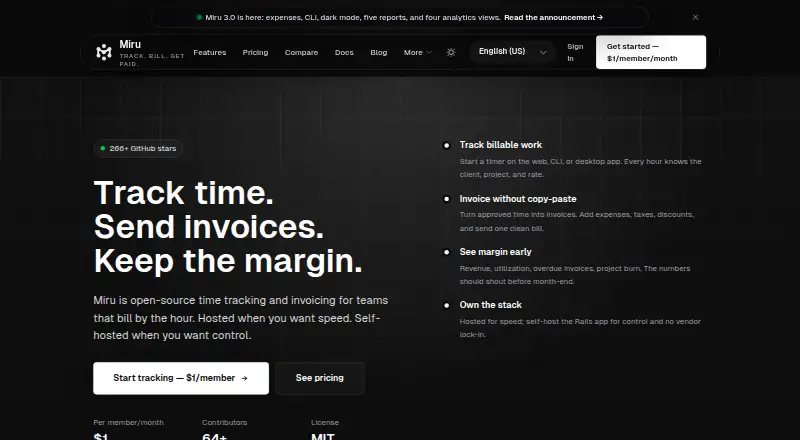
Miru is open-source software for teams that track billable hours and handle invoicing, expenses, payments, and reporting. Team members can record time with timers or manual entries, submit work for weekly approval, and use rates set for each person. Miru can turn tracked or approved work into invoices, with support for expenses, taxes, and discounts, and can send invoices to clients. Reports show paid, pending, overdue, and projected revenue, plus project and team analytics. Miru includes expense billing and a client portal, but does not offer recurring invoices. The MIT-licensed Rails application can be self-hosted, while the desktop timer is available for macOS Apple Silicon and Intel, Linux x64, and Windows x64. Its iOS and Android apps are in beta. The free self-hosted plan includes every feature and unlimited members; customers running it themselves are responsible for operations, backups, upgrades, and security maintenance. Miru Cloud is listed at $1 a month, billed Or $10/member/year.
Who it suits
Miru suits agencies, consultants, freelancers, startups, and service teams that track billable hours and send invoices. Self-hosting may suit teams prepared to manage operations, backups, upgrades, and security maintenance.
What it does well
- Tracks time with timers or manual entries.
- Supports weekly approvals and team-member rates.
- Creates invoices with expenses, taxes, and discounts.
- Reports paid, pending, overdue, and projected revenue.
- Free self-hosted plan includes every feature and unlimited members.
What to know first
- Recurring invoices are not available.
- iOS and Android apps are in beta.
- Self-hosters manage operations, backups, upgrades, and security maintenance.
- Hosted data encryption is described, but SOC 2 Type II is in progress.
Limits
The free Self-hosted plan has every feature and unlimited members, but customers handle operations, backups, upgrades, and security maintenance. Miru Cloud includes a 14-day Pro trial; the mobile apps are in beta.
Plans
| Plan | Billed and limits | Price |
|---|---|---|
| Self-hosted | $0 · all features · unlimited members · Docker deployment · community Discord support | Free |
| Miru Cloud | $1/member/mo · time tracking · invoicing and Stripe payments · expenses and client management · team management and leave · advanced reports and analytics · API and CLI · custom invoice branding · priority email support | $1 a month |
| Miru Cloud Annual | $10/member/year · same features as Miru Cloud | $10 a year |
| Managed Miru | $1K/month plus usage · dedicated deployment · upgrades, backups and monitoring · integration help · security review support · SLA options | $1,000 a month |
As miru.so lists them, read 20 Oct 2026. The maker's own page has the final word.
Getting started
- Visit the Miru website.
- Choose between the free self-hosted plan, Miru Cloud, or Managed Miru.
- For self-hosting, deploy the MIT-licensed Rails app; Docker deployment is included in the Self-hosted plan.
- For Miru Cloud, start the 14-day Pro trial without a credit card.
- Install the desktop timer on macOS Apple Silicon, macOS Intel, Linux x64, or Windows x64, or request mobile beta access through TestFlight or Google Play internal testing.
Miru brings billable time, invoicing, expense billing, and revenue reporting into one open-source tool for agencies, consultants, and service teams. Its appeal is the connected billing workflow and choice of hosted or self-managed deployment; teams should weigh beta mobile apps and the operational work of running it themselves.
Overview
Timers and manual entries feed weekly approvals, member-specific rates, invoices, and revenue reports. That makes Miru more useful than a standalone timer when a team needs to turn recorded work into client bills and track what has been paid or remains outstanding. Reports cover paid, pending, overdue, and projected revenue, alongside project and team analytics.
The MIT-licensed Rails app can be self-hosted, a meaningful option for teams that want to run the software on their own infrastructure. The tradeoff is substantial: self-hosting customers own operations, backups, upgrades, and security maintenance. Miru Cloud or Managed Miru better fits teams that would rather not take on that responsibility.
Key features
Time to invoice
Users can capture time with timers or manual entries, then route it through weekly approvals before billing. Member-specific rates help reflect different billing arrangements across a team. Invoices can be generated from approved or tracked work and include expenses, taxes, and discounts, with invoice sending supported. Miru does not offer recurring invoices, so businesses with repeat billing cycles will need another way to handle that workflow.
Reporting and integrations
Revenue views distinguish paid, pending, overdue, and projected amounts, while project and team analytics give managers context beyond a single timesheet. Integrations include Stripe, Google Calendar, SMTP email, CSV and PDF export, CSV import, REST API, CLI, Zapier, Make, and n8n. QuickBooks Online support is a one-way export of clients, invoices, and recorded payments, not a two-way accounting sync.
Deployment and security
The local-first desktop timer is offered for macOS Apple Silicon and Intel, Linux x64, and Windows x64, and syncs with Miru. Hosted data is encrypted in transit and at rest, using TLS 1.3 connections and AES-256 for stored data. Miru says it is GDPR compliant and that SOC 2 Type II is in progress; enterprise customers can request a data processing addendum. Those assurances may matter to buyers, but teams considering self-hosting must also maintain their own security.
Pricing
Self-hosted costs nothing and includes every feature, unlimited members, Docker deployment, and community support on Discord. It is the strongest fit for teams with the technical capacity to operate the Rails app; the zero price does not remove the cost of staff time for maintenance.
Miru Cloud costs $1 a month, billed Or $10/member/year. Every feature is included, with unlimited members, a 14-day Pro trial, no credit card required, and priority email support. The unusual per-month and per-member annual terms deserve attention when budgeting for a team; the free self-hosted option gives up hosted operations and priority support.
Managed Miru costs $1 a month, billed Base service plus usage; scope agreed before you commit. It includes a dedicated deployment, upgrades, backups, monitoring, integration help, security review support, and SLA options. This is the option for organizations that need operational help, though the agreed scope and usage mean the headline amount alone does not establish the full cost.
Platforms
Miru supports web, Android, iOS, Linux, macOS, Windows, API access, and self-hosting. Its desktop timer runs on the listed macOS, Linux, and Windows architectures. The iOS and Android apps remain in beta, with early access through TestFlight and Google Play internal testing, so mobile-dependent teams should treat those apps as a less mature part of the product.
Who it's for
Miru is a strong match for agencies, consultants, freelancers, startups, and service teams that bill by the hour and want time approvals, expense billing, invoicing, and revenue visibility together. Its unlimited-member plans suit teams that do not want a published seat cap, while self-hosting gives technically equipped organizations a no-cost software option. It is less compelling for businesses that require recurring invoices, mature mobile apps, or a fully hands-off deployment without clarifying managed-service scope.
Pros and cons
- Pro: Timers and manual entries connect to weekly approvals, rates, and invoice generation, reducing gaps between tracked work and billing.
- Pro: Both free self-hosting and hosted plans include every feature and unlimited members, giving teams deployment and support choices rather than feature-tier restrictions.
- Pro: Revenue reports separate paid, pending, overdue, and projected amounts, useful for monitoring billing status as well as billable activity.
- Con: Self-hosted users must handle operations, backups, upgrades, and security maintenance, making the free plan a poor fit without technical ownership.
- Con: Mobile apps are in beta, and recurring invoices are not supported, limiting confidence for mobile-first or repeat-billing workflows.
- Con: QuickBooks Online sync only exports data one way, so it does not keep both systems synchronized.
Alternatives
Choose Harvest if an individual freelancer needs a free plan capped at one seat and two projects. TimeCamp is worth considering when unlimited users and projects on a free plan are the priority. Avaza offers a free tier with unlimited project collaborators, though its listed timesheet/expense, admin/finance, and resource-scheduling users are each capped at one.
Invoice Ninja suits a reader focused on invoicing who can work within its free cap of five clients, despite unlimited invoicing. Paymo is another option, with its free plan limited to one user, one client, two projects, and 1 GB of storage. TMetric has a free plan for up to two seats; its Professional plan includes billable rates and expenses.
Zoho Invoice is a free option for Indian businesses, capped at two users, three projects, and 500 invoices a year. solidtime offers a solo plan for one user and a Professional plan at €8 a month, billed annually, excluding VAT. For more options, see Time Billing Software.
Verdict
Miru is a sensible choice for service teams that need billable-time tracking tied directly to approvals, expense-aware invoices, and revenue reporting, especially if unlimited-member pricing or self-hosting matters. Its main reason to look elsewhere is operational or workflow fit: self-hosting requires ongoing technical care, mobile apps are still beta, and recurring invoices are absent.
Verdict
Miru combines billable-time tracking, invoicing, expense billing, and revenue reporting, with hosted and self-hosted options. Consider the beta status of its mobile apps and the additional operational responsibilities of self-hosting.
Questions
What does Miru cost?
The Self-hosted plan is free. Miru Cloud is $1 a month, with the billing note stating Or $10/member/year. Managed Miru is listed at $1 a month, plus usage; scope is agreed before commitment.
Is Miru open source?
Yes. The Rails app is MIT licensed and can be self-hosted.
Is there a free plan or trial?
Yes. Self-hosted is free and includes every feature and unlimited members. Miru Cloud has a 14-day Pro trial and does not require a credit card.
Which platforms can I use Miru on?
Miru lists web, API, self-hosted, Android, iOS, Linux, macOS, and Windows. Its desktop timer supports macOS Apple Silicon and Intel, Linux x64, and Windows x64; its mobile apps are in beta.
What integrations are available?
The integrations page lists Stripe, Google Calendar, SMTP email, CSV and PDF export, CSV import, REST API, CLI, Zapier, Make, and n8n. Miru can also export clients, invoices, and recorded payments to QuickBooks Online through a one-way sync.
Who makes Miru?
Miru is built and open-sourced by Saeloun, a Ruby on Rails consultancy with 50+ engineers that says it ships from India.
Facts from Miru's own pages
- API
- Miru exposes a REST API with CRUD operations for time entries, invoices, clients, projects, expenses and payments using bearer-token authentication. · miru.so, 20 Oct 2026
- API rate limits
- The API documentation says login, signup, PDF export and checkout endpoints are throttled per IP while other endpoints have no blanket quota. · miru.so, 20 Oct 2026
- Billable time
- Users can track time with timers or manual entries, get weekly approvals, and set rates per team member. · miru.so, 2 Oct 2026
- CLI
- The CLI installs with a shell command and supports time entries, invoices, expenses, payments, projects, clients and Harvest CSV imports. · miru.so, 20 Oct 2026
- Client portal
- A client portal lets customers view invoice information and pay through secure links without creating a Miru account. · miru.so, 20 Oct 2026
- Company founding
- LinkedIn gives Saeloun a founding year of 2019. · linkedin.com, 20 Oct 2026
- Company headquarters
- LinkedIn lists Saeloun headquarters in Boston, Massachusetts, with an additional Pune location. · linkedin.com, 20 Oct 2026
- Company size
- LinkedIn lists Saeloun as a privately held software-development company with 11–50 employees. · linkedin.com, 20 Oct 2026
- Compliance
- Miru says GDPR compliance is implemented and SOC 2 Type II is in progress. · miru.so, 20 Oct 2026
- Desktop
- The local-first desktop timer is available for macOS Apple Silicon, macOS Intel, Linux x64, and Windows x64, and syncs with Miru. · miru.so, 2 Oct 2026
- Desktop app
- The desktop timer is local-first and supports menu-bar controls, timer stacking, idle recovery and synchronization with Miru Web. · miru.so, 20 Oct 2026
- Expense management
- Users can log expenses, attach receipts, route approvals, categorize costs and include project expenses on invoices. · miru.so, 20 Oct 2026
- Headquarters
- India · miru.so, 28 Sept 2026
- Independent feature coverage
- MEDevel independently listed team, client, client-portal, project, reporting and Stripe-payment capabilities. · medevel.com, 20 Oct 2026
- Independent licence fact
- MEDevel reported that Miru is released under the MIT licence by Saeloun. · medevel.com, 20 Oct 2026
- Independent praise
- MEDevel described Miru as an open-source web tool that handles time tracking, invoicing and accounting for small businesses. · medevel.com, 20 Oct 2026
- Integrations
- Official pages identify Stripe payments, QuickBooks Online export or sync, SMTP email, CSV and PDF export, Zapier, Make and n8n connectivity. · miru.so, 20 Oct 2026
- Intended users
- Miru says it is best for agencies, consultants, freelancers, startups, and service teams that track billable hours and send invoices. · miru.so, 2 Oct 2026
- Invoicing
- Miru generates invoices from tracked hours, supports line items, taxes, discounts and branded PDFs, and emails invoices to clients. · miru.so, 20 Oct 2026
- Licence
- The project is released under the MIT licence and the hosted feature set is stated to be present in the open-source version. · github.com, 20 Oct 2026
- Limit: Clutch reviewer complaint
- One Clutch review warns that remote-team time-zone differences can make schedules difficult without deliberate communication. · clutch.co, 20 Oct 2026
- Maker
- Miru is built and open-sourced by Saeloun, a Ruby on Rails consultancy with 50+ engineers that says it ships from India. · miru.so, 2 Oct 2026
- MCP and OpenAPI
- Miru publishes an MCP endpoint, an OpenAPI description and llms.txt files for agent and integration workflows. · miru.so, 20 Oct 2026
- Mobile
- Miru describes its iOS and Android app as in beta, with early access through TestFlight and Google Play internal testing. · miru.so, 2 Oct 2026
Where Miru stands on Freedom251
- Time Billing Software#2 of 31