
microsandbox
What microsandbox is
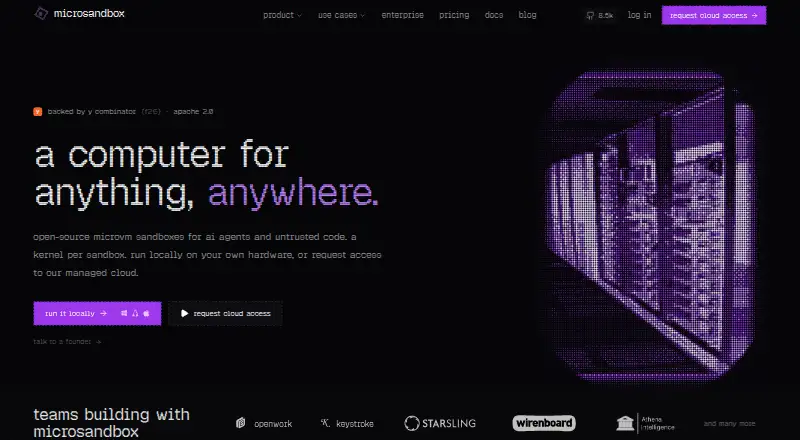
microsandbox is a local-first microVM runtime for running untrusted workloads, including AI agents, user code, plugins, CI jobs, scrapers, and automation. Each sandbox has its own Linux kernel, filesystem, and network boundary, rather than sharing the host kernel as containers do. The local runtime starts on a user's machine without a daemon, root service, or account; it can also run on personal servers or clusters. The product supports TypeScript, Rust, Python, Go, and Ruby SDKs, as well as a CLI and MCP workflows, and accepts OCI images from Docker Hub, GHCR, ECR, GCR, or other registries. Public internet access is enabled by default, while private, host-local, link-local, and metadata destinations are blocked; egress can be allowlisted or disabled. The runtime is open source under Apache 2.0. Its Free plan costs nothing and allows up to three sandboxes, each capped at 1 vCPU, 512 MiB memory, and 8 GiB writable disk. Builder costs $49 a month. Microsandbox Cloud is in private beta and requires an access request.
Who it suits
microsandbox is for developers and teams that need to run untrusted code or automation in isolated environments. It may suit users who want a local runtime or deployment on their own servers or clusters.
What it does well
- Each sandbox has its own Linux kernel and network boundary
- Local runtime needs no daemon, root service, or account
- Supports five language SDKs, CLI, and MCP workflows
- Open source under Apache 2.0
- Egress can be allowlisted or disabled
What to know first
- Cloud is in private beta and requires an access request
- Free plan allows up to three sandboxes
- Free plan has no overage rates
Limits
The Free plan includes 5 vCPU-hours, 20 memory GiB-hours, and 20 disk GiB-hours, with up to 3 sandboxes. Each sandbox is capped at 1 vCPU, 512 MiB of memory, and 8 GiB of writable disk; durable storage is 1 GiB, and there are no overage rates.
Plans
| Plan | Billed and limits | Price |
|---|---|---|
| Free | $0 per month · 5 vCPU-hours · 20 memory GiB-hours · 20 disk GiB-hours · up to 3 sandboxes · each capped at 1 vCPU, 512 MiB memory, 8 GiB writable disk · 1 GiB durable storage · no overage rates | Free |
| Teams | $299 per month · 2,000 vCPU-hours · 8,000 memory GiB-hours · 8,000 disk GiB-hours · 250 GiB durable storage · 25,000 ephemeral-running · 500 persistent-running | $299 a month |
| Builder | $49 per month · 500 vCPU-hours · 2,000 memory GiB-hours · 2,000 disk GiB-hours · 50 GiB durable storage · 1,000 ephemeral-running · 50 persistent-running | $49 a month |
| Enterprise | custom agreement · 4,000 vCPU-hours · 16,000 memory GiB-hours · 16,000 disk GiB-hours · 500 GiB durable storage · ephemeral and persistent running limits set together · committed or BYOC model | On request |
As microsandbox.dev lists them, read 30 Sept 2026. The maker's own page has the final word.
Getting started
- Visit the Microsandbox website.
- Choose the local runtime or run it on your own servers or clusters.
- Use an SDK, the CLI, or an MCP workflow.
- Provide an OCI image from a supported registry.
- For Microsandbox Cloud, request access while it is in private beta.
- Choose the Free, Builder, or Teams plan if using the listed plans.
Microsandbox is a local-first microVM runtime for executing untrusted code, agents, plugins and automation. It suits developers and platform teams that need stronger isolation than containers and want to run on laptops, servers or their own clusters. The central trade-off is clear: isolation and deployment control are strong, while the free allowance is small and cloud access is still gated.
Overview
Every sandbox gets its own Linux kernel, filesystem and network boundary instead of sharing the host kernel. That separation is a meaningful reason to consider Microsandbox for user-submitted code, AI agents, CI jobs, scrapers and plugins where a container’s shared-kernel model is not sufficient. It also makes the runtime relevant to teams building systems that must contain failures or reduce the blast radius of hostile workloads.
The local runtime launches on the user’s machine without a daemon, root service or account. This keeps local development from depending on a permanently running privileged service. The same runtime can run on your servers or clusters, and the cloud platform can be deployed inside your infrastructure, giving self-hosting teams more control over placement and data.
Key features
Microsandbox offers SDKs for TypeScript, Rust, Python, Go and Ruby, as well as a CLI and MCP workflows. That breadth makes it practical to integrate into application code, developer tooling or agent pipelines rather than forcing one interface. OCI images can be pulled from Docker Hub, GHCR, ECR, GCR and other registries, so existing image-based workflows can carry over.
Network policy starts permissive toward the public internet, but private, host-local, link-local and metadata destinations are blocked. You can replace that default with an allowlist or disable egress entirely. This is useful when workloads need selected APIs, but it requires deliberate policy decisions if unrestricted outbound access is inappropriate.
Bound secrets appear as placeholders inside the sandbox and are substituted on the host for supported intercepted requests to approved destinations. Secret handling is not universal pass-through: intercepted TLS is required by default, and request-body substitution must be enabled separately and obeys format and size limits. Teams with unusual protocols or large bodies should account for that constraint before relying on the feature.
Local full snapshots preserve disk, memory and running processes, which is valuable for pausing and resuming active environments. Managed cloud currently supports disk snapshots from stopped persistent sandboxes and disk restore, so cloud snapshot behavior is narrower than the local capability.
Pricing
The Free plan costs nothing, billed at $0 per month. It includes 5 vCPU-hours, 20 memory GiB-hours, 20 disk GiB-hours, up to three sandboxes, 1 GiB of durable storage and no overage rates. Each sandbox is capped at 1 vCPU, 512 MiB of memory and 8 GiB of writable disk. Those limits are suitable for experiments, small checks and personal development, but restrictive for sustained jobs or larger agents.
Builder costs $49 a month, billed $49 per month. It raises allowances to 500 vCPU-hours, 2,000 memory GiB-hours, 2,000 disk GiB-hours and 50 GiB of durable storage, with 1,000 ephemeral-running and 50 persistent-running. This is the sensible starting point for an individual developer or a small service that has outgrown the free caps.
Teams costs $299 a month, billed $299 per month. It provides 2,000 vCPU-hours, 8,000 memory GiB-hours, 8,000 disk GiB-hours, 250 GiB durable storage, 25,000 ephemeral-running and 500 persistent-running. Those larger pools fit shared workloads and higher concurrency better than Builder.
Enterprise uses a custom agreement. It includes 4,000 vCPU-hours, 16,000 memory GiB-hours, 16,000 disk GiB-hours and 500 GiB durable storage; ephemeral and persistent-running limits are set together, with a committed or BYOC model. Choose it when those deployment and capacity terms matter more than a posted price.
Platforms
Microsandbox supports API, Linux, macOS, self-hosted deployments and Windows. It offers both API/CLI access and deployment options for local or controlled infrastructure. Microsandbox Cloud is in private beta and requires an access request, so teams needing immediately available hosted capacity should not assume cloud access.
Who it's for
Choose Microsandbox for engineering teams running untrusted code that need microVM-level kernel separation, configurable egress and the option to self-host. It is especially well matched to agent platforms, CI systems, plugin execution and automation that must accept varied workloads. It is less suitable when a tiny free tier, broad hosted availability or unconstrained credential injection is the priority.
Pros and cons
- Pros: Separate kernels, filesystems and network boundaries provide stronger isolation than shared-kernel containers.
- Pros: Local startup needs no daemon, root service or account, reducing local operational overhead.
- Pros: Allowlisted or disabled egress gives meaningful control over outbound access.
- Pros: Open-source Apache 2.0 licensing and self-hosting support suit infrastructure owners.
- Cons: The Free plan has low compute, memory, disk and per-sandbox limits, with no overage option.
- Cons: Secret substitution depends on intercepted TLS, and body substitution is optional and constrained.
- Cons: Cloud access is private beta, while managed snapshots are limited to stopped persistent sandboxes.
Alternatives
For a broad directory of sandboxing choices, see Sandbox Software.
ANY.RUN is a better fit when you want a freemium service with a free trial and Android, iOS, web and desktop platform coverage.
Pick Context Agent Sandboxes when agent concurrency is the main concern and a free tier for one agent or a $20.00-per-month Plus plan for three agents meets your needs.
Daytona is an alternative for teams seeking freemium developer environments with a pay-as-you-go option and 5 GiB of storage free before storage charges.
Choose Docker Desktop when a conventional container workflow is preferable; its Personal plan is free and Pro is $9 a month.
Northflank suits teams wanting hosted services, databases and cron jobs, including a free Sandbox plan.
Anthropic Sandbox Runtime is a free alternative for Linux, macOS, Windows and self-hosted use.
CAPE Sandbox is a free, open-source self-hosted project with an online demonstration instance.
crun is a free Linux and self-hosted OCI container runtime for those who need containers rather than microVM isolation.
Verdict
Microsandbox is a strong choice for developers and platform teams that place kernel-level isolation, egress control and self-hosting ahead of a generous free quota. Its local, multi-language runtime and Apache 2.0 license broaden its usefulness. Look elsewhere if you need an immediately accessible managed cloud, higher free-plan limits or secret handling without TLS interception constraints.
Verdict
microsandbox offers a local-first microVM runtime with separate kernels and configurable network egress for untrusted workloads. The free plan has tight sandbox and resource limits; paid plans start at $49 a month, while cloud access is in private beta.
Questions
Is Microsandbox free?
Yes. The Free plan costs nothing. Paid plans start at $49 per month.
What platforms does it support?
The listed platforms are API, Linux, macOS, self-hosted, and Windows.
Is Microsandbox open source?
Yes. The runtime is licensed under Apache 2.0.
What does the Free plan include?
It includes 5 vCPU-hours, 20 memory GiB-hours, 20 disk GiB-hours, up to 3 sandboxes, and 1 GiB of durable storage. Each sandbox is capped at 1 vCPU, 512 MiB of memory, and 8 GiB of writable disk.
What are the paid plans?
Builder costs $49 a month and Teams costs $299 a month. Enterprise uses a custom agreement.
Who makes Microsandbox?
It is designed and engineered by Super Rad Company.
Facts from microsandbox's own pages
- Cloud availability
- Microsandbox Cloud is in private beta and requires users to request access. · docs.microsandbox.dev, 30 Sept 2026
- Company
- Microsandbox is designed and engineered by Super Rad Company, whose stated purpose is building tools for the agentic future. · superrad.company, 30 Sept 2026
- Credential handling
- Bound secrets are represented by placeholders inside the sandbox and substituted host-side for supported intercepted requests to approved destinations. · microsandbox.dev, 30 Sept 2026
- Credential limitation
- Secret substitution requires intercepted TLS by default, and body substitution is opt-in with format and size limits. · microsandbox.dev, 30 Sept 2026
- Images
- The runtime accepts OCI images from Docker Hub, GHCR, ECR, GCR, or another registry. · docs.microsandbox.dev, 30 Sept 2026
- Integrations and languages
- The product supports SDKs for TypeScript, Rust, Python, Go, and Ruby, plus a CLI and MCP workflows. · microsandbox.dev, 30 Sept 2026
- Isolation
- Each sandbox is a microVM with its own Linux kernel, filesystem, and network boundary, rather than a container sharing the host kernel. · docs.microsandbox.dev, 30 Sept 2026
- License
- The runtime is open source under the Apache 2.0 license. · microsandbox.dev, 30 Sept 2026
- Local runtime
- The local runtime starts on the user's machine without a daemon, root service, or account. · microsandbox.dev, 30 Sept 2026
- Network controls
- By default, sandboxes can reach the public internet while private, host-local, link-local, and metadata destinations are blocked; egress can be allowlisted or disabled. · microsandbox.dev, 30 Sept 2026
- Self-hosting
- The runtime can be run on the user's own servers or clusters, and the cloud platform can be deployed in the user's infrastructure. · docs.microsandbox.dev, 30 Sept 2026
- Snapshots
- Local full snapshots can preserve disk, memory, and running processes; managed cloud currently supports disk snapshots from stopped persistent sandboxes and disk restore. · microsandbox.dev, 30 Sept 2026
- Support
- The product FAQ directs users with questions to its Discord community. · microsandbox.dev, 30 Sept 2026
- What it does
- Microsandbox is a local-first microVM runtime for running untrusted workloads, including AI agents, user code, plugins, CI jobs, scrapers, and automation. · docs.microsandbox.dev, 30 Sept 2026
Where microsandbox stands on Freedom251
- Sandbox Software#9 of 26