
Context Agent Sandboxes
What Context Agent Sandboxes is
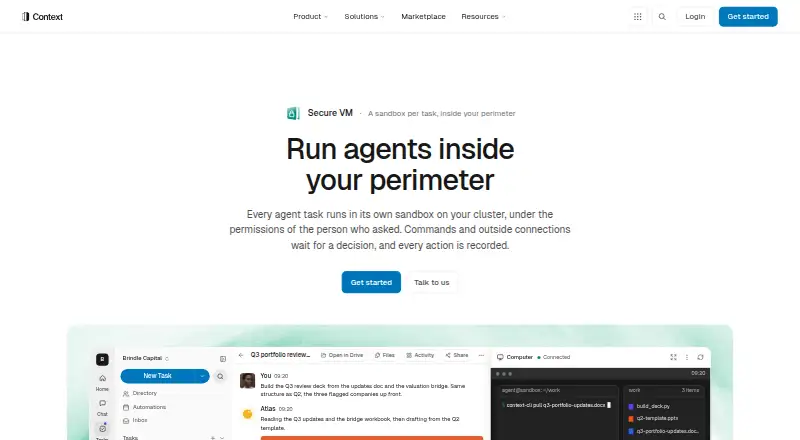
Context Agent Sandboxes gives each agent task a separate sandbox on the customer’s cluster, using the permissions of the person who requested the task. Every run starts fresh, and the sandbox is destroyed after its idle window, 30 minutes by default. These non-root container pods have capabilities dropped, a seccomp profile and no cluster service-account token. Administrators can choose open, domain-allowlist or workspace-only network access, with allowlist decisions logged. In the supervised preset, commands require human approval and connections beyond the allowlist prompt for a decision. Drive is not mounted: files pass through a permission-checking gateway and outputs are pushed explicitly. Standing secrets are kept out of the sandbox; credentials are injected at the edge after authorization. An append-only log records commands, files, connections and permission decisions with the actor and decision maker. Context lists over 180 integrations and remote MCP servers. Enterprise deployments run on the customer’s Kubernetes cluster, with KOTS installation on EKS or AKS and an air-gapped bundle. Free costs nothing for one agent at a time; Plus is $20 a month for three, and Pro is $200 a month for ten agents and 25,000 monthly model-use credits. Enterprise pricing is custom.
Who it suits
It suits teams that want agent tasks isolated on their own cluster with configurable network and approval controls. Enterprise deployment is aimed at customers running sandboxes in their own cloud.
What it does well
- Each task gets a fresh sandbox with a 30-minute default idle window.
- Administrators can set three network-access modes.
- Audit logs record commands, files, connections and decisions.
- Free plan includes sandboxes for one agent at a time.
What to know first
- Persistent storage is not available.
- Enterprise pricing is custom and not listed.
- Enterprise customers pay their cloud provider for compute.
Limits
The Free plan includes one agent at a time. Plus allows three agents at a time; Pro allows ten agents at a time and includes 25,000 credits a month for model usage. Enterprise compute is paid to the customer’s cloud provider.
Plans
| Plan | Billed and limits | Price |
|---|---|---|
| Free | $0 · Includes sandboxes · one agent concurrently · model credits apply | Free |
| Plus | $20 per person per month · Three agents concurrently · sandbox time not metered · model credits apply | $20 a month |
| Pro | $200 per person per month · Ten agents concurrently · 25,000 credits · sandbox time not metered | $200 a month |
| Enterprise | Custom · Own cloud deployment · cluster-sized capacity · enterprise support by agreement | On request |
As context.ai lists them, read 15 Oct 2026. The maker's own page has the final word.
Getting started
- Open the Context Agent Sandboxes website.
- Choose the Free plan for sandboxes with one agent at a time, or review Plus and Pro.
- For a custom Enterprise deployment, arrange deployment on your Kubernetes cluster.
- For Enterprise installation, use KOTS on EKS or AKS, or the air-gapped bundle.
Overview
Context Agent Sandboxes gives organizations a way to run AI-agent tasks in isolated environments on their own cluster. It suits teams that need to govern access to company data and destinations; the strongest reason to choose it is its combination of permission controls and audit records, while short-lived sandboxes rule it out for workflows that need persistent files.
Key features
Each task starts in a fresh sandbox, which is destroyed after its idle window—30 minutes by default. That clean slate limits what can carry between tasks, but persistent storage is not available, so teams must arrange for needed files and outputs to pass through the supported gateway steps.
Sandboxes run as non-root container pods with capabilities dropped, a seccomp profile, and no cluster service-account token. Administrators can select open, domain-allowlist, or workspace-only network access, with allowlist decisions logged. The supervised preset requires human approval for commands and pauses connections outside the allowlist for a decision. That provides useful oversight, though approval requirements add friction to agent workflows.
Drive is not mounted in the sandbox. Files are fetched through a permission-checking gateway, and outputs must be pushed explicitly. Standing secrets are kept out of the sandbox; credentials are injected at the edge after authorization. An append-only audit log records commands, files, connections, and permission decisions, including the actor and decision maker. These controls favor deliberate, reviewable work over unrestricted file and network access.
Context lists more than 180 integrations across data, documents, communication, CRM, ITSM, finance, and identity, as well as remote MCP servers. It states that it holds SOC 2 and ISO 27001 certifications and provides reports on request. Basic support through standard channels during business hours is included in every agreement; Enterprise support is set per order.
Pricing
The Free plan costs nothing and includes sandboxes for one agent at a time. It is a useful starting point, but its single-agent cap limits concurrent work.
Plus costs $20 a month, billed per person per month, and allows three agents at a time; sandbox time is not metered. It fits a person who needs more concurrent agents without a sandbox-time charge.
Pro costs $200 a month, billed per month, and allows 10 agents at a time, with 25,000 monthly credits for model usage and unmetered sandbox time. It is the more suitable paid tier for higher concurrency and included model credits, though the price is a substantial step up from Plus.
Enterprise has custom pricing and includes a custom enterprise deployment running in your own cloud. Enterprise customers pay their cloud provider for compute, unlike Context-plan sandbox time, which is not metered. Teams considering this option should weigh their cloud compute costs and confirm support terms set per order.
Platforms
Context Agent Sandboxes supports Linux, macOS, Windows, web, and self-hosted use. Enterprise sandboxes run on the customer's Kubernetes cluster and can be installed through KOTS on EKS or AKS, including with an air-gapped bundle. API or CLI access is available.
Who it's for
This is a strong fit for organizations that want agent tasks separated on their cluster and need to control network access, mediate file access, and retain an audit trail. It is a weaker fit for teams that need persistent sandbox storage, unrestricted agent access, or a high number of concurrent agents on the free tier.
Pros and cons
- Pros: Per-task fresh sandboxes and non-root container isolation reduce carryover between tasks and limit the sandbox's privileges.
- Pros: Network choices, human approvals, gateway-mediated files, and edge-injected credentials give administrators several ways to govern agent access.
- Pros: The append-only audit log records actions and permission decisions with the people involved, supporting review of agent activity.
- Cons: No persistent storage means sandbox files do not remain available as durable task state.
- Cons: The free plan permits only one agent at a time, and Enterprise pricing is custom, making the cost of higher-scale deployment less predictable.
- Cons: Explicit file transfers and supervised approvals can slow workflows that need frequent data exchange or unattended execution.
Alternatives
For a different sandbox approach, ANY.RUN has a free Community plan with supported Windows, Android, and Ubuntu environments and also offers a free trial. Choose it when those environments are the priority.
Daytona offers a free tier and pay-as-you-go pricing with 5 GiB of storage free before storage charges. It may suit readers whose first concern is a storage allowance rather than Context's task-isolation controls.
Docker Desktop has a free Personal plan that includes Docker Desktop, Docker Engine and Kubernetes, Docker Hub, Docker Scout, and Docker Debug; its Pro plan costs $9 a month. Consider it when those Docker tools are the better match.
Northflank offers a free Sandbox plan with two free services, one free database, two free cron jobs, and always-on compute. It is worth considering when those free resources are more relevant to the workload.
Anthropic Sandbox Runtime is a free alternative for Linux, macOS, Windows, and self-hosted use.
microsandbox has a free monthly plan with 5 vCPU-hours, 20 memory GiB-hours, 20 disk GiB-hours, and up to three sandboxes, each capped at 1 vCPU and 512 MiB of memory. Its stated resource allowances make it a more concrete option for small, quota-bounded workloads.
CAPE Sandbox is a free, open-source self-hosted project with an online demonstration instance.
crun is a free OCI container runtime for Linux and self-hosted use.
Browse more options in Sandbox Software.
Verdict
Choose Context Agent Sandboxes if your organization needs per-task isolation, controlled access to files and credentials, and an audit trail, especially for deployment on its own Kubernetes cluster. The main trade-off is the absence of persistent storage, alongside plan-based concurrency limits and custom Enterprise pricing. Teams that need durable sandbox state or want broader free-tier capacity should compare alternatives before committing.
Verdict
Context Agent Sandboxes emphasizes per-task isolation, permission checks and auditability. Review the plan’s agent limits and compute arrangements, and note that files and outputs move through explicit gateway steps.
Questions
Is there a free plan?
Yes. The Free plan costs nothing and includes sandboxes with one agent at a time.
What do the paid plans cost?
Plus is $20 a month, billed per person per month. Pro is $200 a month. Enterprise pricing is custom.
Which platforms are supported?
The listed platforms are Linux, macOS, self-hosted, web, and Windows.
Can I use an API or CLI?
Yes, API or CLI access is available.
Does it offer integrations?
Context lists a catalog of 180+ integrations across data, documents, communication, CRM, ITSM, finance, and identity, along with remote MCP servers.
Where does Enterprise run?
Enterprise sandboxes run on the customer’s Kubernetes cluster. KOTS installation is available on EKS or AKS, including an air-gapped bundle.
Facts from Context Agent Sandboxes's own pages
- Air-gapped operation
- Air-gapped bundles include the required images and can use open-weight models inside the disconnected boundary, reducing the available model catalog. · context.ai, 15 Oct 2026
- API
- The REST task API can create, poll, cancel and share tasks, upload files, download outputs and read evaluations. · context.ai, 15 Oct 2026
- API reliability features
- Task creation supports idempotency keys, structured output schemas and signed webhooks with up to three delivery attempts. · context.ai, 15 Oct 2026
- Apple app requirements
- The Context iPhone and iPad app requires iOS or iPadOS 16.4 or later; Mac compatibility requires macOS 12 and Apple silicon. · apps.apple.com, 15 Oct 2026
- Approval controls
- Under the supervised preset, commands require human approval, and connections outside the allowlist prompt for a decision before leaving. · context.ai, 8 Oct 2026
- Audit
- Commands, files, connections, and permission decisions are recorded in an append-only audit log with the actor and decision maker. · context.ai, 8 Oct 2026
- Audit trail
- The append-only audit record includes task, model and tool calls, sources, actions, approvals and results, and can be exported as CSV. · context.ai, 15 Oct 2026
- Command-line client
- Context Code installs on macOS, Linux and Windows and pairs a terminal session with a workspace task list. · context.ai, 15 Oct 2026
- Company record discrepancy
- Crunchbase lists an older Context.ai product-analytics entity as Get Context Co., London-based, 1–10 employees, acquired by OpenAI, with operating status closed. · crunchbase.com, 15 Oct 2026
- Company size and headquarters
- LinkedIn lists Context as a privately held applied-AI company headquartered in San Francisco with 11–50 employees. · linkedin.com, 15 Oct 2026
- Compute cost
- Sandbox time is not metered on Context plans, while Enterprise customers pay their cloud provider for compute. · context.ai, 8 Oct 2026
- Connector integrations
- Documented connectors include Slack, Google Workspace, Salesforce, Notion, Snowflake, GitHub, HubSpot, Linear, Zendesk, Box and Microsoft 365 services. · context.ai, 15 Oct 2026
- Credential handling
- Standing secrets are kept out of the sandbox; credentials are issued at the edge after authorization and expire with the action or run. · context.ai, 15 Oct 2026
- Credentials
- Standing secrets are not placed in the sandbox; credentials are injected at the edge after an authorization check. · context.ai, 8 Oct 2026
- Custom integrations
- Administrators can register internal HTTP or MCP services using a form or YAML and choose bearer, API-key, HMAC-SHA256 or OAuth 2 authentication. · context.ai, 15 Oct 2026
- Deployment
- Enterprise sandboxes run on the customer's Kubernetes cluster and can be installed through KOTS on EKS or AKS, including an air-gapped bundle. · context.ai, 8 Oct 2026
- Deployment options
- Enterprise deployments can run on managed infrastructure, a customer VPC, on-premises hardware or an air-gapped environment. · context.ai, 15 Oct 2026
- Desktop clients
- Context Desktop is offered for macOS, Windows and Linux, with signed or notarized macOS packages and 64-bit Windows and Linux installers. · context.ai, 15 Oct 2026
- Documentation and support
- The Help Center covers setup, usage, agent building, connectors, deployment, security, data, billing and support, while basic business-hours support is included in agreements. · context.ai, 15 Oct 2026
- Encryption
- Context states that customer personal data uses TLS in transit and industry-standard encryption at rest. · context.ai, 15 Oct 2026
- Ephemeral environments
- A task receives a fresh sandbox that is destroyed after its configured idle period, 30 minutes by default, while task files can be snapshotted and restored. · context.ai, 15 Oct 2026
- File access
- Drive is not mounted in the sandbox; files are fetched through a permission-checking gateway and outputs are pushed explicitly. · context.ai, 8 Oct 2026
- Fresh runtime
- Each task run starts a fresh sandbox that is destroyed after its idle window, which is 30 minutes by default. · context.ai, 8 Oct 2026
- Funding news
- TechCrunch reported on May 28, 2025 that Context announced an $11 million seed round led by Lux Capital, bringing reported total funding to about $15.75 million. · techcrunch.com, 15 Oct 2026
Where Context Agent Sandboxes stands on Freedom251
- Sandbox Software#5 of 26