Freedom251 › Virtualization Management Software

ManageIQ
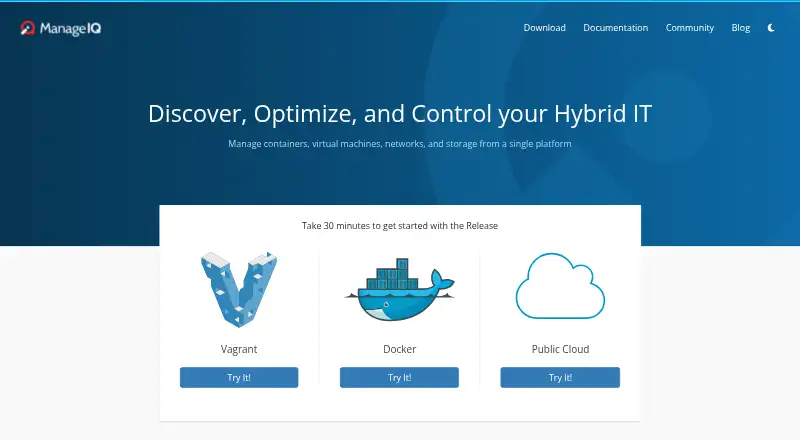
What ManageIQ is
ManageIQ is a free, open-source, self-hosted platform for managing connected cloud and infrastructure systems. It discovers inventory across virtualization, container, network, and storage environments, maps resource relationships, and tracks changes. A service catalog lets users order resource bundles and manage their lifecycle through policy, compliance, delegated operations, chargeback or showback, and retirement. It scans virtual machines, hosts, and containers without requiring an agent, including foreign and uncooperative VMs. Utilization metrics support finding unused systems, right-sizing recommendations, capacity planning, and what-if scenarios. ManageIQ runs as an agentless virtual appliance, either standalone or federated. Deployment options include appliances on cloud and virtualization platforms, a monolithic Docker container, and podified deployments on Kubernetes and OpenShift. It offers a REST API using HTTP and JSON, and lists providers such as AWS, Azure, Google Cloud, IBM Cloud, Kubernetes, OpenStack, Red Hat, and VMware. Supported operations vary by provider; several listed infrastructure providers lack capacity and utilization support. Docker and Vagrant downloads are intended for proof-of-concept and non-production use.
Who it suits
ManageIQ suits organizations that want to manage connected infrastructure through a self-hosted system. Its inventory, lifecycle, compliance, and optimization capabilities may fit teams managing multiple provider types.
What it does well
- Discovers and maps connected infrastructure inventory.
- Scans VMs, hosts, and containers without agents.
- Supports capacity planning and what-if scenarios.
- Provides a REST API using HTTP and JSON.
What to know first
- Supported operations vary by provider.
- Several listed infrastructure providers lack capacity and utilization support.
- Docker and Vagrant builds are intended for non-production use.
Limits
ManageIQ is free and open source. Docker and Vagrant downloads are intended for proof-of-concept and non-production use; supported operations also vary by provider, and several listed infrastructure providers lack capacity and utilization support.
Plans
| Plan | Billed and limits | Price |
|---|---|---|
| ManageIQ | Open-source software · Docker and Vagrant downloads are intended for proof-of-concept and non-production use | Free |
As manageiq.org lists them, read 9 Oct 2026. The maker's own page has the final word.
Getting started
- Open the ManageIQ website and review its deployment options.
- Choose an appliance, Docker monolithic container, or podified Kubernetes or OpenShift deployment.
- Select a provider and confirm the operations available for it in the capabilities matrix.
- Use the web interface with Chrome, Firefox, Safari, or Microsoft Edge.
- Use the REST API through HTTP requests and JSON responses if needed.
- Consult the community discussions forum or Gitter for questions and ideas.
ManageIQ is an open-source, self-hosted platform for governing virtual machines, containers, networks, storage, and cloud providers from one console. It is best for infrastructure teams that need discovery, service lifecycle controls, compliance checks, and capacity planning across a mixed estate. The broad scope is compelling, but provider-specific capability gaps and non-production download restrictions make deployment planning essential.
Overview
ManageIQ builds an inventory of connected infrastructure, maps relationships between resources, and records changes over time. That gives teams a shared operational view instead of separate inventories for each virtualization or cloud system. It is more than a provisioning tool: the same platform combines governance, lifecycle workflows, compliance, and utilization analysis.
The software is open source and community-driven. Questions and ideas are handled through the project discussion forum and Gitter chat, so organizations wanting a formal commercial support arrangement should look elsewhere or arrange support independently.
Key features
- Cross-provider discovery: ManageIQ covers virtualization, containers, networks, and storage, with a capability matrix naming AWS, Azure, Google Cloud, IBM Cloud, Kubernetes, OpenStack, Red Hat, and VMware. The breadth helps mixed-environment operators, while the matrix must be checked before relying on a particular action.
- Service catalog and lifecycle: Users can order resource bundles through a catalog and apply policy, compliance, delegated operations, chargeback or showback, and retirement workflows. This suits internal platforms that need controlled self-service rather than ungoverned requests.
- Agentless compliance: Scans cover virtual machines, hosts, and containers without installing an agent, including foreign and uncooperative virtual machines. That reduces deployment friction where guest access is restricted.
- Optimization and planning: Utilization metrics support finding idle systems, right-sizing recommendations, capacity planning, and what-if scenarios. These functions are useful for teams making consolidation and growth decisions, although their value depends on the provider exposing the required capacity and utilization data.
- Deployment and API: The agentless virtual appliance can run alone or in a federated deployment. ManageIQ also runs as an appliance on several cloud and virtualization platforms, as a Docker monolithic container, or podified on Kubernetes and OpenShift. A REST API uses standard HTTP requests and JSON responses, enabling integration with existing automation.
Pricing
| Plan | Price | Terms |
|---|---|---|
| ManageIQ | free | Open-source software. Docker and Vagrant downloads are intended for proof-of-concept and non-production use. |
There are no paid tiers, seat charges, quotas, or trial-renewal terms in this plan. The zero-price model fits organizations able to operate self-hosted open-source software and validate their own support needs. Teams requiring production deployment should use an appropriate appliance or Kubernetes/OpenShift approach rather than treating the Docker or Vagrant builds as production distributions.
Platforms
ManageIQ supports API, Linux, web, and self-hosted use. Documentation names Chrome, Firefox, Safari, and Microsoft Edge as working browsers. Supported hypervisors include VMware vSphere, VMware vCloud, oVirt, Red Hat Virtualization, and Microsoft SCVMM. Provider operations are not uniform: several infrastructure providers lack capacity and utilization support, so platform compatibility alone does not guarantee feature coverage.
Who it's for
Choose ManageIQ when one team must govern a heterogeneous estate and wants inventory, catalog-based self-service, compliance, chargeback or showback, and planning in one self-hosted system. It is particularly suitable for organizations comfortable checking provider matrices, operating an appliance or cluster, and using community support. It is a weaker fit for buyers seeking a managed service, guaranteed commercial assistance, or identical operations across every cloud and hypervisor.
Pros and cons
Pros
- Broad infrastructure coverage: One inventory model spans virtualization, containers, network, storage, and major cloud providers.
- Agentless scanning: Compliance checks can include foreign or uncooperative virtual machines without guest agents.
- Governed self-service: Catalog ordering connects policy, delegated operations, financial tracking, and retirement.
- Open and extensible: The REST API, self-hosted model, and community contribution path support integration and customization.
Cons
- Provider differences matter: Capabilities such as capacity and utilization are absent for several listed providers.
- Operational responsibility stays with you: Self-hosting and community channels replace a bundled commercial support plan.
- Download restrictions: Docker and Vagrant builds are expressly for proof-of-concept and non-production use.
Alternatives
Proxmox VE is a freemium self-hosted alternative with a paid Premium subscription priced per occupied physical CPU socket when that licensing model suits your virtualization deployment.
Virtuozzo Infrastructure fits teams wanting freemium self-install or a hosted trial, including a self-install allowance of up to 96 physical cores and 1TB of storage.
ZStack is worth considering for a time-limited, full-featured ZSphere deployment or its separate ZStack Cloud offering.
Apache CloudStack is a free, open-source IaaS choice when cloud orchestration is the primary requirement.
LXD suits users focused on KVM virtual machines and system containers in a self-hosted environment.
oVirt is a free open-source virtualization solution with production use stated for its community edition.
PegaProx offers permanently free self-hosted software with the same features for all users.
VMware Workstation Pro is the narrower choice for running virtual machines on Windows or Linux hosts without a subscription or license key.
For broader category browsing, see Virtualization Management Software, Cloud Automation Software, and Cloud Management Software.
Verdict
ManageIQ is a strong choice for infrastructure organizations that need one open-source control plane for discovery, governed self-service, compliance, and planning across varied providers. Choose it for breadth and agentless governance; look elsewhere if provider-uniform operations, managed hosting, or production-ready Docker and Vagrant packages are non-negotiable.
Verdict
ManageIQ provides a broad set of infrastructure discovery, lifecycle, compliance, and planning capabilities for self-hosted deployments. Check provider-specific operations and the stated non-production limitation for Docker and Vagrant builds.
Questions
How much does ManageIQ cost?
ManageIQ is listed as free, at no cost.
Is ManageIQ open source?
Yes. The project describes ManageIQ as open source and invites community contributions.
Can ManageIQ be self-hosted?
Yes. It is self-hosted and can run as an appliance, a monolithic Docker container, or podified on Kubernetes and OpenShift.
Which providers does ManageIQ list?
The capabilities matrix lists AWS, Azure, Google Cloud, IBM Cloud, Kubernetes, OpenStack, Red Hat, and VMware. Supported operations vary by provider.
Does ManageIQ provide an API?
Yes. Its REST API uses standard HTTP requests and responses with JSON content.
Are Docker and Vagrant downloads intended for production?
The download page says those builds are intended for proof-of-concept and non-production use cases.
Facts from ManageIQ's own pages
- Agentless appliance
- The project describes ManageIQ as agentless and distributed as a virtual appliance that can run standalone or in a federated deployment. · manageiq.org, 9 Oct 2026
- Browser support
- The documentation lists Chrome, Firefox, Safari, and Microsoft Edge as browsers known to work with ManageIQ. · manageiq.org, 9 Oct 2026
- Capability variation
- The capabilities matrix shows that supported operations vary by provider; for example, several listed infrastructure providers lack capacity and utilization support. · manageiq.org, 9 Oct 2026
- Cloud management
- ManageIQ discovers inventory, maps relationships, and tracks changes across connected virtualization, container, network, and storage systems. · manageiq.org, 9 Oct 2026
- Community support
- The project directs users to its community discussions forum and Gitter chat for questions and ideas. · manageiq.org, 9 Oct 2026
- Compliance scanning
- ManageIQ scans VMs, hosts, and containers without requiring an agent, including foreign and uncooperative VMs. · manageiq.org, 9 Oct 2026
- Deployment options
- ManageIQ can run as an appliance on several cloud and virtualization platforms, as a Docker monolithic container, or podified on Kubernetes and OpenShift. · manageiq.org, 9 Oct 2026
- Download limitation
- The download page says Docker and Vagrant builds are intended for proof-of-concept and non-production use cases. · manageiq.org, 9 Oct 2026
- Integrations
- The capabilities matrix lists providers including AWS, Azure, Google Cloud, IBM Cloud, Kubernetes, OpenStack, Red Hat, and VMware. · manageiq.org, 9 Oct 2026
- Optimization
- ManageIQ captures utilization metrics and supports identifying unused systems, right-sizing recommendations, capacity planning, and what-if scenarios. · manageiq.org, 9 Oct 2026
- Project status
- ManageIQ describes itself as open source and invites community contributions. · manageiq.org, 9 Oct 2026
- REST API
- ManageIQ provides a REST API implemented using standard HTTP requests and responses with JSON content type. · manageiq.org, 9 Oct 2026
- Self-service catalog
- Users can order resource bundles from a service catalog, with lifecycle management that includes policy, compliance, delegated operations, chargeback or showback, and retirement. · manageiq.org, 9 Oct 2026
Where ManageIQ stands on Freedom251
- Virtualization Management Software#5 of 34
- Cloud Management Software#9 of 35
- Cloud Automation Software#10 of 32